Mortal Sin, by Laurie Breton

>> Sunday, March 21, 2010

TITLE: Mortal Sin
AUTHOR: Laurie Breton

COPYRIGHT: 2004
PAGES: 377
PUBLISHER: Mira

SETTING: Contemporary US (Boston)
TYPE: Romantic Suspense
SERIES: No (although I think there are some characters from a previous book who show up)

REASON FOR READING: Random pick from TBR in Uruguay

Park Square. Mass Ave. The Combat Zone. All home to Boston's sex trade. Home also to runaways and lost souls, home to high rollers and politicians looking for action they can't find anywhere else. It is home, too, for Father Clancy Donovan, who spends his time here trying to get young girls off the street. Bone weary and frustrated, he has lost the joy in his life and has no idea how to get it back.

Divorced three times and not yet thirty-five, Sarah Connolly is trying hard to make a new start when life throws her a curve. Kit, her fifteen-year-old niece, has run away from home, and Sarah will need every ounce of her stubbornness and determination to track her down. Suspecting Kit has disappeared into the Combat Zone, and with no one else to turn to, Sarah appeals to Clancy for help.

The unlikely pair team up to find Kit, but in the process find something else -- something powerful, something unexpected and something that will shake them to their core.
What was it with me and priests these last holidays? Two books with female priests, and then this one, with a Catholic (male, of course) priest.

Sarah Connolly has recently moved to Boston from the South with her teenaged niece, Kit, after the girl's new stepmother refused to accept her. Kit isn't adapting well to her new life and feels no one cares about her so, as the book starts, she runs off.

Sarah is terrified when she discovers Kit is missing and she soon realises the police won't be much help in helping her find a runaway who, from all indications, left voluntarily. At a friend's recommendation, she approaches Father Clancy Donovan, a priest at a Catholic church in the inner-city church who spends much of his time helping young runaways and trying to get them off the streets, especially once they turn to prostitution.

Clancy is nothing like most people's image of a Catholic priest. He hasn't been a priest all that long, and before entering the seminary, he spent many years travelling the world with the Merchant Marine. Clancy is not at all out of his depth in the rough streets of the inner city, and he brings his experience to bear in his work there.

Clancy agrees to help Sarah to help Kit, and they both soon find out that it's not going to be easy, and that Kit may be in grave danger. And as they work together to find the girl, something begins to develop between the two.

This is one dark book, both in tone and subject matter. It's also one that's most probably going to hit some very sensitive hot buttons. Having a Catholic priest as the hero is likely to be a problem for many, especially if they're Catholic themselves. It was actually a bit of a problem for me, even though I'm agnostic and no big fan of Catholicism.

Oh, I had no problem whatsoever with the idea of a priest discovering that he's falling for a woman, especially when their relationship started innocently enough. He's human, it can happen. It has happened, time and time again. Not to mention that Clancy's doubts about his vocation didn't exactly start when he met Sarah. He's been struggling with some of the Church's attitudes for a while, and has already begun to has some glimmers of doubt about whether this is where he should stay in the long term. I suspect, given who he is and what he cares about, that even without Sarah entering his life, he wouldn't have been long for the clerical life.

What I had trouble with was what I saw as too much hemming and hawing on Clancy's part about what he was going to do after he and Sarah got involved. At one point he actually half considers staying as a priest, while keeping Sarah as his lover. That, I didn't like at all. If you can't fulfill the promises you made when you entered the priesthood, then you leave. You might think that the rules are stupid (and as a former Catholic, I think many of the rules are extremely stupid!), but if you don't want to follow them, then you need to go. Even if you still believe the Catholic church is the place for you, you don't stay as a priest. I didn't know I had such strong opinions about it, but I clearly do.

Anyway, Clancy does make what I thought was the right decision in the end, but his waffling left a bad taste in my mouth.

The other thing that didn't completely satisfy was the suspense. It started out well enough. It's not a spoiler to reveal that Kit is taken by a guy who's planning to prostitute her. The character of the girl herself is well developed, a stubborn teenager who thinks she knows everything and can take care of herself, even though to the reader, she's tremendously naive and gullible. So that was good.

What wasn't so good was the fact that her "captor"'s actions were, I thought, completely preposterous. The guy spends weeks grooming her, a lot of effort making her falling love with him and sleeping with her and being very generous and nice in bed. Why? When after a while he'll just try to force (force, mind you, not convince) her to have sex with a john, which is obviously going to make her a bit upset with him? What was the point of the seduction? I just couldn't buy that a pimp would put so much time and effort into a girl (who was pretty enough, but hardly multi-million dollar material), and then just blow it. That character of the pimp felt very, very fake, and I couldn't take this subplot seriously.

There were some good moments, and the characters were interesting and their issues unusual and original, but I had too many problems with the book, especially in the second half, to really like it.

MY GRADE: I can't give it a better grade than C-.

Read more...

Do-Over, by Dorien Kelly

>> Friday, March 19, 2010

TITLE: Do-Over
AUTHOR: Dorien Kelly

COPYRIGHT: 2003
PAGES: 218
PUBLISHER: Harlequin Flipside

SETTING: Contemporary US
TYPE: Category romance
SERIES: None

REASON FOR READING: Random TBR pick when I was in Uruguay.

If the gods decided to grant Cara Adams one "do-over," the choice would be a no-brainer--she wouldn't have been sucked in by Mark "the Shark" Morgan. Back in law school, Cara had "dumbed down" to catch Mark's eye. Thanks to her stunt, she lost a plum job at a Wall Street firm, and the Shark is enjoying life in the Big Apple. Now Cara's thirty and doing just fine, thank you very much. Positive she's a shoo-in for a partnership at her prestigious Michigan law firm, Cara's bought herself a new loft, paid off her student loans and is ready for the success she deserves. But the gods are laughing now. Her ally in the law firm bolts in the middle of the night, her secretary gets fired for using the file room as her own boudoir, and...Mark the Shark has come home. Really, the gods must be crazy.

Will Cara go down without a fight? Not this time.
What a deceptive cover this book's got. No one looking at the fluffy cartoon cover and the Harlequin Flipside logo would suspect that what's actually inside is a powerful story about a woman fighting to find her place in a man's world. Not fluffy, not flip, just plain good and quite a powerful story, as well.

Cara Adams has been working her tail off for years at her law firm, and it appears her efforts are beginning to pay off. Everything points to her being made a partner in the coming few months, with the ensuing prestige, money and security. A good thing, too, because otherwise the killer mortgage on Cara's new condo will really begin to bite.

Cara's world begins to unravel when she arrives at work one morning only to discover that her longtime mentor at the firm has jumped ship and gone to work for another. Having been very close to this person, Cara is immediately suspect in the partners' eyes, and confidence in her is put on hold while they assess the damage over the weekend.

And things go from bad to worse when Cara finds out Mark Morgan has just joined her firm. Mark was in uni with Cara, and her big crush on him meant she underperformed in her interview when they were competing for the same job. Cara has always remembered that moment with shame, and she'll be damned if she'll allow him to beat her again. But it seems sexism is alive and well at her firm, and just by being a man, Mark is able to build an immediate rapport with the senior partners.

Even worse, what's also alive and well is the attraction between Cara and Mark, hard as she might work to ignore it.

Do-Over was a book that really affected me viscerally. It's probably a weird comparison, but you know how I felt when I was reading it? Exactly like I did when I read Susan Elizabeth Phillips' Ain't She Sweet, and Sugar Beth had just returned to her home town, only to face hostility all around. Exactly like I did when I used to read mountains of Harlequin Presents years ago, and they all featured the heroine being the victim of a Big Minsunderstanding that meant the hero despised her.

It's the unfairness and injustice of it all that affects me. I got terribly frustrated with what Cara was facing at work, the overwork, the good-old-boy sexism. Even though I've never faced anything like it myself, I completely identified with Cara and her reactions. It sounds like an unenjoyable read, but that wasn't the case at all. I found it cathartic, actually, and it's a credit to Kelly that she was able to make me feel so strongly, without feeling manipulated in the least.

So as sort of denunciation of the good-old-boy club and sexism in the workplace, this works. Kelly had a harder time with the romance, I thought, since Mark is pretty oblivious a lot of the time. He's not a sexist pig himself, but he doesn't quite get it. He doesn't really understand what Cara is going through. He'll accept the invitation to play golf with the senior partners without even thinking about it, even though if he did, he would agree that it would only be fair that Cara be afforded the same opportunities. So he supports her, but it doesn't even occur to him to give up his advantages for the sake of fairness. Could he? Should he? Is it really his problem that the other parners are a bunch of fossils? Those were all questions it was interesting to think about.

In the end, the romance does work, because oblivious or not, Mark is a good guy, and Cara ends up getting what's best for her. That, the ending, was something else I had to pause to think about. Now, this might be a bit of a spoiler, but I thought there was a danger, if the book went in the direction it ended up going, of getting a "women can't cut it under pressure" message.

In the end, though, that wasn't the message I got. I didn't feel that the book was arguing that Mark was any better than Cara because he was all right with the pressure. For starters, as a man, it was clear he didn't have to push himself as hard as Cara did, just to keep running in place. The message I got was that Cara (not women in general, Cara), because of the person she was, and the pressure she automatically put on herself if in an environment such as the law firm she was in, would do a lot better and be a lot happier in a more relaxed place, where the focus was on satisfying work, rather than getting more and more money. Ergo, happy ending all around, even for my extremely feminist sensibilities.

It's not often that a barely-200-pages-long category romance will make me think about things and feel so strongly as this one did. It's a good one.

MY GRADE: A B+.

Read more...

The Keys To The Street, by Ruth Rendell

>> Wednesday, March 17, 2010

TITLE: The Keys To The Street
AUTHOR: Ruth Rendell

COPYRIGHT: 1996
PAGES: 376
PUBLISHER: Dell Mystery

SETTING: Contemporary London
TYPE: Mystery / Fiction
SERIES: None

REASON FOR READING: Random pick from the old TBR, I just felt like a mystery.

Each of the murdered men was found impaled on the spiked fence around Regent's Park. Except for one, all were street people - like Pharaoh the Key Men - whose real identities had vanished with their descent into the city's underside. The bodies were found near the museum where Mary Jago worked and the mansion where she house-sat during the owners' absence. But quiet, pretty Mary could never have suspected that the threads connecting the dead would soon become tangled around her own simple, ordinary life.

Now the abusive relationship Mary Jago recently left, the mysterious man she was about to love, the inheritance suddenly thrust into her hands, and the dog walker who sas something he shouldn't were opening a Pandora's box into Mary's comfortable world. And the lies, sins, and violent acts that spilled out would be entirely unexpected, chilling to the bone… and suddenly, shockingly deadly.
The Keys To the Street is marked as mystery on the spine, but I think I'd characterise it as plain fiction. Oh there is the mystery of who's killing homeless men living on the streets of London and impaling on the rails around Regent's Park, but the book is not about that. It's about the characters, about Mary Jago, finally leaving an abusive relationship and seemingly finding her soulmate in a man she donated bone marrow to, about Roman Ashton, living on the streets after tragedy in his comfortable middle class life and about Bean, the dog walker. It's about the many ways they all connect and how each's actions affect the other.

Rendell is brilliant at fleshing out her characters fully. I might not like many of them, but they always ring true, and I always end up understanding it. Mary, for instance, is an unlikely heroine. I felt impatient with her at times for not standing up for herself, but couldn't help but enjoy reading about her, mainly because this is a very self-aware character. Mary knows she's a bit of a victim, and slowly but surely, she gets over it, and I cheered for her triumph. She doesn't get a perfectly happy ending, but a hopeful one that's more to do with her personal growth than with any external circumstances.

My favourite character, however, was Roman. He was the one I cared most about and really, really wanted to be well at the end. I also thought the role he played in the narrative was very well done. He provides the very interesting point of view of an insider in the dossers' world but with an outsider's clarity of view.

Much as I enjoyed the characters, the very best thing about TKTTS was its ending. The solution to the mystery was breathtakingly perfect. A real "a-ha, now I understand!" moment. And best of all, Rendell trusts her readers and doesn't give unnecessary explanations about the implications of the perfectly chosen few little words with which she wraps everything up. If you've been paying attention, you'll know exactly who this is and why they did it. If not, well, if not, you're screwed.

Finally, a word about the setting. Rendell clearly knows the streets around Regent's Park like the palm of her hand, and the area comes alive under her hand. I'm not that familiar with the area (beyond getting off my train at Euston every couple of weeks and having once stayed in a hotel near Regent's Park tube station), but I think I could pretty much recognise it and walk around easily after reading this! I should try it the next time I'm in London!

MY GRADE: A B.

Read more...

Eclipse, by Stephenie Meyer

>> Monday, March 15, 2010

TITLE: Eclipse
AUTHOR: Stephenie Meyer

COPYRIGHT: 2007
PAGES: 559
PUBLISHER: Atom

SETTING: Contemporary Washington state, USA
TYPE: Young Adult / Vampire
SERIES: Third in the Twilight series.

REASON FOR READING: I read Twilight a few years back and wasn't particularly impressed. I was entertained by it and didn't hate it, but I had absolutely no desire to continue. But a friend dragged me to see New Moon recently, and that got me curious to find out how things would turn out.

As Seattle is ravaged by a string of mysterious killings and a malicious vampire continues her quest for revenge, Bella once again finds herself surrounded by danger. In the midst of it all, she is forced to choose between her love for Edward and her friendship with Jacob -knowing that her decision has the potential to ignite the ageless struggle between vampire and werewolf. With her graduation quickly approaching, Bella has one more decision to make: life or death. But which is which?
Eclipse picks up pretty much where New Moon left off (and apologies, but I'm not summarising the basic setup of this series. If you haven't read Twilight and New Moon, you shouldn't be reading Eclipse, anyway). Edward and Bella are back in Forks after their European adventure. Graduation is fast approaching and with it, the date of Bella going through her change and become a vampire, just like Edward.

At the same time, Bella is still struggling to keep up her friendship with Jacob, in spite of the natural enmity between werewolves and vampires. It's not just that Edward is very reluctant to have her close to a creature he sees as unpredictable and dangerous; Jacob doesn't know if he even wants to continue being Bella's friend, given that she's planning to willingly become a creature he finds intolerable.

External threats are also still an issue. Victoria is still after Bella, and it's quite clear she won't give up. The Volturi, as well, are always there in the background of their minds, with the threat they pose to Bella if she doesn't become a vampires soon.

And as if that wasn't enough, a serial killer is stalking nearby Seattle, taking people seemingly at random and from the most unlikely places. It's clear to the vampires that it's not a human killer, but one of theirs, and thus we get introduced to the concept of the newborn vampires, something that at last succeeds in making Bella at least a little bit scared of the consequences of the massive transformation she's decided to go through.

So, a lot going on, but the real meat of the book is the romantic triangle. Edward or Jacob, Jacob or Edward, which will Bella choose? We get into their minds quite a bit this time (including in a scene in a tent which is a fan-ficcer wet dream), and even as I was mentally groaning, I was lapping it up.

Was I happy with the conclusion? Well, it's not that it wasn't quite obvious who Bella was going to end up with, but I felt especially disappointed after getting a bit more from Jacob's POV. Yes, he's a bit young and immature, but I still found him a much better match for Bella than Edward.

I think the main problem I have is that I find Bella and Edward's relationship incredibly creepy. I recently read a blog where someone went through one of those "Are you a victim of domestic violence" checklists and making quite a convincing case that Bella would have to answer yes to pretty much all the questions. Having read that, I can't help but see their relationship in that light. Yes, in this installment Edward succeeds in becoming a bit better about trusting Bella's judgment about what's dangerous, and thus less controlling, but there's still a huge difference in maturity and outlook that squicks me out completely, especially because Bella is such a typical teenager herself.

All in all, and even with my doubts about the romance, this was an enjoyable book. It's been a while since I read Twilight, but I have the impression the writing was better, and the action scenes significantly so. Almost despite my better judgment, I'm going to have to read Breaking Dawn and see how things turn out.

MY GRADE: A B-.

Read more...

Ghosts of Spain, by Giles Tremlett

>> Saturday, March 13, 2010

TITLE: Ghosts of Spain: Travels Through a Country's Hidden Past
AUTHOR: Giles Tremlett

COPYRIGHT: 2006
PAGES: 426
PUBLISHER: Faber and Faber

SETTING: Well, Spain, I suppose!
TYPE: Non Fiction
SERIES: No

REASON FOR READING: Picked it at randomly at my local library.

The appearance, more than sixty years after the Spanish Civil War ended, of mass graves containing victims of Francisco Franco’s death squads finally broke what Spaniards call “the pact of forgetting”—the unwritten understanding that their recent, painful past was best left unexplored. At this charged moment, Giles Tremlett embarked on a journey around the country and through its history to discover why some of Europe’s most voluble people have kept silent so long. In elegant and passionate prose, Tremlett unveils the tinderbox of disagreements that mark the country today. Ghosts of Spain is a revelatory book about one of Europe’s most exciting countries.
"Essential reading for anyone who wants to understand Spain", says the BBC History Magazine. I couldn't agree more. In this collection of beautifully crafted essays, Tremlett, an Englishman who's been living in Spain for years, lovingly explores what Spain is like and the past that has made it that way.

The subtitle (Travels Through a Country's Hidden Past) might be a bit deceptive, as it really only describes the first couple of chapters. These open the book by looking at the Spanish Civil War and its legacy of Francoism, as well as the Transition and people's attitudes to it today, the "pact of forgetting", as Tremlett describes the collective amnesia Spain decided on after emerging from Francoism (especially interesting to me, since we attempted something very similar one emerging from our own dictatorship, only it cracked a lot more easily and faster).

But there are lots of things as well, explorations of what Spain is today. This is often linked to the past, as a way of giving readers an understanding of how things developed. Whether Tremlett's discussing the experience of childbirth in Spain and the attitude towards children, flamenco music, Spaniards' attitude towards brothel-going and their general refusal to be shocked by sexuality, while still managing to be pretty sexist sometimes, the emergence of mass tourism and its effects, or the Basque country (unfortunately, as the author says, necessarily with a focus on ETA), he does a brilliant job, being clear and illuminating, and having the knack to give his reader the perfect amount of background information. I especially liked the Moros y Cristianos (Moors and Christians) chapter, with its analysis of the links between the train bombings in Madrid and the history of Al Andalus. Beautifully structured, and really making sense of things that were later cynically twisted by parts of the international media.

Tremlett's perspective is an interesting one, since he's a bit of an insider-outsider -an integrated outsider, I think he calls it. He's married to Spanish woman, with children being raised as normal Spanish children, so he knows Spain and clearly feels part of it, but he can still with a slight detachment and with complete lack of defensiveness. It's the perfect combination

And the writing is wonderful. Sometimes with non fiction the actual writing loses importance, so you end up slogging through dry prose to get at interesting material, but that wasn't the case here at all. From the first page, the writing just wraps you up and carries you with it. You don't want to stop reading, and that's not just because of the interesting things you're reading, but because of the way they're being communicated to you.

On a very personal note, this book was one I feel I've been waiting all my life to read. I probably know Spain and Spanish culture better than most of the English readership of this book. I grew up in Uruguay, and as one of Spain's former colonies, we still have significant cultural links. But that means that for things that were before my time, I never really got it, because a certain degree of knowledge was assumed in any, say, newspaper or magazine article. For instance, I never happened on the whole story, from the beginning, of General Tejero's attempted coup. I knew of it, I'd recognise the pictures from the day, but all articles I read assumed that I knew the basics already, or that I knew the people involved and what their background and political leanings were. Even trying to do a bit more research about it, I faced the same "assumed knowledge" problem. For things like that, reading Tremlett's account, where the target audience was people who probably had never heard of it, or knew very little, was priceless.

I was also very struck by how much of the Spanish we Latin Americans still have in us. Our generals seemed to take a page right out of Franco's book, and the attitudes are very similar in many, many ways. At one point Tremlett describes a kind of Spanish film that emerged in the late stages of Francoism, in which (paraphrasing here, since I can't find the quote now) a stupid, ugly Spanish man is chased by beautiful women, just because he's a "macho español", a species much prized, especially amongst Northern European woman. Oh god, I SO recognise that! That's pretty much every single Argentinian comedy programme from the 80s! Alberto Olmedo and his "bebotas", etc. That sort of thing has always made me want to throw up.

The only flaw I find in the book is that it didn't cover something I'm really interested in, and which is immigration, especially from Latin America. I know that the fact that I'm interested in something isn't a reason it should be in a book (I'm not that egocentric), but I would think this is an important issue in Spain. Whenever I've been, immigrants are pretty visible.

But oh, well, that only lowers my grade from an A+ to an A, and I don't give out those very often. Read this, even if you're only slightly interested in Spain. You won't regret it.

MY GRADE: An A.

Read more...

Turn Me On, by Kristin Hardy

>> Thursday, March 11, 2010

TITLE: Turn Me On
AUTHOR: Kristin Hardy

COPYRIGHT: 2004
PAGES: 251
PUBLISHER: Harlequin Blaze

SETTING: Contemporary US
TYPE: Category romance
SERIES: 1st in the Sex and the Supper Club series

REASON FOR READING: I've liked previous Hardy Blazes, even gave one (My Sexiest Mistake) an A-.

Members of the Sex & Supper Club cordially invite you to a sneak preview of intimacies best shared among friends

When a gang of twenty-something women get together, men are always on the menu!

Stripping school? Exhibitionism? Fetishes? ... all sexy, all topics for Sabrina Pantolini's uncensored sex TV series. True Sex explores wild secret sensual desires and will be her masterpiece. Friends at the Club agree that covering voyeurism, lap-dance lessons and X-rated toys - the more off-beat the better - will rock everyone's world.

Including her own.

Stef Costas is Sabrina's most dangerous decision yet. Bringing him on board as director for the no-holds-barred project is like throwing gasoline on a fire. Her once sizzling affair with the enigmatic hunk burned them both. Badly. Now their relationship is strictly business - unless, of course, the scorcher they're filming turns into their reality, and the go-for-it producer goes for it, again...
Sabrina Pantolini and Stef Costas were college sweethearts. Their relationship ended when the more traditional Stef decided that Sabrina's Hollywood royalty upbringing and what he saw as her party-girl behaviour didn't mesh with what he required in a serious relationship.

Years later, Sabrina (after a few years of being a party girl for real) is trying to get her career as a producer off the ground. She's half-sold the idea of a pilot to a network. The programme is to be a documentary series called "True Sex", exploring real people's sex lives. She has everything lined up, when her director quits.

Over those years, Stef has become one of the best documentary directors in the country. He's about to begin the project he's been working towards all his life, when his funding suddenly gets cut off. One of his connections promises to help, but Stef needs to do him a favour first: help out his niece by directing this pilot for a documentary series she's producing.

Of course, neither Stef nor Sabrina are happy to find themselves forced to work with the other, but they've got no choice. And working on the hot-hot-hot subjects of the documentary is not helping to keep things cool.

This is one of those "look how edgy I am!" Blazes. It clearly aims to have modern characters who are (especially the heroine) really cool and relaxed about sex, but what it feels is self-conscious. There's, for instance, the obligatory scene where Sabrina gets together with her girlfriends to talk about sex, and that felt really, really uncomfortable. Not the explicitness of the conversation (we don't really hold back all that much with my friends, either), but the feeling that they were all trying as hard as they could to be edgy and out there.

Same thing for the scenes of them working on the documentary. Supposed to be edgy and out there, but while entertaining enough, I didn't find them particularly hot. Maybe it was because while the documentary's intention is described as exploring all the different ways people live their sexuality, from the scenes that were described, it seemed to be mostly about exhibitionism. I'm afraid that doesn't happen to push any of my buttons, so coupled with that very self-conscious feel I've mentioned that I detected in these scenes, I found these scenes a bit meh.

The romance wasn't too interesting, mainly because the conflict depended on Stef being a bit of a self-righteous prig and getting all judgmental about Sabrina. Oh, he's hot for her and happy enough to hook up when they get turned on by what they've been filming, but can he trust her when he suspects she might still be as much of a party girl as she was all those years earlier and have all those slutty Hollywood values? I could never warm up to either of these characters.

This is not a bad book, by any means. I suspect it will work much better for other readers (actually, I suspect it would have worked for me a few years ago), but it didn't do it for me.

MY GRADE: A C+.

Read more...

The Oldest Kind of Magic, by Ann Macela

>> Tuesday, March 09, 2010

TITLE: The Oldest Kind of Magic
AUTHOR: Ann Macela

COPYRIGHT: 2005
PAGES: 379
PUBLISHER: Medallion Press

SETTING: Contemporary Texas
TYPE: Paranormal romance
SERIES: I'm not sure, I think it might be related to this one?

REASON FOR READING: Random choice, it looked intriguing

Daria Morgan is a magic practitioner, one of a group of people who uses magic and spells to do their everyday jobs. Her job: A management consultant. John "Bent" Benthausen is a CEO who, despite every improvement in product and production, can’t get his bottom line out of the Red Sea. He needs a management consultant. With her special gifts, Daria gets right to the heart of her employer’s problem—crooked employees. Crooked, vicious, employees who are now out to get Daria. Those are just Problems One and Two. Problem Three: There is an ancient force, an irresistible compulsion, called the soulmate imperative. It’s known throughout the practitioner ranks for bringing together magic-users and their mates in a lifelong bond. And it won’t be happy until the participants surrender to the inevitable... the Oldest Kind of Magic...
I'm being lazy today and not providing a summary. The one quoted above is pretty accurate, so I'll leave it at that. The only problem is that, accurate or not, a simple description of the plot kind of makes you think this is a silly, wacky book. It is not. Absolutely not. It's quite thoughtful, actually, and I liked it quite a bit.

This is a soulmates book, but it's a good soulmates book. It doesn't just use the concept unquestioned and as an excuse to get out of showing us two people falling in love. Here, soulmates means simply that two people are perfectly compatible, and Daria and Bent truly are that. We see that and can't help but see that of course they'd be in love and perfect for each other.

And even with this, Daria truly has trouble with the concept of soulmates. As most sane people would, she hates the idea of a compulsion pushing her anywhere, and of something artificial making her fall for a random guy. It's only when she realises this is not quite how this operates in her world that she does accept her feelings for Bent.

It's an interesting idea, the way Macela develops her magic. Very matter-of-fact, really. It kind of reminded me of some of JAK's books, the latest, especially, where people's talents for something are presented as sometimes being a psychic talent that they just don't know they have (e.g. excellent business leaders being strat talents, I think). That's pretty much the case with Daria. Her use of her abilities is pretty overt, but to the outsider she's simply very perceptive and a person people easily open up to. Anyway, it's an intriguing world. I only wish that this particular paranormal framework (or however you want to call it) didn't require all the women to be virgins, while letting the male practitioners do what they damn well please. Tedious, useless, old double-standards.

I loved that Daria and Bent are two characters who truly are grown-ups. They talk and actually *discuss* things. I thought I saw a conflict with the soulmates thingie coming from a mile away. Of course, I thought, when Bent finds out about the soulmate imperative, he'll feel betrayed and reject Daria. Well, it didn't work out quite like that. This is good, since I hate it when the whole conflict is based on a miscommunication that doesn't really fit with the characters' personalities, as it wouldn't have in this case.

However, the fact is that the romance is a bit too conflict-free. Even Bent's commitment issues disappear just like that -poof! It doesn't mean I was bored with the book. I never was, but it was always very low-drama and understated. Even the small suspense subplot is pretty undramatic.

Among the other things I liked was that this is a book with a very strong sense of place. It's set in Texas, and it feels very distinctive. And not just that, the company Bent is running feels like a real company, with issues I recognise. It's all very well done.

Based on this and my previous experience with Macela, I'd recommend her as an author to try.

MY GRADE: A B.

Read more...

Practicing History, by Barbara W. Tuchman

>> Sunday, March 07, 2010

TITLE: Practicing History
AUTHOR: Barbara W. Tuchman

COPYRIGHT: 1981
PAGES: 306
PUBLISHER: Macmillan

SETTING: N/A
TYPE: Non Fiction
SERIES: N/A

REASON FOR READING: I've enjoyed many of Tuchman's books, ever since I randomly picked up The Zimmerman Telegram in my high school library.

Practising History is a collection of essays Tuchman published over the years. There's a bit of everything here, from commencement addresses to newspaper articles and editorials, public speeches to book reviews. While some were more interesting than others, and the degree to which they felt dated varied, on the whole, I found the whole collection an excellent, very enjoyable read.

The book is divided into three sections. The first one was the one I found most interesting, called "The Craft". That's Tuchman thinking about how she goes about writing history, what the techniques are, that sort of thing. All essays here were excellent, but I especially liked three. History by the Ounce explored the usefulness of the corroborative detail and the difficulties in choosing exactly what was the most appropriate detail to use in this manner. The Historian as Artist had me nodding all the way through, because it's the very reason I read Tuchman. She's scholarly but beautiful to read. Biography as a Prism of History, meanwhile, was similar in a way to History by the Ounce. In it, she describes how when she's done a biography, it's hasn't been really out of interest in the subject himself, but as a way of saying something about the times he lived in.

"The Yield" was the second section, and contained a selection of articles on either current or very recent affairs, on a host of different subjects. Some were more relevant today than others , but having been written a minimum of 35 years ago, they all very clearly showed the difference between what's considered important at the time and what is destilled by time as key. The ones I liked best here were:

Woodrow Wilson on Freud's Couch, in which Tuchman slices to ribbons a Freudian analysis of the motivations behind some of Wilson's actions. It's easy to forget now, when a Freudian way of looking at things has been pretty much absorbed into our outlook, but the excesses have been rejected, how frustrating it must have been to see everything explained by an absurd reduction to one extremely simplistic cause.

How We Entered World War I: "We" here is the US, and this one was quite illuminating to me. Maybe Americans study this more in detail, but although I knew there had been much resistance there to entering the war, I didn't know the nitty-gritty. Who was for, who was against, and what the arguments were.

Israel's Swift Sword was a celebration of the Israeli Defence Force and its performance in the Six-Days War. I found myself caught up in the worshipful, very passionate mood of the article, and it actually brought a tear to my normally cynical eye. It's easy to forget now that Israel is perceived as the strong one in the area just how precarious and scary their situation must have felt to the early Israelis.

The Assimilationist's Dilemma: Ambassador Morgenthau's Story. A subject I knew nothing about: why some very influential Jews were very definitely not Zionists. As Tuchman describes in an early essay, this says a lot about the spririt of their age.

If Mao Had Come To Washington was something else I knew nothing about, the US's actions in China right before Mao came to power, the missed opportunities and the ways in which one particular man who's the wrong one for his position can have disastrous consequences. This one really clarifies what an essay in the next section (Why Policy-Makers Don't Listen) refers to.

Kissinger: Self-Portrait is a book review of Kissinger's autobiography, and it gave me great pleasure to have her tear down this man I despise. Not very objective, but there you go.

Finally, "Learning From History" was probably the least interesting of the three parts. Some very detailed analysis over the course of the Vietnam war lost me a bit, because it assumed knowledge that her readers would have had at the time, but that I definitely don't.

On the Vietnam area, I thought the most thought-provoking was a commencement address delivered in 1972, The Citizen Versus the Military, in which, in clear frustration, Tuchman castigates liberals for leaving the field in a huff and holding themselves aloft from "them", the military, giving them free rein to do what they want. At one point she basically tells them that rather than chase the ROTC off campus they should all join and then strike. That will bring the (she believed, illegal, unjustified) war to a stop!

Also really interesting were the articles written around the time of the Watergate scandal, arguing for impeachment and for abolishing the presidency. Her arguments do make sense, I have to say!

Finally, I especially liked Why Policy-Makers Don't Listen, which I mentioned above and which analyses why sometimes excellent advice is not listened to, and explains the filters it sometimes goes through, which strip it of its meaning and convincingness.

If you're interested in history, this collection is highly recommended.


MY GRADE: A B+.

Read more...

Lover Enshrined, by JR Ward

>> Friday, March 05, 2010

TITLE: Lover Enshrined
AUTHOR: JR Ward

COPYRIGHT: 2008
PAGES: 560
PUBLISHER: Signet Eclipse

SETTING: Contemporary New York state
TYPE: Urban Fiction / Paranormal romance
SERIES: 6th in the Black Dagger Brotherhood series.

REASON FOR READING: JRW's like crack. I resisted until now, but gave up.

In the shadows of the night in Caldwell, New York, there’s a deadly war raging between vampires and their slayers. And there exists a secret band of brothers like no other—six vampire warriors, defenders of their race. And now, a dutiful twin must choose between two lives...

Fiercely loyal to the Black Dagger Brotherhood, Phury has sacrificed himself for the good of the race, becoming the male responsible for keeping the Brotherhood's bloodlines alive. As Primale of the Chosen, he is to father the sons and daughters who will ensure that the traditions of the race survive and that there are warriors to fight those who want all vampires extinguished.

As his first mate, the Chosen Cormia wants to win not only his body but his heart for herself- she sees the emotionally scarred male behind all his noble responsibility. But while the war with the Lessening Society grows more grim, and tragedy looms over the Brotherhood's mansion, Phury must decide between duty and love.
If you haven't read the other books in the series, don't start with this one. In fact, don't bother reading any further here, because it won't make much sense to you. If you've read the others and liked them, I think you'd probably like this one. If you hated them, then Lover Enshrined won't change your mind.

I was warned before I started reading that in this book, the BDB series moved from proper romance to urban fiction. I don't know if I'd go as far as to say that, because there's definitely a romance here. Still, more and more of the book is taken up by other storylines. There's great development of the friendship between John, Qhuinn and Blaylock, there's a lot about Rehvenge, clearly setting up the next book, and there are big things happening with the Omega and the Lessening Society. There's also a bit of Tohr (I think!), there's Zsadist and Bella, there's Xhex, there's Doc Jane... tons of bits and pieces of different storylines.

And you know what? I really liked that this happened. It helped that the romance between Phury and Cormia is probably one of the weakest I've read in the series so far, so I wasn't particularly torn up when the action moved from them to something else. It's not a horrible romance, and Cormia isn't as much of a limp dishrag as she seemed in the previous book, but still. I just couldn't warm up to Phury, with his addiction problems and his indecisions and the way he kept blowing hot and cold with poor Cormia. It was depressing to read about him. Plus, I wasn't too enthused with the whole Chosen / Primale thing, the whole Chosen world pisses me off.

I still think the random sprinkling of h's is as lame as ever, but I think the lameness actually got a bit lighter here. The brandname-dropping wasn't as heinous and the big, bad vampires didn't use too much silly teen-speak (there was one "I'm outtie", but that was it).

The weakest part of the book was the ending. The resolution of the whole Primale thing was much, much too easy. If that was all it took, then all that angst that has gone on for a couple of books now was a complete waste of time. Plus, the Scribe Virgin has seemingly had a personality transplant. The pretty scarily authority-mad deity of previous books, who gets pissed off and can make you grovel if you as much as ask her a question goes pretty much "yeah, ok", when her wisdom in creating the Chosen world as she did is questioned. Very weird.

My favourite part of the book? The bits about John and his friends, and about John and Xhex. In fact, I'm half tempted to wait to read the next one in the series until John's book comes out in a few months.

MY GRADE: A B.

Read more...

The Bridal Bet, by Trish Wylie

>> Wednesday, March 03, 2010

TITLE: The Bridal Bet
AUTHOR: Trish Wylie

COPYRIGHT: 2003
PAGES: 176
PUBLISHER: Mills & Boon Tender

SETTING: Contemporary Ireland
TYPE: Category romance
SERIES: None

REASON FOR READING: Can't remember why I bought it, I picked it up at random from my TBR pile in Uruguay

The biggest gamble of his life!

Ryan Callaghan and Molly O’Brien have been best friends for ever. But a childhood game turns serious when Ryan dares Molly to pretend they’re dating and she accepts!

Ryan’s quick to point out that pretend couples have to do a lot of very real kissing. And, as old friends become brand-new lovers, Molly realizes that the stakes for this bet are far higher than she had first thought.
Boring, boring, boring. It's strange, because I love friends-to-lovers plots, and I was really looking forward to the Irish setting, but I could barely bring myself to finish this. I didn't engage with it at all. At no point was I at all absorbed in the story.

I found the plot ridiculous and contrived. Ryan and Molly have been best friends since childhood. Molly moved in the US for some years, after breaking up with her long-time partner (also a good friend of them both), but she's recently moved back to her tiny hometown in Ireland. She and Ryan are living together, and as the book starts, they decide to pretend to be involved because... well, I never understood the point of it. It involved making Molly seem more interesting, and thus getting this guy to notice her. Sounds like a pretty idiotic way of achieving it, really. If what it takes to get him interested is Molly being in a relationship, then he's a right bastard, IMO.

Anyway, while pretend-kissing, Molly and Ryan realise that they quite like it and find it hard to keep it pretend. But oh, no, they absolutely can't get involved, because.... well, I didn't really understand that, either. I suppose because otherwise the book would end on page 20.

At one point Molly's ex shows up and it looked like the story would get a bit more interesting, but no such luck. Things soon fizzled, ending up with a pretty lame Big Misunderstanding.

There was nothing truly offensive here, but it was all so mediocre and boring that I can't recommend this book.

MY GRADE: A C.

Read more...

The Hunger Games, by Suzanne Collins

>> Monday, March 01, 2010

TITLE: The Hunger Games
AUTHOR: Suzanne Collins

COPYRIGHT: 2008
PAGES: 454
PUBLISHER: Scholastic

SETTING: Future
TYPE: YA / Dystopia
SERIES: First in trilogy

REASON FOR READING: I'm not normally drawn to YA, but futuristic dystopia definitely appeals.

Could you survive on your own, in the wild, with everyone fighting against you?

Twenty-four are forced to enter. Only the winner survives. In the ruins of a place once known as North America lies the nation of Panem, a shining Capitol surrounded by twelve outlying districts. Each year, the districts are forced by the Capitol to send one boy and one girl between the ages of twelve and eighteen to participate in the Hunger Games, a brutal and terrifying fight to the death - televised for all of Panem to see.

Survival is second nature for sixteen-year-old Katniss Everdeen, who struggles to feed her mother and younger sister by secretly hunting and gathering beyond the fences of District 12. When Katniss steps in to take the place of her sister in the Hunger Games, she knows it may be her death sentence. If she is to survive, she must weigh survival against humanity and life against love.

WINNING WILL MAKE YOU FAMOUS. LOSING MEANS CERTAIN DEATH.
A few years earlier, all districts of Panem rebelled against the Capitol, the governing district. They were quashed, and to remind them of this, every year, the Capitol organises the Hunger Games.

The Hunger Games are a gladiatorial reality TV show. Every year, a girl and a boy from every one of the outlying districts are selected and forced to compete in the nationally televised games, which pit them against each other in a fight to the death -literally.

This year, even though the odds were extremely low, Katniss Everdeen' younger sister's name came was drawn in the lottery. Knowing that the little girl would have absolutely no chance, Katniss volunteered to take her place. The boy's spot was taken by Peeta Malark, probably one of the last people Katniss would have liked to see there. Peeta was kind to Katniss once when her family was starving, but if she is to survive, Katniss knows Peeta will have to die.

For some reason, took me about a week to get into the book. But once I got to the point where Katniss and Peeta get ready to leave for the Capitol (pretty early on, really), I couldn't stop turning the pages. In fact, I ended up staying up late and finishing the last half in one gulp.

It was a compulsive, page-turning read, which didn't really concentrate on the action (brilliantly written as that element was) but on characters and relationships, which is just how I like it.

Katniss is really, really cool, a brilliant choice for heroine and narrator. She's a kind person and a loving friend, and she's not cruel, but when her survival depends on her keeping her cool and doing things she wouldn't choose to do, she just does them, and with no self-flagellation. She has her vulnerabilities, but is still incredibly strong.

This comes to the fore in her relationship with Peeta. Peeta is very clearly in love with Katniss. Very clearly to us readers, that is, even though Katniss is pretty clueless about his feelings. Katniss doesn't

quite feel the same way about him. She likes him, she becomes more and more fond of him all the time, and there are some feelings there she doesn't quite know what to do with, especially since she also has feelings for her friend Gale back home. It's not as clear-cut to her as it clearly is for Peeta.

This means that since I really liked Peeta, their interactions were, at the same time gripping and very hard to read. Because as part of the strategy that might just save them from certain death, Katniss has to play up the star-crossed lovers angle, and pretend to be madly in love with Peeta. Only she can't tell Peeta she's pretending.

In most circumstances I'd hate a character who does what Katniss does, but it's her life on the line, so you can't but accept that she's doing what she has to. And given that, I quite liked her clear-headedness about it. No self-sabotaging from our Katniss... she doesn't go on and on about how bad she feels that she's pretending and Peeta will be destroyed when he finds out (to be fair, for a long time she's so clueless about Peeta's feelings that this wouldn't arise at all, in the first place). She just gets on with the business of surviving.

And surviving is a huge struggle in the environment they're plunged into. It's not only the human predators (the participants from the richer districts actually seek to go to the Hunger games and train for that for years) that Katniss has to contend with. The people who control the game just love to surprise participants, and every single bit of the place they're in can become (and often does become) a deadly weapon.

I have to say, I'm not the biggest fan of action-oriented books. Action sequences tend to bore me to tears, and I often end up skimming them, hoping to get back to more juicy stuff (i.e. the emotional development). But the action sequences here are so well written that I could see them happening in my mind and never got lost. They are also so linked to the characters, that I wasn't in any particular hurry for them to end. Everything is brilliantly conceived. Even the little silver parachutes, which seem at first like deus ex machina, on second thought, they do have a link to what's going on and are a predictably product of the characters' actions. In that sense, they make sense within the framework of the story.

The only reason The Hunger Games wasn't and A was the ending, which was much too unsatisfying. After the emotionally wrenching experience that was reading the rest of the book, I felt like I deserved a bit more resolution in the emotional areas (basically, the relationship between Katniss and Peeta). I felt all I got was an abrupt "to be continued".

As much as I enjoyed reading THG, I wavered a bit about whether I should keep reading the series (the second book is out now, and there's going to be a third). As well done as it is, I just find the world in which the book is set incredibly depressing and hopeless. With a character as defiant and unwilling to play the Capitol's game and just enjoy the riches she'd get as the winner of the Hunger Games while disregarding the misery around her, I can see no way we can get a happy ending. Because this is not a world where the only problem is an evil government to overthrow. There is that, but there is also the fact that a large proportion of the people, pretty much the whole Capitol, is so morally bankrupt that they enjoy such a barbaric thing as the Hunger Games. I'm weak though, so I'll read the next book anyway and see what I think.

MY GRADE: A B+.

Read more...

More short ones

>> Saturday, February 27, 2010

TITLE: Sundays with Vlad: From Pennsylvania to Transylvania, One Man's Quest to Live in the World of the Undead
AUTHOR: Paul Bibeau

I think the idea of this book was to trace the origins of the Dracula myth, while exploring how it's lived, enjoyed and exploited both around the world and in Romania. I'm interested in the subject, but the execution was a bit of a mess, with pretty bad writing that didn't flow at all, some very forced humour and extremely roundabout ways of getting at the point of stories. I read some 100 pages before I gave up and moved on to something else.

MY GRADE: A DNF.


TITLE: Being There (read in Spanish, with the title Desde el Jardín)
AUTHOR: Jerzy Kosinski

I read this because it's my dad's favourite book (which he rediscovered this summer) and he insisted I should. It's quite a weird story (which was made into a movie in the 70s) about a man who's spent his entire life as a servant, locked up in a house. He's a gardener, and his only connection to the world is his TV. When the master of the house dies, he leaves, without much idea what to do.

And what happens is that people see in him whatever they want to see, and start projecting into his simple, innocent replies a wealth of intentions and depth of meaning, and he starts acquiring influence and power without actually doing anything.

The book says some quite interesting things, and I suspect they might have been new and revolutionary when it was published. However, some of it felt old-hat to me, today, and the book suffered and felt dated for that. Still, it's worth a read (and it's so short and simply written, that it takes only a couple of hours to get through!).

PS: My dad, who despises the Uruguayan president-elect, Jose Mujica, tucked into the book a photocopy of a newspaper article in which the author attempted to project sophisticated theoretical frameworks into some of Mujica's extremely off-the-cuff remarks. I kind of see dad's point!

MY GRADE: A B-


TITLE: Superfreakonomics: Global Cooling, Patriotic Prostitutes, and Why Suicide Bombers Should Buy Life Insurance
AUTHOR: Steven D. Levitt and Stephen J. Dubner

"Sequel" to Freakonomics. Levitt and Dubner continue to apply their economics, incentive-based methodologies to unlikely subject areas. Most of it was good, although not as great as the first book. The last chapter, on climate change and geoengineering has been causing quite a stir, with accusations that they got a lot of the science involved wrong. I don't know enough about the subject that I would have noticed that, but I did feel that they were being awfully cavalier about the uncertainties involved. The other thing was, the strange use of the word "freak" is beginning to bother me. Is this an American/British thing? Because I just don't think it means what they think it means...

MY GRADE: A B.

Read more...

Fantasy in Death, by JD Robb

>> Thursday, February 25, 2010

TITLE: Fantasy in Death
AUTHOR: JD Robb

COPYRIGHT: 2010
PAGES: 433
PUBLISHER: Piatkus

SETTING: New York in the 2060s
TYPE: Police procedural / romance
SERIES: 31st full novel in the In Death series

REASON FOR READING: Autoread series

Bart Minnock, founder of the computer-gaming giant U-Play, enters his private playroom, and eagerly can't wait to lose himself in an imaginary world, to play the role of a sword-wielding warrior king, in his company's latest top-secret project, Fantastical.

The next morning, he is found in the same locked room, in a pool of blood, his head separated from his body. It is the most puzzling case Eve Dallas has ever faced, and it is not a game. . . .

NYPSD Lieutenant Eve Dallas is having as much trouble figuring out how Bart Minnock was murdered as who did the murdering. The victim's girlfriend seems sincerely grief-stricken, and his quirky-but-brilliant partners at U-Play appear equally shocked. No one seemed to have a prob lem with the enthusiastic, high-spirited millionaire. Of course, success can attract jealousy, and gaming, like any business, has its fierce rivalries and dirty tricks-as Eve's husband, Roarke, one of U- Play's competitors, knows well. But Minnock was not naive, and quite capable of fighting back in the real world as well as the virtual one.

Eve and her team are about to enter the next level of police work, in a world where fantasy is the ultimate seduction-and the price of defeat is death...
Fantasy in Death falls into the good but not spectacular group of In Death books. It was an interesting case, with well drawn characters, and Eve's interactions with her friends were nice and satisfying. I enjoyed it, but it was basically a comfortable read, without much oomph.

Robb pushes the technology she has dreamed up for her series to the limit in this case. Bart Minnock is found by his girlfriend locked up in his holo room, decapitated while he was playing an exciting new game his gaming company was developing. It's a perfect locked room mystery. How did the killer get through building security and his droid? How did they smuggle in an electrified sword, and where on earth did they get it? Eve and her team are baffled.

Only we readers know that they are barking up the wrong tree, because the very first scene of the book shows the murder from Bart's point of view, and it looks like, to all intents and purposes, the game killed him.

So this was one of those mysteries where the reader knows more about the murder than the police we see investigating. That can be frustrating, if the investigators are too oblivious, but that wasn't the case at all. I couldn't fault Eve or any of her team for not seeing a clue, or not coming to the right conclusions. When Eve finally does make the leap of logic and guess what could have happened, it was a moment of brilliance. At the same time, it was plausible that she would be the one to do it, rather than one of the geek squad. As she explains, coming at it from the outside, she didn't have the "knowledge" that such and such a thing couldn't be done.

It also worked because even though we saw the murder happen, we couldn't be 100% sure of what exactly had happened. Clearly Bart didn't run into his murder and invite him/her in for a quick game, that was clear enough, but how exactly did the murder happen? We saw it, but we saw what Bart saw, so we're not sure.

On the personal areas, friendship plays a large role in this book. We see a lot of Eve interacting with her female friends, and she's much more mellow and relaxed about it now. For her it's never going to be girly-girly relationships with her friends, but what she has with Mavis and Nadine and Reo is real and is strong.

And this links in with the case, because friendship is important there as well. Bart and his partners look like an ideal group of friends. They love and complement each other. When the possibility that one of them could have done that to Bart, I really, really recoiled at the idea.

On the romance front, nothing much going on. Roarke knows the murdered man and so his death affects me, which leads to a bit of a spat at one point, but that's pretty much it. No big developments here, but still always nice to see Eve and Roarke together.

MY GRADE: A B.

Read more...

The Impostor, by Celeste Bradley

>> Tuesday, February 23, 2010

TITLE: The Impostor
AUTHOR: Celeste Bradley

COPYRIGHT: 2003
PAGES: 389
PUBLISHER: St. Martin's

SETTING: Regency England
TYPE: Romantic suspense
SERIES: Second in The Liar's Club series.

REASON FOR READING: I enjoyed The Pretender, which I read some years ago.

It isn't easy moving about Society dressed like a dandy-especially when one is a ruthless spy. But that's precisely the latest mission for Liar's Club agent Dalton Montmorecy. Dalton is posing as Sir Thorogood, the elusive cartoonist whose scathing political caricatures have all of London abuzz. The true identity of Sir Thorogood is a mystery, and Dalton hopes that impersonating him will flush out the real menace before his cartoons do further damage to the Crown. Now, if Dalton could only find a way to get the irksome, yet oddly appealing widow, Clara Simpson, off his trail...
When Clara meets Sir Thorogood at a ball, she's certain he is an impostor-because she's the true Sir Thorogood. Secretly penning the cartoons under the frothy nom de plume, Clara hopes to save enough money so that she can leave her in-laws and find a new residence. Now she is determined to reveal an imposter's identity-and that means doing some undercover work herself. But pretending to be someone you're not has a funny way of making a woman do things she wouldn't ordinarily dream of-even if it drives her straight into the arms of her devilishly handsome adversary!
Clara Simpson is an impoverished widow, stuck living with her late husband's silly relatives. She's got a talent for drawing cartoons, and in order to get enough money to set up her own home, she started drawing political cartoons. She sent them to a paper and since then, they have been a runaway success, both making really good money and exposing the injustices in society that bother Clara.

Clara publishes her cartoons under the pseudonym of Sir Thorogood, and is very careful to hide her identity. Not only would it be disastrous for her reputation if it came out that she is Sir Thorogood, but some of her cartoons have managed to upset some very powerful people. These people, it turns out, are well-connected in government, and the Prime Minister, Lord Liverpool, determined to maintain order at all costs, orders the Liar's Club to investigate.

Dalton Montmorencey, Lord Etheridge, has very recently taken over as leader of the Liar's Club, after the retirement of the previous head, in book 1 of the series. He's not well-known in society, so his brilliant plan is to go about in society pretending to be Sir Thorogood, thus goading the real Sir Thorogood into revealing himself. For a reason that is never fully explained, this involves going round town dressed in ridiculous bright clothing and prancing about like a dandy.

Clara, obviously, is incensed that this ridiculous man is stealing her thunder. Just as brilliantly as her foe, her plan to deal with this is to pretend to be flighty and silly, thus making sure no one suspects her. And with both hero and heroine behaving like complete braindead idiots, the plot moves forward to involve them feeling inexplicably attracted to each other, mistaken identities and a possible betrayal of Dalton by the men supposed to be serving under him.

The book started as a bit of a trainwreck. So bad, in fact, that I was close to dropping it within the first 20 pages (this was one of the volumes in my old Uruguayan TBR, and I'd promised myself I'd allow myself to do this if the book didn't engage me immediately). The hero and heroine behave like idiots (see above), not to mention that the whole concept of the spy society, the Liar's Club, is pretty cheesy.

But after the author got the contrived setup out of the way, the story actually became pretty decent. This was mainly because of Dalton, who was a pretty complex character. This is a guy who came into his title at a very young age and was raised by his mentor, Lord Liverpool, to be serious and loyal. What he's also become is very lonely and detached, and not a particularly charismatic leader. Even though he has been named the head of the Liar's Club, he hasn't managed to connect with his operatives, and he feels uncertain of their loyalty. I really liked the complexity of his patriotism. He sympathises with Clara's causes, but he's willing to sacrifice this sort of thing for the good of the country as a whole (well, for the good of the Crown, which I wouldn't be 100% sure is the same thing, but which clearly was so in people's minds at the time).

Clara I liked significantly less. Her intelligence goes up and down like a rollercoaster, sort of mirroring my enjoyment of the book. She starts out quite silly, so much so that I didn't think her Widow Simpleton play-acting was that much of a stretch. Then she's good for the middle section of the book, but then her IQ plunges yet again and she becomes dumb as a brick.

In this final section, the plot goes off the rails again. It was cruising along at a B grade right until then, but things then became ridiculous and contrived again, not to mention stupidly complicated. And Clara follows suit by arbitrarily deciding to go off on her own to "investigate", with predictably disastrous consequences. The nitwit figures out something treasonous in front of the person she suspects of being the traitor and blurts out what she's just figured out, that sort of thing. And I started getting the feeling that that imbecilic behaviour was catching, because supposedly master spy Dalton, as well as one of his best operatives, both suffer from it in that section, behaving recklessly and allowing bumbling idiots to get the drop on them.

And you know what else I disliked? The way real historical characters are brought into the story, and not just as background. Lord Liverpool, especially, is an important character and doesn't come off very well. I don't really know enough about him to know if he deserved such a portrayal, but this sort of thing makes me uncomfortable.

MY GRADE: I think a C+ is about right. Some of the bits at the beginning and end are more like C-, but the middle was good.

Read more...

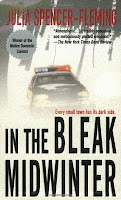
In the Bleak Midwinter, by Julia Spencer-Fleming

>> Sunday, February 21, 2010

TITLE: In the Bleak Midwinter
AUTHOR: Julia Spencer-Fleming

COPYRIGHT: 2003
PAGES: 384
PUBLISHER: Minotaur Books

SETTING: Contemporary US
TYPE: Mystery
SERIES: 1st in the Rev. Clare Fergusson & Russ Van Alstyn series.

REASON FOR READING: I've been hearing good things about this series for a while now, but I think what made me pick it up in the end was something Katharina said.

Heavy Snow...Icy Desires...Cold-Blooded Murder

Clare Fergusson, St. Alban's new priest, fits like a square peg in the conservative Episcopal parish at Miller's Kill, New York. She is not just a "lady," she's a tough ex Army chopper pilot, and nobody's fool. Then a newborn infant left at the church door brings her together with the town's police chief, Russ Van Alstyne, who's also ex-Army and a cynical good shepherd for the stray sheep of his hometown. Their search for the baby's mother quickly leads them into the secrets that shadow Miller's Kill like the ever-present Adirondacks. What they discover is a world of trouble, an attraction to each other-and murder...
At the start of In The Bleak Midwinter the new Episcopalian priest of Miller's Kill finds an abandoned baby outside the church. Police chief Russ Van Alstyn, called in to investigate, is surprised to find the new priest to be not only a woman, but one who's ex-Army, just like him, and who's nothing like any other priest he's known.

As Russ investigates the case (which soon begins to get more and more complicated, when murder is thrown into the pot), much helped by the things Clare runs into as she tends to her parishioners, the two become friends.

I know that was a pretty sketchy summary, but it's a good mystery, with plenty of twists and turns and red herrings, and it's best to discover what happens as you go along. The one thing I'm going to say about it is something about the way the investigation proceeds, just because I always mentally groan a little bit at the idea of amateurs "dabbling" in murder investigations. Most of the book, Clare isn't playing detective, or anything silly like that. She's too sensible for that. She just comes across relevant things doing perfectly normal priestly things. She does do something pretty stupid near the end, but that a relatively minor annoyance, and on the whole, the whole issue of "what on earth does she think she's doing?" doesn't arise at all.

Clare is the kind of priest an agnostic (i.e me) can be comfortable reading about. She clearly has a deep faith but isn't judgemental about it and is very human, with flaws she knows she has and works to get beyond. Clare sees her duty as being as much about helping those who need help as about the ritual and pomp and tending spiritually to her congregation.

This conception of her duty places her at odds with much of her solidly middle-class, conservative congregation's wishes. They'd like the congregation to grow, so they're happy to have Clare plan projects to raise their profile, but they'd like the new additions to the congregation to be the "right" sort of people, so the sort of projects Clare thinks she should be doing (i.e. helping people in real need, such as single mothers, etc.) won't necessarily do it for them. Clare, however, regards it as her duty to do what she whole-heartedly believes is right and what she believes God would want her to do, not what her congregation wants. This conflict is always in the background here, and from what I've read of the upcoming books in the series, it doesn't disappear easily.

Russ is also an interesting character, although maybe not as fascinating to me as Clare was, maybe because his background isn't quite as unique. What intrigued me the most about Russ at this point was his marriage. Russ has been married for years. He's not particularly happy, but he's not unhappy, either. He cares for his wife, even loves her and is very loyal to her, but isn't in love with her, either. This is not a cheating hounddog at all... at least, he doesn't seem to be one (keep in mind I've read only the first to books in the series at this point and have avoided any spoilers), which makes his relationship with Clare palatable. Speaking of which...

Good as the mystery was and as much as I liked the main characters on their own, what makes this book outstanding is the relationship between Clare and Russ. At this point, it is all about them becoming friends. I know many other readers see their relationship as being non-platonic from the beginning, but I didn't. It'll sound corny, but what came to my mind when I was reading was that Russ and Clare were clicking soul to soul, meeting and liking the very essence of the other person. It doesn't matter that Russ is agnostic and Clare a priest, that he's a cynic and she's not, or that there's a 14-year age difference betwen them. There's chemistry there, just not the sexual kind. It's a rare thing to read about, a completely platonic friendship between a man and a woman who soon start to deeply care about each other. By the time a slightly different awareness enters the relationship, near the end of the book, they were already friends. I'm really going to enjoy seeing this develop.

Something else I liked about the book was how well the setting is done. Miller's Kill really comes alive, and the winter is a character in its own right. It's vividly described and plays a huge part in the story, especially because Clare is new to the area and has never had to experience rural upstate New York in December. Neither have I, nor anything at all like it, and now that the coldest January in years in England has given me some experience of snow and ice, I really identified with her mistakes.

MY GRADE: An A-.

Read more...

The Sinister Touch, by Jayne Castle

>> Friday, February 19, 2010

TITLE: The Sinister Touch
AUTHOR: Jayne Castle

COPYRIGHT: 1986
PAGES: 187
PUBLISHER: Dell

SETTING: 1980s US
TYPE: Series romance
SERIES: 3rd in the Guinevere Jones quartet: follows The Desperate Game and The Chilling Deception.

REASON FOR READING: I wanted something short and sweet, and the first two in the series were good examples of early JAK.

Were They Dealing with a Demonic Cult or a Devilishly Clever Killer?
GUINEVERE JONES - Being a good neighbor was easy when the window across the way framed a handsome young handsome young artist. But when she became witness to sudden violence in his apartment, it was only a hint of the trouble to come.

ZACHARIAH JUSTIS - He was up to his ears with an enchanting new client whena twitch of jealousy, the ticking of biological clocks, and a confrontation with mortal danger made him rethink his relationship to Gwen.

A slashed canvas, a pentagram streaked by a bolt of lightning, chilling blood rites - they lead Gwen and Zac into the dark heart of mystery where art, magic, and money weave a dangerous spell.
As the previous two, this was a fun read, with a mystery in which our Guinevere gets mixed up and into which she drags along her reluctant PI boyfriend, Zach, as well as further development to their relationship.

The mystery this time starts out with the defacing of a painting. The artist who's been working on it lives across the street from Gwen, and their polite nodding at each other every morning through the window has long aroused Zac's jealousy. The painting incident leads to Gwen and the artist actually meeting for coffee (leading to Zach gnashing his teeth even more), and to Gwen's insistence on helping solve the mystery (i.e. getting into trouble), much to Zac's disgust.

The mystery's pretty meh, nothing special, even though it involves supposedly "exciting" elements like weird Satanic cults and strange symbols. I think my main irritation with it was that Gwen comes off a bit TSTL, in her insistence on butting into something that doesn't concern her at all and which is likely to put her in danger.

The romance is more interesting and better done (I think I say the same in every single JAK review). Gwen and Zac's relationship has been developing since their first meeting in book 1, and it's progressing quite slowly. At the start of the book, Zac, especially, is struggling with how to get the relationship up to the level of commitment he would want.

It's all about biological clocks here (and I was very amused by the way the whole concept was treated as this newfangled thing that Zach has only now found out about and half doubts even exists). Zac suspects Gwen (who's getting a bit long in the tooth, being in her 30s *sobs*) might start wanting a child soon, and worries that if she does, she might not perceive him, the owner and sole employee of a struggling PI agency, as prime father material.

Gwen, meanwhile, is suspicious of Zac's latest client, a glamorous businesswoman who seems to be taking up too much of his time during non-working hours. And her suspicions are pretty much justified, because the woman has a fully operational biological clock of her own, and she certainly thinks Zach is suitable father stud material. I must say, watching tough Zach getting terrified and freaked out was great fun.

I mostly enjoyed this part of the book. Some aspects of their relationship are a bit dated, like Zac's thinking that his role is to "lay down the law" to Gwen and "read her the riot act" when she "misbehaves". On the positive side, though, Gwen won't let herself be bullied, and just treats this part of Zac's personality as the throwback it is, as well as a manifestation of his insecurities regarding her. This made Zac's caveman instincts funny rather than irritating.

I'm looking forward to the final book in the quartet now, and won't let too much time pass before I get to it.

MY GRADE: A B.

Read more...

A few short ones

>> Wednesday, February 17, 2010

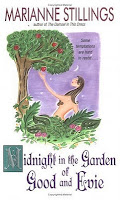
TITLE: Midnight In The Garden Of Good And Evie
AUTHOR: Marianne Stillings

The plot apparently includes a treasure hunt, orchestrated by a recently murdered mystery author in order to a) find his murderer (he knows he's made many enemies over the years) and b) determine who gets his fortune. The heroine is forced to team up with a childhood foe of hers if she wants to have a chance at the money.

I loved the idea of it, but the actual book, not so much. I read only the first 70 pages, and in them I encountered mainly forced humour and unbelievable characters. It's not that there was anything truly egregious, just lots of inane one-liners and bickering when no normal person would react that way.

This was one of the books in my Uruguayan TBR, and since I had given myself permission to drop anything that didn't appeal sooner rather than later, I did just that.

MY GRADE: DNF.


TITLE: Cold Comfort Farm
AUTHOR: Stella Gibbons

It's the 1930s* and Flora Poste's parents have died, leaving her with only a small allowance, not enough to live on very well. So Flora decides to move in with distant cousins, the Blackadders, who live in the country, and who turn out to be extremely strange. There's nothing for Flora to do but to use her modern woman's talents to sort them all out!

I've read a bit about this book now, and apparently, pastoral novels, idealising rural life were all the rage at the time, but after the brilliant send-up that was Cold Comfort Farm, the genre all but died. I think I probably would have enjoyed it more if I'd known more about what it was supposed to be parodying and been able to identify the archetypes, but I still enjoyed this quite a bit.

* Actually, I realise now that it was supposed to be set in the future, in the mid-1940s, I believe, but at the time I thought it was set in 1930, and was extremely puzzled by the mention of something happening in 1946, and the Anglo-Nicaraguan war, as well as by the way everyone seemed to fly off in private planes at the drop of a hat!

MY GRADE: A B.


TITLE: A Long Way To The Floor
AUTHOR: David Byck

Lent to me by my yoga teacher, it's a practitioner's account of how he got into Ashtanga yoga and how his practice has developed. It was an interesting read. It's not going to get any writing prizes, but I found his experience useful to read about and enjoyed it. I especially appreciated the author's honesty. I know I'm not the only one who struggles with the "no ego" thing, but it was still good to actually read about someone else struggling not to compare himself with others and show off!

MY GRADE: A B-.

Read more...

My Hero, by Marianna Jameson

>> Monday, February 15, 2010

TITLE: My Hero
AUTHOR: Marianna Jameson

COPYRIGHT: 2005
PAGES: 384
PUBLISHER: Signet

SETTING: Contemporary US
TYPE: Straight romance
SERIES: I don't think so

REASON FOR READING: Random pick up from my TBR -see below!

Romance writer Miranda Lane is famous for her sensitive heroes, but her new editor wants something different: a tough cop who's sexy as Hell and twice as hot. But cops leave Miranda cold—until she encounters Stamford detective Chas Casey. Arrestingly handsome, this Connecticut Yankee packs the kind of heat Miranda needs.

Intrigued by this sexy, sharp-tongued writer who's full of fire one minute and cool as a breeze the next, Chas tolerates Miranda's off-beat research tactics with one goal in mind: seduction.

Chas is the perfect research subject - until he steals Miranda's heart. A specialist in drive-by romance, Chas doesn't do commitment. But Miranda doesn't do casual, so she ends their affair, underestimating the steep, unexpected cost of that plot twist in her life story.

When his involvement in her research costs Chas a coveted promotion, a shaken Miranda writes her way back into his heart knowing their love story will never end.
My Hero was my first read while on holiday in Uruguay. When I went back last year I mainly read from my keeper shelf, after being away from it for over a year, but this year I decided to tackle the TBR I left behind when I moved to England. I decided to go for stuff I wasn't too sure about and be ruthless about it. If it wasn't capturing my attention, I'd just stop and go for another one.

I started My Hero with that mindset and after a very slightly rocky start, I soon knew there was no danger it'd turn into a DNF.

The rocky start was due to a bit of an iffy setup. Miranda Lane is a romance writer known for her dreamy beta heroes. She's got a new editor now, though, a brash, opinionated woman who demands Miranda completely rewrite her latest (due to come out in a matter of months). If she doesn't change her kind Southern gentleman hero into an alpha Northern cop (and make the book a LOT steamier), then the book won't come out at all. Unfortunately, the new editor means it, not to mention that she's known as a bit of a magician who can turn authors into superstars, so after a bit of convincing by her agent, Miranda reluctantly decides to go ahead with the rewrite.

Now, let's stop right there. Does this sort of thing actually happen, or is it as preposterous as it sounds? I mean, I could understand and editor asking the author to amp up or tone down some element, or possibly even any of the changes I described above in isolation, but this is pretty much writing a completely different book, just because the editor has some hangups. But oh, well, moving on.

When she receives these news, Miranda just happens to be visiting a friend in Connecticut, a perfect place to do some research and try to understand this "type" that's so foreign and unlikeable to her, the alpha male. And it just so happens that, although the local police force reject her formal request to interview one of its cops, Miranda has already met Detective Chas Cassidy through some friends. Chas is very attracted to Miranda, in spite of her standoffish attitude, and he agrees to help her with her research.

I think my favourite thing about My Hero was its lack of predictability. At first sight, both Miranda and Chas are familiar characters. Miranda's past has given her a distrust and dislike for alphas, most especially cops, and Chas is the scion of a very wealthy family, who hate him being a cop and constantly pressure him to join the family business instead. So quite a few times, I thought the story and characters were ready to head into well-worn, commonplace territory, but it always turned out that Jameson would immediately veer off into something a lot more original and which I tended to like quite a bit better than what I'd been expecting. It meant that both Miranda and Chas (and therefore, their relationship) turned out to be quite subtly drawn and to have plenty of depth, and this made them real.

Something else I wasn't expecting was the fact that My Hero is a plain, straight contemporary romance. From the back cover, I thought it was going to be a romantic suspense. With Chas being a cop, and involved in several cases during the book, I kept half expecting one of them to somehow endanger Miranda there at the end... visions of her being kidnapped by the baddie and this making Chas realise he loves her, etc. But this is not at all what happens. See what I mean about the book not going in the directions I expected? Instead, the cases were either background into Chas' life (he's a cop, and he clearly works), or, in the case of another of the investigations, provides insight and development into his relationship with his family and his decision to join the police. This element, by the way, was yet another thing that went in a direction that was completely different to and much better than the one I was expecting.

I think this is intended to be a celebration of the true alpha, the non-Neanderthal kind, the type who is tough and a clear leader but is also kind. To me, Chas was more a mix of alpha and beta (I think some people call that an omega?) than a proper alpha, but never mind, he was just lovely and I enjoyed it. He deserved to be celebrated!

MY GRADE: A very excellent B+.

Read more...

What Happens in London, by Julia Quinn

>> Saturday, February 13, 2010

TITLE: What Happens in London
AUTHOR: Julia Quinn

COPYRIGHT: 2009
PAGES: 384
PUBLISHER: Avon

SETTING: Regency England
TYPE: Straight romance
SERIES: Not that I know of

REASON FOR READING: After a couple of disappointing books, I haven't been reading JQ in the past couple of years, but the buzz about this one was that it was a return to what we all loved about her.

Rumors and Gossip . . . The lifeblood of London

When Olivia Bevelstoke is told that her new neighbor may have killed his fiancÉe, she doesn't believe it for a second, but, still, how can she help spying on him, just to be sure? So she stakes out a spot near her bedroom window, cleverly concealed by curtains, watches, and waits . . . and discovers a most intriguing man, who is definitely up to something.

Sir Harry Valentine works for the boring branch of the War Office, translating documents vital to national security. He's not a spy, but he's had all the training, and when a gorgeous blonde begins to watch him from her window, he is instantly suspicious. But just when he decides that she's nothing more than an annoyingly nosy debutante, he discovers that she might be engaged to a foreign prince, who might be plotting against England. And when Harry is roped into spying on Olivia, he discovers that he might be falling for her himself...
What Happens in London started out with dark rumours of murder and a bit of spying, but soon turned into a charming, lovely, character-driven romance.

When one of Olivia Bevelstoke's friends comes to her with the tale that her new neighbour is rumoured to have murdered his fiancee, Olivia doesn't quite believe it. Still, her bedroom window gives her an excellent view of Sir Harry Valentine's study, so the temptation to do a bit of spying on him is too great to resist. And what she discovers is quite suspicious. What nobleman spends hours and hours closeted in his study, poring over papers, and sometimes wearing strange, plumed hats?

The answer is: a nobleman who speaks fluent Russian and is therefore invaluable to the War Office, not as a spy, but as a translator. Harry is quite aware that Olivia has been spying on him (let's just say she's not the mistress of concealment she thinks she is) and can't resist jerking her around a little bit (for instance, wearing strange, plumed hats while in his study).

Harry might not be a spy, but the War Office has no problem using his abilities when it turns out that his neighbour has started being courted by a mysterious Russian prince. Harry is ordered to approach Olivia and try to overhear anything Prince Alexei says in his presence.

And so starts a romance that is funny, tender and romantic. Harry and Olivia don't particularly like each other at first. In fact, he thinks she's one cold bitch. But once they start spending some time together... wow. When JQ is good, she's really, really, really good. She doesn't just tell us these two are falling in love; we actually see them doing so, and we follow them every step of the way. And it's unmistakeably not just lust (although things do get pretty intense and steamy at times), it's very clearly love. You see them clicking as persons, and just through conversations, you totally get what they see in each other and how they fit perfectly together.

And I was very happy to watch as they did, because I loved them both to bits. I actually quite liked that Olivia is very much a normal debutante. She's intelligent and capable, but she actually likes her life and is perfectly content that her future is to make a good marriage and settle into society. As much as I love reading about women who pushed at the constraints of their time, it was refreshing to read about someone like Olivia.

It's kind of the same with Harry. Even though a description of the plot makes this sound like this is a spy book, Harry isn´t a spy at all. He was a soldier, but now he really is merely a translator for the War Office. And not just that, Harry knows very well that he would absolutely hate being a spy. He even actually says that he doesn't enjoy risk and danger, that even in war, once the battle was over, he felt like hell. Quite refreshing, and amazingly normal for a romance hero!

In addition to a wonderful romance, we get some great secondary characters. Harry's relationship with his brother was interesting. Their father was a drunk, an amiable and non-aggressive one, but JQ is very good at showing exactly how that would still be hell for a child to live with. Harry got out of the house as soon as he could, and his brother resents him for having left him behind, and seems determined to follow in their father's footsteps. There's one particular scene among Harry and Edward that was particularly heartwrenching, and I wish we'd got a bit more resolution in that particular plotline, although it did end in a hopeful note.

Harry's cousin Sebastian was also a fun character, and pretty intriguing, too. I hope the next book is about him, and I'm one who's usually irritated by sequel baiting. Oh, and Prince Alexei was brilliant, as well! He seemed to be headed towards cartoon characterisation at the beginning, but he soon becomes quite human and interesting (if not particularly likeable). For those who've read this already, I think it was about the time when he's so nonchalant about dying by pigeon-pecking, in one particularly hilarious scene.

Speaking of which, have I mentioned how funny, funny, funny this book is? Lovely, gentle humour infuses the whole thing, and it reaches perfection in that scene I mentioned, the scene in the drawing room with Miss Buttersworth and the Mad Baron was hilarious. Watch out for it if you decide to read this. It's literally laugh-out-loud funny, even approaching the mallet-of-death scene in The Viscount Who Loved Me in perfection.

Ms Quinn, glad to have you back!

MY GRADE: An A-.

Read more...

Blog template by simplyfabulousbloggertemplates.com

Back to TOP