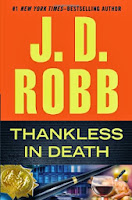
Thankless in Death, by JD Robb

>> Wednesday, November 13, 2013

TITLE: Thankless in Death
AUTHOR: JD Robb

COPYRIGHT: 2013
PAGES: 416
PUBLISHER: Putnam

SETTING: Futuristic: 2060 New York
TYPE: Police procedural & Romance
SERIES: By my count, 39th full-length title in the In Death series

In the latest suspense thriller in the #1 New York Times bestselling series, the year 2060 is drawing to a close in New York City and loved ones are coming together for Thanksgiving. But sometimes the deepest hatreds seethe within the closest relationships, and blood flows faster than water…

Lieutenant Eve Dallas has plenty to be grateful for this season. Hosting Roarke’s big Irish family for the holiday may be challenging, but it’s a joyful improvement on her own dark childhood.

Other couples aren’t as lucky as Eve and Roarke. The Reinholds, for example, are lying in their home stabbed and bludgeoned almost beyond recognition. Those who knew them are stunned—and heartbroken by the evidence that they were murdered by their own son. Twenty-six-year-old Jerry hadn’t made a great impression on the bosses who fired him or the girlfriend who dumped him—but they didn’t think he was capable of this.

Turns out Jerry is not only capable of brutality but taking a liking to it. With the money he’s stolen from his parents and a long list of grievances, he intends to finally make his mark on the world. Eve and her team already know the who, how, and why of this murder. What they need to pinpoint is where Jerry’s going to strike next.

The latest installment of the series is not a whodunnit, or even a why- or how-dunnit. It's all about how Eve and her team can catch a useless, entitled, self-absorbed arsehole who's determined to get even with the multitudes he feels have slighted him.

Jerry Reinhold, mooching off his parents' after his ex girlfriend kicked him out for stealing her savings and losing them in Las Vegas, is incensed when his mother tells him they'll be asking him to move out. He snaps and, angry, stabs her with a knife (the same one she's using to make him a sandwich). But instead of being horrified about what he's done, he finds it a revelation. He feels he's found his life's calling. Killing will be both a way of getting even with the multitudes he feels have wronged him throughout his life, and of getting the big money he needs to live the life he deserves.

I initially thought "oh, no". Jerry is a horrible, horrible character: entitled, mean, and generally hateful. He's also rather stupid, and only gets away with so much because of dumb luck. So when I realised we would end up spending quite a bit of time from his POV, I really, really didn't look forward to the way it seemed the book would develop. But it was a lot better than I thought.

The hunt for Jerry turned out to be solidly enjoyable. As usual, Eve and her team follow all the logical avenues and there are no unlikely intuitive leaps. It's all solid police work, and very satisfying to read. As for Jerry's POV, well, I won't say I liked it, but it was necessary for the book to work. It was also less disturbing than I would have thought, which was weird. There is some very graphic and explicit on-stage violence (torture, mainly), and I tend to find this really traumatic. But here, after the first couple of scenes, I didn't really find myself that disturbed by it. I think it may have been because it was so graphic, so horrendous, that I disconnected myself from it as a sort of defence mechanism.

On the personal front, there's all the stuff about family and friends coming to Eve and Roarke's for Thanksgiving, and although that was fun, it was something else that was my favourite. More and more in the last few books, Robb has focused on aspects of Eve's job beyond her day-to-day work as a detective. For instance, an earlier book explored her role as a leader (and euw, this does sound horribly managementy, almost like some sort of case study, but it really isn't how it's done in the books. It feels very natural there). Here, we see Eve struggling with an issue I've been thinking about more and more in the last couple of years: the move from a specialist role into a more senior, managerial one. There's opportunity to have more influence and the prestige of the more senior role, but there's also the nightmares of management and the leaving behind of a hands-on occupation that is enjoyable, and has become intertwined with one's identity. So far I've been making the same decision Eve makes, and for exactly the same reasons, but like her, there's always the sense that the move will have to happen at some point. For someone who, from her bio, has never worked in jobs where she's had to face these issues, Robb gets it remarkably right.

Something else that was interesting here (to me, at least!) was my reaction to Roarke. I know a lot of readers have been put off from the series by how OTT everything about him is. I do agree he's OTT and really would prefer someone not quite as perfect in every single way, but this book was the first time I felt he was out of place in the series. As I said earlier, in the last few books, the focus has been on Eve as a leader, Eve as a boss, and this has felt so realistic that having Roarke pop up owning everything in the known world kicked me out of the story a time or two. It felt wrong, and like he was in the wrong book.

I also found the Irish relatives (they visit for Thanksgiving) annoying, maybe because constant contact with actual Irish people has made me realise how off Robb's rendering of the language is, and how stereotypical and cringey is her portrayal of the actual characters. It was a tiny part of the book here, but it's making me sort of dread her upcoming Dark Witch.

MY GRADE: A B+.

Read more...

Skios, by Michael Frayn

>> Monday, November 11, 2013

TITLE: Skios
AUTHOR: Michael Frayn

COPYRIGHT: 2012
PAGES: 272
PUBLISHER: Faber and Faber

SETTING: Contemporary Greece
TYPE: Fiction
SERIES: None

On the private Greek island of Skios, the high-paying guests of a world-renowned foundation prepare for the annual keynote address, to be given this year by Dr. Norman Wilfred, an eminent authority on the scientific organization of science. He turns out to be surprisingly youthful, handsome, and charming—quite unlike his reputation as dry and intimidating. Everyone is soon eating out of his hands. So, even sooner, is Nikki, the foundation's attractive and efficient organizer.

Meanwhile, in a remote villa at the other end of the island, Nikki's old friend Georgie has rashly agreed to spend a furtive horizontal weekend with a notorious schemer, who has characteristically failed to turn up. Trapped there with her instead is a pompous, balding individual called Dr. Norman Wilfred, who has lost his whereabouts, his luggage, his temper, and increasingly all sense of reality—indeed, everything he possesses other than the text of a well-traveled lecture on the scientific organization of science.

Farce is not my favourite kind of comedy. I tend to find it tiresome and annoying, but that's probably because it's ridiculously hard to do well; therefore, in most cases, it's badly done. Skios is high farce, but it is also beautifully done, and I loved it.

The setup is, almost by definition, ridiculous and improbable. Oliver Fox arrives at Skios for an assignation with a married woman. He sees a beautiful young woman holding a sign for Dr. Norman Wilfred and, on impulse, approaches her. She assumes he is, indeed, the eminent scientist Dr. Wilfred (although he looks a lot younger and better looking than in his photograph) and carts him off to the prestigious conference she's organising, where he's expected to deliver the final lecture.

When the real Dr. Wilfred walks out past customs, there's no one holding a sign with his name on it. There's a taxi driver waiting, though, and he takes Dr. Wilfred to a house that's already occupied by a madwoman who thinks he's some sort of rabid rapist. The woman is called Georgie, and she was expecting her lover, Oliver.

On the surface, this is pure entertainment, and it really is fun and hilarious. The farcical elements are choreographed like clockwork and the funny bits are hilarious. I'm sure just reading it would already be funny, but the delivery achieved by Martin Jarvis, the narrator of the audiobook I was listening to, made it even more so. The scenes with the taxi drivers, particularly, made me almost cry with laughter.

But there's a lot more to it. The satire is extremely well-observed and spot-on, not relying on meanness or easy targets. There's also a deceptive depth to the characters. Oliver, for instance, initially comes across as a charming rotter, simply out for a lark. But after a while, it becomes clear there's more going on inside his head, a touch of something darker than one might assume. And Dr. Wilfred, boring pompous Dr. Wilfred, discovers a side to himself he never knew was there.

Just fantastic.

MY GRADE: An A-.

AUDIOBOOK NOTES: As I mention above, I listened to the audiobook narrated by Martin Jarvis, and it was fabulous.

Read more...

Ten Tiny Breaths, by KA Tucker

>> Saturday, November 09, 2013

TITLE: Ten Tiny Breaths
AUTHOR: KA Tucker

COPYRIGHT: 2012
PAGES: 262
PUBLISHER: Self-published

SETTING: Contemporary US
TYPE: New Adult
SERIES: There's a sequel telling the sister's story

Kacey Cleary’s whole life imploded four years ago in a drunk-driving accident. Now she’s working hard to bury the pieces left behind—all but one. Her little sister, Livie. Kacey can swallow the constant disapproval from her born-again aunt Darla over her self-destructive lifestyle; she can stop herself from going kick-boxer crazy on Uncle Raymond when he loses the girls’ college funds at a blackjack table. She just needs to keep it together until Livie is no longer a minor, and then they can get the hell out of Grand Rapids, Michigan.
But when Uncle Raymond slides into bed next to Livie one night, Kacey decides it’s time to run. Armed with two bus tickets and dreams of living near the coast, Kacey and Livie start their new lives in a Miami apartment complex, complete with a grumpy landlord, a pervert upstairs, and a neighbor with a stage name perfectly matched to her chosen “profession.” But Kacey’s not worried. She can handle all of them.

What she can’t handle is Trent Emerson in apartment 1D. Kacey doesn’t want to feel. She doesn’t. It’s safer that way. For everyone. But sexy Trent finds a way into her numb heart, reigniting her ability to love again. She starts to believe that maybe she can leave the past where it belongs and start over. Maybe she’s not beyond repair.

But Kacey isn’t the only one who’s broken. Seemingly perfect Trent has an unforgiveable past of his own; one that, when discovered, will shatter Kacey’s newly constructed life and send her back into suffocating darkness.

The basic plot here is very typical NA: Heroine with a huge, horrible tragedy in her past, which has made her withdrawn from life. Hero who tries to reach her, but who has secrets of his own. With such a popular set-up, you're always going to get good and bad executions, and I thought this was one for the 'good' column.

Kacey Cleary is the sole survivor of a drunk driving accident which killed not only her parents, not only her boyfriend, but her best friend as well. Understandably, this left her pretty messed up. For a while she tried all the standard self-destructive ways of coping with tragedy, until her younger sister, Livie made her promise Kacey wouldn't leave her as well. As the book starts, Kacey is still not coping that well, but she's doing better. And then she discovers that the uncle they live with has made sexual advances on Livie, and realises they need to get out of there.

The two end up living in an appartment complex in Florida (I pictured something like the one in Melrose Place), where Kacey ends up getting close to two of the neighbours. The first is Storm, who becomes a friend and offers Kacey a job as a waitress in the club where she strips. The second takes a while longer. His name is Trent, and he's about Kacey's age and much too attractive. After a while, Kacey beings to feel that she can start building a regular life and begin to develop relationships with people again. But it turns out Trent has his own issues, and they are such that they threaten his relationship with Kacey.

Ten Tiny Breaths is an angsty read, but angsty in a way I enjoyed. Although there is a romance, the highlight for me was seeing Kacey heal, moving away from a numb state, where she hardly cares what happens to her and is completely isolated from anyone but her sister. This is done in a gradual, believable way. The romance fit well into that theme. It was possibly a bit too fast to be believable, but I did buy it. Finally, I particularly appreciated the non-stereotypical way in which Tucker portrayed Storm, and how she got her own really sweet (in a good way) HEA.

My only problem with this book is, like most people I know who've read it, with the ending. There's a twist, and those developments (I'm trying to be vague here) result in a resolution which I'm not sure was a healthy one for everyone involved.

Since this is self-published, I should say something about the writing. It's not awful, but it's not great, either. There are some typos, some words used incorrectly, and the author needs to learn how to use hyphens properly, but it wasn't too distracting, or even bad enough to lower the grade.

MY GRADE: A B.

Read more...

October 2013 reads

>> Friday, November 01, 2013

Fewer than usual this month, but on the other hand, no duds. I'll take that!


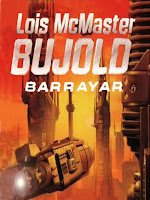
1 - Barrayar, by Lois McMaster Bujold: A
review coming soon

Audiobook. This one continues the story where Shards of Honor left off. Cordelia is now Lady Vorkosigan, and expecting a baby. But with Aral named Regent for the underage Emperor, it's not a peaceful life. Brilliant, brilliant, brilliant. I love Bujold's honourable, competent main characters and I love how they deal with what are really serious issues. Why on Earth didn't I continue with the series the first time??


2 - Thankless in Death, by JD Robb: B+
review coming soon

Eve and the team are after an entitled, self-absorbed arsehole who kills his parents for daring to ask him to get a job and move out, and then, having discovered a taste for killing, decides to get even with the multitudes whom he feels have slighted him. I liked it much better than I thought I would at the beginning.


3 - Troubled Waters, by Sharon Shinn: B+
review here

Reread in preparation for the release of the sequel in early November (I realised reading that blurb that I had no idea who the heroine was!). The books are set in a world dominated by the 5 elements. The heroine was born amongst the ruling families, but her father was disgraced and she grew up in exile. After her father dies, the King's advisor turns up to collect her, telling her she's meant to become the King's fifth wife. And so it all starts. As I noted in my review, it's a book with not much of a sense of peril, but it's still hugely enjoyable. I always sort of sink into Shinn's prose, and this was no exception.


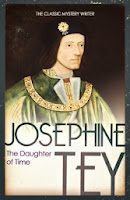
4 - The Daughter of Time, by Josephine Tey: B+
review here

Reread for my book club (well, listened to the audiobook this time). Detective Alan Grant is laid up in hospital after an accident and very bored, so he uses his investigative techniques to look at the accusations that Richard III murdered the little Princes in the tower. The material is as fascinating as ever, and the structure really clever. I enjoyed it this time as well, but it really is very partisan. Also, this time around I particularly noticed some of the more dated elements, such as the difference between the cultured, upper class characters (all of whom are interested in and appreciative of the new point of view Grant offers them) and the working class characters (who refuse to consider it at all). The narration by Derek Jacobi really made clear (quite in line with the tone of the text, really) how patronisingly working class characters are dealt with. Other elements, such as the personalised, even somewhat defferential care Grant gets in an NHS hospital (in which he stays for weeks on end for what's basically a broken leg!) are just as much of the time the book was written in (the 1950s), but charming, rather than infuriating.


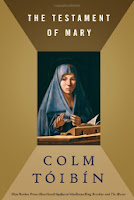
5 - The Testament of Mary, by Colm Tóibín: B+
review here

On the Man Booker shortlist. Mary of Nazareth reminisces about the events of her son's life. Short, but her ambivalence about what's going on, as well as the way the brutality of the crucifixion is brought to life, pack a punch. It's a fascinating perspective.


6 - Appointment With Death, by Agatha Christie: B
review coming soon

Audiobook. I chose this one as my next Christie because part of it is set in Jordan, including some really interesting scenes in Petra. That was great fun to read, as was the plot about the horrible, controlling matriarch, whose death is suspected to have been caused by someone in her family having had enough of her psychological torture.


7 - We Need New Names, by NoViolet Bulawayo: B-
review here

On the Man Booker shortlist. We follow the heroine from her childhood in Zimbabwe to her teenage years in the US. The first Zimbabwe-set part was good, but the second got really unfocused as the author just chucked in everything but the kitchen sink.


8 - The Lowland, by Jhumpa Lahiri: B-
review here

On the Man Booker shortlist. The story of two brothers. One of them leaves Calcutta and settles in the US after completing his studies, the other becomes a revolutionary. I liked it, but it felt a bit too stretched and the really interesting themes at the beginning of the book then narrowed into something a lot less interesting.


9 - Stir Me Up, by Sabrina Elkins: B-
review coming soon

New Adult. The heroine is about to finish high school and is determined to become a chef, over her father's objections. The hero is a young veteran who had a leg blown off in the war, and is recovering at the heroine's house, as his aunt is her stepmother. I thought it started well, and I liked it, but I sort of gradually lost interest as the book progressed.


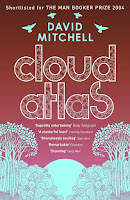
10 - Cloud Atlas, by David Mitchell: Still listening
review coming soon

Audiobook. I've heard enough about this one to know it's supposed to be 6 different stories nestled within each other. So far I've had 3: a journal written by a 19th century man travelling in the South Pacific, letters detailing the escapades of a young English composer in 1920s Belgium and a noirish thriller set in the 1970s, starring a plucky reporter investigating a nuclear power station. I've enjoyed all of them in their own right (and knowing we return to each later made me feel ok about leaving them at quite key moments to move on to another), but in spite of some links (so far, each protagonist finds the previous story), I don't yet get why these stories have been put together in this book. I'm hoping this will become clearer.


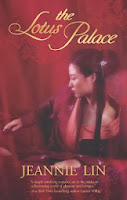
11 - The Lotus Palace by Jeannie Lin: Still reading
review coming soon

I've actually only just started this one. I've been meaning to try one of Lin's China-set historicals for ages. So far, all I know is that the heroine is maidservant to a courtesan and the hero a client there. He seems like a bit of a wastrel so far, but I'm sure there'll be more to him.

Read more...

November 2013 wish list

>> Thursday, October 31, 2013

A relatively modest month, but I'm very excited about a couple. November 5th looks like a particularly good day!


Books I'm definitely planning to get


Royal Airs, by Sharon Shinn (Nov 5)

I loved Troubled Waters, the first in the series. I especially loved the world Shinn had created, and felt very disappointed when it looked like it was going to be used for just the one book. Well, we’re back to Welce here, and I’m looking forward to visiting again.


The Luckiest Lady in London, by Sherry Thomas (Nov 5)

Thomas is an autobuy author for me, and this one has one of my favourite romance plots, the marriage of convenience. It sounds like a particularly interesting example of it, too.


Through The Evil Days, by Julia Spencer-Fleming (Nov 5)

I’m a bit behind with this mystery (but with strong romantic elements) series, but I loved the first books enough that I’ll just stockpile the later books. It’s one I’m confident I’ll catch up with.


Books that interest me and I'll keep an eye on


Don’t Want To Miss a Thing, by Jill Mansell (Nov 5)

I read one book by Mansell a while ago and liked it. It was gentle and comfortable, and that’s exactly what I want sometimes. I’ve been meaning to read her again.


Roman Holiday 1: Chained, by Ruthie Knox (Nov 11)

Ruthie Knox seems to be trying out some very novel formats in her latest books. Well, novel formats for romance, because the serialised novel has a long history. She’s previously done a serial on something called Wattpad, and Roman Holiday goes back to the format, only the different episodes will just be regular ebooks. It will apparently be 10 parts, each published a week apart (there are a couple more in November). Except, that is, that there will be a gap of “a few months” between the first 5 episodes and the last. I’ll be honest, although I’m interested in the story, but have no interest in reading it in serial form, especially with that long gap in the middle. I might buy now and wait till all bits are out, or just wait until (hopefully) the whole thing is published in one piece.


Yours To Keep, by Serena Bell (Nov 11)

The heroine is an undocumented immigrant, which is something I don’t think I’ve ever seen in romance, and the author blogs at Wonkomance, which is always a good sign.


Read more...

The Girl of Fire and Thorns, by Rae Carson

>> Monday, October 21, 2013

TITLE: The Girl of Fire and Thorns
AUTHOR: Rae Carson

COPYRIGHT: 2011
PAGES: 448
PUBLISHER: Greenwillow

SETTING: Fantasy world
TYPE: Fantasy
SERIES: 1st in a trilogy

Once a century, one person is chosen for greatness.

Elisa is the chosen one. But she is also the younger of two princesses. The one who has never done anything remarkable, and can't see how she ever will.

Now, on her sixteenth birthday, she has become the secret wife of a handsome and worldly king--a king whose country is in turmoil. A king who needs her to be the chosen one, not a failure of a princess.

And he's not the only one who seeks her. Savage enemies, seething with dark magic, are hunting her. A daring, determined revolutionary thinks she could be his people's savior, and he looks at her in a way that no man has ever looked at her before. Soon it is not just her life, but her very heart that is at stake.

Elisa could be everything to those who need her most. If the prophecy is fulfilled. If she finds the power deep within herself. If she doesn't die young, as most of the chosen do.

First off, apologies if I get names wrong here, as I listened to the audiobook and there were some issues with the pronounciation of Spanish words. I checked a few things against summaries and reviews, but I might have missed some.

Princess Lucero Elisa of Orovalle is the bearer of a Godstone. The Godstone is a real, physical stone lodged in her belly button (which, writing it now, I realise sounds slightly ridiculous. Don't worry, it isn't), and is a mark from God that she's been chosen to do something great. What exactly that might be is a bit hazy to Elisa. Previous bearers she knows of have done all manner of heroic, great and more pedestrian good deeds. Many have lost their own lives in the process.

We meet Elisa when she's about to marry Alejandro, the king of the neighbouring country of Joya d’Arena. Elisa is 16, and although her Godstone marks her as very special (Bearers come along maybe once a century), she doesn't feel she is, especially next to her beautiful, clever sister, the heiress to the throne. Elisa is shy, overweight and awkward, more comfortable studying religious texts than dealing with the issues of government. When she hears she's about to get married to Alejandro, she wishes with all her heart for an ugly husband. Maybe that way she'll have a chance of a good marriage. No such luck, Alejandro is gorgeous.

We follow Elisa as she travels to her new home and faces many challenges. There's the fact that Alejandro decides to keep their marriage a secret "for now", and courtiers aren't kind to an unattractive, scared girl of apparently little importance. But there's also danger to Elissa's very life, and the harrowing challenges she ends up having to face also give her the chance to come into her own.

I have to thank Jane from Dear Author from making me aware of this series. I'm not a huge YA reader, so I might easily have overlooked this hugely enjoyable book without her review. It was a really satisfying read, one with a character who undergoes a big change which is also believable. I particularly liked what Carson did with the issue of Elisa's weight and her relationship with food. She does lose weight, but it's not about being prettier, but about being fitter. The emphasis is on the change in her character. She becomes tougher and firmer in character as her body does the same (and the difficult conditions and exhausting adventures that she has to go through cause both). Neither the weight nor her fear melt away easily, it's tough, and she earns both every single pound that goes off and every bit of leadership skills.

I also liked how Carson used Elisa's perception of food to show she's still the same character, one who really appreciates good food. There's one particular scene that was very telling. Elisa is in an incredible dangerous situation, captive and about to be tortured, when her captor offers her some food. And Elisa can't help but take the time to notice that the meatball she's being offered is not just "a meatball", but venison flavoured with garlic and herbs. That was so Elisa!

Additionally, the perception of her physical changes by other characters were a really good way of emphasising which of them were worthy, especially the male characters. Having the ones who are worth Elisa's time being able to see beyond her looks is a bit of an obvious thing to do, but I've read so many "makeover"-type books where the heroine's change causes the hero to look at her differently that I particularly appreciated this.

I liked pretty much everything about this. Elisa was great, but so were the myriad secondary characters, all of whom were well-drawn and felt like individuals, with their own concerns outside of our protagonists. The romance element was surprising and served the story, and I thought turned out exactly as it should have (don't go into this book expecting a romance novel, though; that's not what this is about). I also mostly liked the Medieval Spain-inspired setting. It didn't feel particularly fresh (all of it felt very based on existing things: places and religions, for instance), but it was detailed and made sense. The only thing there that didn't quite convince me was the language, which was a sort of bastardised Spanish, but bastardised in a way that didn't completely make sense. I could put up with it ok, althought things like having female names being given to prominent male characters (Belén and, FFS, Rosario) tried my patience.

Still, minor annoyances didn't detract from this at all. I can't wait to read the rest of the trilogy. There is good closure here (no cliff-hanger endings, don't worry), but at the same time, plenty of territory that could be explored, and I shall join Carson when she does that.

MY GRADE: A B+.

AUDIOBOOK NOTE: The narration was fine, with the voice and tone sounding exactly how I'd expect Elisa to sound. My only complaint is that the narrator, Jennifer Ikeda, kind of butchered some of the Spanish pronounciation. For instance, for quite a long time, I assumed Joya d'Arena was actually Joya de Reina, because that's what it sounded like when she read it. It was annoying, but only mildly so.

Read more...

Calculated in Death, by JD Robb

>> Saturday, October 19, 2013

TITLE: Calculated in Death
AUTHOR: JD Robb

COPYRIGHT: 2013
PAGES: 416
PUBLISHER: Putnam

SETTING: Futuristic: 2060 New York
TYPE: Police procedural & Romance
SERIES: By my count, 38th full-length title in the In Death series

On Manhattan's Upper East Side a woman lies dead at the bottom of the stairs, stripped of all her valuables. Most cops might call it a mugging gone wrong, but Lieutenant Eve Dallas knows better.

A well-off accountant and a beloved wife and mother, Marta Dickenson doesn’t seem the type to be on anyone's hit list. But when Eve and her partner, Peabody, find blood inside the building, the lieutenant knows Marta's murder was the work of a killer who's trained, but not professional or smart enough to remove all the evidence.

But when someone steals the files out of Marta's office, Eve must immerse herself in her billionaire husband Roarke's world of big business to figure out who's cruel and callous enough to hire a hit on an innocent woman. And as the killer's violent streak begins to escalate, Eve knows she has to draw him out, even if it means using herself as bait...

It's been a while since I've been truly excited by a new In Death, but they're dependably enjoyable comfort reads, and that's exactly what this new installment turned out to be.

When the body of accountant Marta Dickenson is found at the bottom of the stairs of a building in renovation, Eve and her team immediately know it's not the mugging gone wrong that it appears to be. It looks like a hit to them, but one performed by a not particularly professional hitman. Evidence points towards the reasons for the murder being somehow related to the Marta's work, so there we go, perfect opportunity to involve Roarke!

The case is more interesting than it sounds. Going through an accountant's workload could be a bit (well, a lot) mind-numbing, but Robb keeps it interesting by focusing on the people and personalities involved as much as on the business dealings they're involved in. I ended up really enjoying the investigation, even if I did think the ramp-up in violence at the end was unnecessary. I think the original case alone was strong enough to stand on its own.

I particularly appreciated that there was a very real sense of tragedy here. Marta never becomes just "the victim". She was a real person, and it's clear her death is felt as a huge blow by the people who knew and loved her. I came close to tears quite a few times.

The "personal" side of this book was nothing huge, but it was still interesting, and showcases the many ways in which Eve has changed over the series. The premiere of the Icove film that has been rumbling on for several films is coming up, and though Eve is not at all excited about going, she's a lot more chilled out and relaxed about doing so than she would have been at the start of the series. I also liked that through the case, she got a little bit of a better sense of what Roarke's everyday life is about. And as in previous books, we got to see more of Eve the manager and leader at work, advising Trueheart of career development. Again, it sounds boring, but when you know the characters involved as well as longtime readers of the series do, it's not.

MY GRADE: A B+.

Read more...

The Arrangement, by Mary Balogh

>> Thursday, October 17, 2013

TITLE: The Arrangement
AUTHOR: Mary Balogh

COPYRIGHT: 2013
PAGES: 400
PUBLISHER: Dell

SETTING: Early 19th century England
TYPE: Romance
SERIES: 2nd full length novel in the Survivor's Club series, related to The Suitor novella.

A mesmerizing story of passionate awakening and redemption, Mary Balogh’s new novel unites a war hero consigned to darkness with a remarkable woman who finds her own salvation by showing him the light of love.

Desperate to escape his mother’s matchmaking, Vincent Hunt, Viscount Darleigh, flees to a remote country village. But even there, another marital trap is sprung. So when Miss Sophia Fry’s intervention on his behalf finds her unceremoniously booted from her guardian’s home, Vincent is compelled to act. He may have been blinded in battle, but he can see a solution to both their problems: marriage.

At first, quiet, unassuming Sophia rejects Vincent’s proposal. But when such a gloriously handsome man persuades her that he needs a wife of his own choosing as much as she needs protection from destitution, she agrees. Her alternative is too dreadful to contemplate. But how can an all-consuming fire burn from such a cold arrangement? As friendship and camaraderie lead to sweet seduction and erotic pleasure, dare they believe a bargain born of desperation might lead them both to a love destined to be?
The Survivor's Club series follows a group of characters who came back from the Napoleonic wars having suffered pretty bad physical and/or mental damage, and became friends when they sought refuge in the same place. The Arrangement tells the story of Vincent Hunt, Viscount Darleigh, who was blinded in his very first battle, when he was still very young.

Vincent finds himself in a bit of a pickle. Having grown up in relatively straitened circumstances, he unexpectedly inherited a title and a big pile of money. This, however, happened while he was still recovering from his injuries, and his mother and sisters took over his new estate for him. They did it with the best of intentions, but the result is that he's never been able to feel like he was in control of his new life. It makes it particularly hard to resist their unceasing efforts to get him married, especially because Vincent knows that if he dies without issue they'll all be back in genteel poverty straight away. Again, this matchmaking is done with the best of intentions. They feel it's the right thing for him to have a young woman to love and coddle him, just as they do now (which, understandably for someone who's made huge strides in adapting to his blindness, drives him mad).

Best of intentions or not, they pile on the pressure until Vincent snaps, running away when it becomes clear the young woman who's been invited to his home, her whole family in tow, has been led to expect a proposal from him (her story is told in The Suitor). But that's not the end of the marital traps, and there's one waiting for him when he goes back to spend some alone time in the house he grew up in.

Sophia Fry lives nearby, having been taken in by her aunt when she didn't have anywhere else to go. The aunt and her family make it crystal clear that she's only there because they felt they had to take her in or be badly thought of by others. She's practically invisible, referred to as "the mouse". On impulse, she intervenes when her cousin very deliberately tries to lead Vincent into a compromising situation so that he'll have to marry her. For her troubles, Sophia is kicked out and has nowhere to go until, resigned to the fact that he's going to have to get married at some point soon and he might as well marry someone of his choice, Vincent proposes a marriage of convenience.

This was one I liked ok, but very definitely did not love. Mainly, this hinges on my mixed feelings about Vincent. On the positive side, I liked that Balogh's portrayal of his blindness does not come from the Catherine Anderson school of writing. She doesn't portray him as a victim. It's clear that dealing with his new circumstances has been and still is extremely challenging, and he still has moments when it hits him, and hard, that he's blind, and will never, ever see again. The focus, however, is on what he can do in spite of his blindness and even on what he can now do because of it. That last point is made somewhat clumsily, with a fight, but at least it's made.

The problem is, he was a bit of a doormat at the start of the book, and that's never addressed. I understand all the circumstances, but his mother and sister really do love him and want the best for him, and they seem like relatively sensible people, not stupid at all. I'm not saying he should have gone all imperious and ranted and raved at them, but an honest discussion? Tell them how he feels, that he does want to marry, and understands why they feel it's so important, but "please do not ever invite a random young woman to the house and all but promise her I will marry her"? That seems pretty reasonable to me, but he runs away instead. And then, the second time he's almost trapped into marriage, he basically lets himself be led by Sophia's cousin into a compromising situation, knowing all the while that that's what she's doing, and that all it would take to stop it is dig his heels in and say "Best not, Miss March, I wouldn't want to compromise you", or something innocuous like that. It was all a bit hard to swallow, especially considering that he was otherwise portrayed as a man with immense strength of mind.

The romance was similarly mixed. The relationship itself was one I really liked. It starts out with respect and liking, and for all the right reasons. They like each other for who they are, and each likes how the other treats them. Vincent likes Sophia because she doesn't treat him like a victim. In fact, she doesn't think of him as a victim, and finds the way he clearly doesn't think of himself as one attractive. So that was great, and resulted in a relationship that felt health and good. The problem was that the conflict, the reason Balogh found to keep them from just declaring their love and arriving at their HEA, was very flimsy. For no very good reason at all, they agree when they decide they'll get married that after a while, they'll live separately. And then they keep having small misunderstandings where each thinks the other still definitely wants that, and can't wait until they can be in peace on their own. It was just silly and contrived.

Still, for all of that, it was a very pleasant read. I enjoyed the secondary characters (there was a fair bit of seriesitis, but not as much as in other recent Baloghs) and the developments in Sophia's need for a family, and I even liked the hints for the next book in the series.

MY GRADE: A B-.

Read more...

Man Booker reading 6 - The Lowland and wrap-up

>> Tuesday, October 15, 2013

Man Booker reading 1 - Harvest and The Kills

Man Booker reading 2 - The Luminaries

Man Booker reading 3 - A Tale For The Time Being

Man Booker reading 4 - We Need New Names

Man Booker reading 5 - The Testament of Mary

Finally, with only a week to go, I got to Jhumpa Lahiri's The Lowland. In it, we travel back to 1960s Calcutta to meet brothers Subhash and Udayan. Subhash is the older brother and a solid, dependable young man who gets dragged into scrapes by his more mischievous, daring younger brother. As they grow up, Subhash continues to be dependable and conscientious, while Udayan continues to be a daring troublemaker. Their closeness begins to fray when they enter university and Subhash concentrates on his studies while Udayan gets involved in a revolutionary movement and his life becomes all about bringing about social change, whatever the danger that brings him. The book then covers decades and 4 generations, moving between Calcutta and the US, where Subhash moves for his graduate studies and ends up staying.

It starts out well, with wide themes being embodied in the characters' lives, from social injustice to environmentalism, and including familial obligation and how that can be interpreted in the modern world. I was really excited about how those contrasting approaches of Subhash and Udayan might be developed and confronted. But after the death of an important character, the focus becomes much narrower, and we spend a lot of time looking at a loveless marriage falling apart and at a woman chafing against the roles life has imposed on her. Now, I actually love novels that focus on very domestic issues (I'm a romance reader, after all, and think there's little more fascinating than relationships) and I should have been captivated by that important female character, but this just wasn't done in a way I found particularly interesting or illuminating. It felt cold, like we were getting a bird's eye view of the characters' lives, without really getting involved. The way it was narrated didn't help, as the sections from several characters' points of view were done in quite an omniscient way, which felt a bit distancing.

There were several points where I felt the book could have ended, including about halfway through, and about two thirds in. Lahiri did reengage me in the story for short periods, but it all felt like it was being stretched a bit, possibly unnecessarily. In the end I wasn't sorry I'd read it, but was quite underwhelmed. A B-.


So, that is that. It looked for a while like I might not make it and I did wonder whether I even should, but it was just a (really long) blip. I don't think I would have picked up any of these books independently, and I think I would have missed something if I hadn't, so this project of reading the shortlist still looks like a good idea.

The winner will be announced tonight. And after all that reading, I suspect who I think should win and who I think will win might have different answers. The first question is easy to answer. A Tale For The Time Being was by far my favourite. I thought it was objectively really impressive, but I also really enjoyed it and thought it was very fresh and different. The thing is, it didn't really feel like the sort of book that would win. I don't know if I can put my finger on it, but that's my gut feeling. If I had to guess, I would go for Harvest. That was my initial guess, based purely on the fact that there is a perception that Jim Crace is due a win, and given that the book really is very, very good, I don't think it would be a tragedy if this did happen.

Read more...

Man Booker reading 5 - The Testament of Mary

>> Monday, October 14, 2013

Man Booker reading 1 - Harvest and The Kills

Man Booker reading 2 - The Luminaries

Man Booker reading 3 - A Tale For The Time Being

Man Booker reading 4 - We Need New Names

The next book was, yet again, something completely different (and its diversity is something I really liked about this year's shortlist): Colm Tóibín's The Testament of Mary. This is more a novella than a novel, at barely 100 pages, and the Mary of the title is Mary of Nazareth, the mother of Jesus Christ. The book consists of Mary remembering the events of the last few years. She's being plagued by two demanding and disapproving men, who want to hear about her son, but she doesn't like it, so she won't talk to them. She'll tell us instead.

The point here is not 'was he or wasn't he?'. That's left ambiguous. What I found fascinating was the look at what it would have felt like for a mother to have her son become this powerful figure, someone who attracted adulation and admiration from followers who were convinced he was the Son of God, as well as the dangerous attention of the authorities, who saw him as a troublemaker they had to do something about. Mary's mixed feelings are believably portrayed. She loves her son, but part of her doesn't much like that he's become the centre of what she sees as a travelling circus, and she resents that. She often even resents him.

I was particularly struck by Tóibín's view of the crucifixion through a mother's eyes. It's something that has become so stylised and symbolic that the sheer brutality of it can get lost, but it's really brought to the centre here. I found that section harrowing and hard to read, exactly as it should be.

The book is beautifully written, with every word carefully chosen, and I enjoyed it. It didn't quite rock my world, though, and I found it interesting and good rather than brilliant and amazing, so it was a B+.

Tomorrow: The Lowland, by Jhumpa Lahiri and wrap-up

Read more...

Man Booker reading 4 - We Need New Names

>> Sunday, October 13, 2013

Man Booker reading 1 - Harvest and The Kills

Man Booker reading 2 - The Luminaries

Man Booker reading 3 - A Tale For The Time Being

After the enjoyable sojourn in Japan and Canada that was A Tale For The Time Being, I decided to move onto Africa, and picked up NoViolet Bulawayo's We Need New Names. It tells the story of a girl called Darling, and starts when she's 10 years old and living in a slum in Zimbabwe circa 2007-08. We see what's going on from her eyes and her friends': the inflation, the elections and the violence that ensues, the expropriation of assets from whites, the epidemic of untreated AIDS. We then follow her as she's sent to the US to live with her aunt, and see her life as she grows up.

It was a very readable book (so much so that I polished it off in a couple of days) and I did mostly like it, but I don't really get what the Man Booker judges thought was so great about it. The writing is nothing particularly impressive. It was trying to do something interesting, gradually changing the register to reflect the narrator's changes in both age and circumstances, but I didn't think it succeeded. At the beginning, especially, it kept pulling me up short with sections which really, really didn't sound like a 10-year-old. I could see the seams a bit too often.

As for the theme and the story, well, it was a bit mixed. The first half, where Darling is still in Zimbabwe, is well done. The device of having a child simply describing what she's seeing, not really understanding it herself, but in a way that it's chillingly clear to the reader exactly what's going on, is a good one, and Bulawayo executes it well. Not extraordinarily well, though, nor is it particularly novel or revolutionary. And then, the second half was a bit of a mess, in my opinion. There were some things in it I thought were fascinating (the immigrant experience is something I'm particularly interested in), but it felt like the author didn't quite know what to concentrate on. She ended up just throwing in as many themes as possible, and as a result, the whole thing felt unfocused and confused. Also, it just stops at what felt like a random point, with no resolution of any kind. Unfortunately, I can't give this more than a B-, and I say unfortunately because I felt there was a lot of unfulfilled potential there.

Tomorrow: The Testament of Mary, by Colm Tóibín

Read more...

Man Booker reading 3 - A Tale For The Time Being

>> Saturday, October 12, 2013

Man Booker reading 1 - Harvest and The Kills

Man Booker reading 2 - The Luminaries

Feeling a bit discouraged after spending so much time on books I didn't enjoy, I decided on my next to start on my flight back from Jordan (oh, how I love my kindle!). That was Ruth Ozeki's A Tale For The Time Being, and I knew within a few pages that it was going to be ok :)

Ruth, a writer, finds a diary in a Hello Kitty lunchbox washed up on the beach of the Canadian Pacific island she lives in. It was writen by Nao, a 16-year-old Japanese schoolgirl, who says she doesn't have much time left, and she intends to write up the story of her amazing great-grandmother Jiko, a woman prominent in the Japanese feminist movement in the early 20th century, and who's currently a 104-year-old Buddhist nun. In fact, though we do get to know the wonderful Jiko, we get even more about Nao herself: about her difficulties in fitting into life in Japan after spending her formative years in Silicon Valley, about her struggles in school, where her sadistic classmates bully her in horribly inventive ways, and about her sucidal father, who is having as much trouble as Nao. As she reads the diary, Ruth becomes more and more involved in Nao's life and obsessed with finding out what's become of her, especially as Ruth suspects the lunchbox might have been washed away by the 2011 tsunami.

A Tale For The Time Being is a wonderful book. It's as much the story of Nao and Ruth, whose lives resonate with each other in unexpected ways, as an exploration of Zen Buddhism and quantum theory, and an intensely spiritual novel. I realise this might put off some readers; in fact, it might have put me off, because my immediate assumption would be that it's a show-offy, up-its-own-arse thing. But it's not, I swear. It's all done in a very, well, humble and loving way, a bit like the character of Jiko, Nao's great-grandmother. It also doesn't feel like an add-on, but it's intimately linked with the story itself. I really liked it. It was an A-.

Tomorrow: We Need New Names, by NoViolet Bulawayo

Read more...

Man Booker reading 2 - The Luminaries

>> Friday, October 11, 2013

Man Booker reading 1 - Harvest and The Kills

So after The Kills, I went straight for the book on the shortlist that sounded best, and that was The Luminaries, by Eleanor Catton. Granted, it was another monster, at 850 pages, but I heard a few reviews on my regular bookish podcasts, and it sounded like it was absorbing and entertaining, as well as well-written. Having learnt my lesson, I didn't even consider trying to get the paper book from the library, and just bought the ebook. I started reading it on the flight out to Jordan.

The book starts with a young man arriving to a small gold-rush town in a remote corner of New Zealand, and interrupting a gathering of 12 men in one of his hotel's public rooms. The men have got together to share what they know about the strange events that have occurred in the past weeks, with gold appearing, gold disappearing, and people doing more or less the same thing.

There is a lot of stuff going on here, and it did move along. Unfortunately, the book utterly failed to connect with me. There are a lot of characters and there is a lot of plot, but none of these really made me want to continue reading. I can enjoy a book purely emotionally and I can enjoy one purely intellectually (the best, of course, are good in both ways), but neither worked here. I didn't care a whit about any of the characters, even though (or because?) there were many of them, and they were really diverse. I didn't care about what was going on with the gold. And though I thought the writing was at times lovely, the structure felt like the author was trying to be too clever for her book's good and the book felt sprawling, and not in a good way. It could have lost about a third of the section I read. And I did read quite a bit of it: I got to the halfway point (yup, a further 400+ pages with no joy), and that might have been only because I was reading in relatively short snatches, while travelling. Enough; it was another DNF.

Tomorrow: A Tale For The Time Being, by Ruth Ozeki

Read more...

Man Booker reading 1 - Harvest and The Kills

>> Thursday, October 10, 2013

The winner of the Man Booker Prize will be announced next Tuesday . I mentioned when the longlist was announced that I was planning to read all the books on the shortlist (or at least, read enough of each to get a feel of what they are like and how I like them). I loved doing that last year and, although there was a period where I wondered at my sanity, I've enjoyed it just as much this time.

I got started straight away. Obviously, at the time I didn't know which ones would be on the shortlist, but I had a bit of a guess, purely based on prejudice of which ones sounded more like "Booker books".

My first guess was Harvest, by Jim Crace, because everyone was saying he was due for a win, and we all know how that works with the Booker sometimes. It was also one my local library had. I was immediately absorbed by this tale of a small, insular English community in an unspecified past time, confronted by the outside world. I've done a longer review of it here, but to summarise, I adored the first half. The writing was beautiful and in a way that felt appropriate for the relatively uneducated narrator, and the themes really resonated (especially seeing what I interpreted as the point of view of an immmigrant who's been there a while and has become an almost-local, contemplating the arrival of new immigrants). I thought the book then went in a direction that I found a lot less original and interesting, and things went a bit vague and overly "dreamy" on the writing department, but on the strength of the perfect first half, this was a B+.

That one was a pretty quick read, so I was feeling confident. Plenty of time to read several before the shortlist was announced!, I thought. And then The Kills happened. This book by Richard House was one I wasn't sure would get on the shortlist, but it sounded pretty experimental and like it was hard work, which I thought the judges might value after that whole "readability" row a couple of years back. Plus, my library system seemed to have only a single copy, so I thought I'd best order it immediately, in case it took a while. It didn't; in fact, it arrived pretty much as soon as I finished Harvest, before anything else. I started it, and got totally bogged down.


I thought initially that this was purely due to physical reasons. It's a 1,000-page beast, and the actual act of reading it was a complete pain. It was such a heavy book that I couldn't carry it around and say, read it during my commute. Fine, I could read it on those relatively few evenings I spend at home, maybe daytime on the weekends. If I put a cushion on my lap and rested the book on it, it would be ok. Well, it took me a whole month to read 400 pages. Blame Sybil the cat. If I'm sitting on my reading sofa, she's become accustomed to curling up on my lap. And obviously, if Syb was there, I couldn't use the cushion, and holding the book in the air was impossible. Syb does go off to do stuff (like sit on the cable box and jump at nothing at all) in between snoozes, though, and then I'd pick up the book, but it felt like every time I did that she'd immediately come back, leap onto the back of the sofa and look at me balefully until I put the book aside and let her climb back on. She'd sleep for 5 more minutes, then rinse and repeat. I may have told her off a couple of times. I ended up biting the bullet and just buying the ebook, even though it was quite expensive. And then I realised it wasn't just a problem with the format.

Backtracking a bit: the book is made up of 4 independent but connected 250-page books. The first one, Sutler, is about a man on the run from one of those behemoth civilian contractors who work for the US military in Iraq. When he absconded after an explosion, under instructions from the man who hired him, he thought he was doing something only mildly dodgy, but it turns out he's been set up as the fall guy for a multi-million dollar embezzlement. The second book The Massive, goes back to Iraq with a bunch of civilian contractors, whom the same shadowy figure who hired Sutler has arranged work for at a remote burn pit. The third book, The Kill, changes tone and setting radically, and moves to Naples, where a strange murder takes place. Several of the characters in books 1 and 2 are reading a book about a murder based on a book based on a murder (I think I got that right!), and this is apparently that first book I mentioned.

I honestly don't know what the 4th book is about, because I never got that far. I struggled up to page 650, not caring much about any of the characters and only mildly curious about what was going on. I did have a bit of curiosity about if and how book 4 was going to tie it all together, but not much. And then the shortlist was announced, and The Kills wasn't on it, blast it! I immediately put it aside, thinking maybe I'd come back to it after reading the other 5 books, but I can say now that I'm not going to do that. I don't mind working hard, but during the big chunk I read, I got no joy at all for all that hard work, and have no great faith it's going to be such a great ending that it'll compensate for that. So, a DNF, and it really should have become one sooner.

Tomorrow: The Luminaries, by Eleanor Catton

Read more...

Deadly Decisions, by Kathy Reichs

>> Wednesday, October 09, 2013

TITLE: Deadly Decisions
AUTHOR: Kathy Reichs

COPYRIGHT: 2000
PAGES: 368
PUBLISHER: Pocket Star

SETTING: Contemporary Canada (Montreal) and US
TYPE: Suspense / Mystery
SERIES: #3 in the Temperance Brennan series

When innocent blood is spilled, she deciphers the shattering truth it holds.

Nine-year-old Emily Anne Toussaint is fatally shot on a Montreal street. A North Carolina teenager disappears from her home, and parts of her skeleton are found hundreds of miles away. The shocking deaths propel Tempe Brennan from north to south, and deep into a shattering investigation inside the bizarre culture of outlaw motorcycle gangs -- where one misstep could bring disaster for herself or someone she loves.

In this, the third book in the series featuring forensic anthropologist Tempe Brennan, Montreal is in the grips of an all-out war between outlaw motorcycle clubs. Tempe's first instinct is to think they can just kill each other if they want, but the gangs' activities have a way of drawing in innocents. Tempe's autopsy of a young girl who died when she was caught in the crossfire during a tit-for-tat killing fills her with the need to be involved in the case, and she's seconded into the task force investigating the gangs.

At the same time, all is not well in Tempe's personal life. Andrew Ryan, the cop who's started to become something more than a colleague, has been arrested, and all evidence points to him being a dirty cop. Also, Tempe's nephew Kit has come to stay for a while after a fight with his father. He's obsessed with motorcycles, and Tempe gets really worried when he starts hanging out with some shady characters.

This one did not work for me at all. On the plus side, some of the forensics were interesting, and I was intrigued by some of what I saw of Claudel (Ryan's now-former partner, whom Tempe has always found rigid and unbending). We see some humanity there, and I'm hoping there will be more developments there. Other than that, nothing.

The "case" the plot concentrates on was a bust for me. We've all got our preferences when it comes to mystery or suspense plots, and in my case, I tend to stay away from stuff revolving around organised crime. I tend to prefer more of a whodunnit, or even a "howdunnit", which the plot here really wasn't. It's all about a bunch of nasty, brutish, stupid men behaving brutally, and I hated every minute spent with them. All I could think about was all these "motorcycle club" romances that have been coming out lately, and I honestly don't see the fascination. The investigation itself felt amorphous and unfocused, and therefore unsatisfying. Although Tempe has a couple of concrete cases she's looking into, it's never clear what would be accomplished by solving them. The bigger picture was too big, and there was no real resolution at the end of the book.

It was, however, the more personal that had me almost not finishing the book. Reichs has always had a tendency in this series to rely on Tempe behaving in incredibly stupid ways to move the plot where it needs to go, and there was a lot of that here. First there's the the way she deals with what Kit's doing. Yes, he's a total idiot for hearing some of the grisly details his aunt tells him about what's going on with motorcycle clubs and still thinking it's a good idea to hang around that scene, but Tempe's way of dealing with it rivals his stupidity. She basically stands there and wrings her hands. Reichs tries to tells us that she does try her best, it's just that there's no reasoning with a 19-year-old male when it comes to risk-taking, but I didn't buy it. I could think of all sorts of ways she could have spoken to him. How about sharing how she's been targetted herself, and that him being around those people puts her in danger? It was very frustrating.

The Ryan thing wasn't great, either. Tempe's reactions just didn't ring true. She's shocked when she hears the news and tries to contact Ryan, but then she just leaves it and hardly thinks about it. After those few phone calls, she barely tries to contact him. It's also a bit too obvious to the reader, right from the start, what's going on there, so the revelations at the end were more "duh" than "oh, wow".

MY GRADE: A C-.

AUDIOBOOK NOTES: This one was narrated by Lorelei King, who I though got Tempe right. She sounded like I picture her. The detailed forensic sections get a bit tedious when read out loud, but there's nothing Ms King can do about that!

Read more...

About Last Night, by Ruthie Knox

>> Monday, October 07, 2013

TITLE: About Last Night
AUTHOR: Ruthie Knox

COPYRIGHT: 2012
PAGES: 248
PUBLISHER: Loveswept

SETTING: Contemporary England
TYPE: Romance
SERIES: None

Cath Talarico knows a mistake when she makes it, and God knows she’s made her share. So many, in fact, that this Chicago girl knows London is her last, best shot at starting over. But bad habits are hard to break, and soon Cath finds herself back where she has vowed never to go . . . in the bed of a man who is all kinds of wrong: too rich, too classy, too uptight for a free-spirited troublemaker like her.Nev Chamberlain feels trapped and miserable in his family’s banking empire. But beneath his pinstripes is an artist and bohemian struggling to break free and lose control. Mary Catherine—even her name turns him on—with her tattoos, her secrets, and her gamine, sex-starved body, unleashes all kinds of fantasies.When blue blood mixes with bad blood, can a couple that is definitely wrong for each other ever be perfectly right? And with a little luck and a lot of love, can they make last night last a lifetime?
Cath Talarico spent most of her teens and early twenties making bad decisions she now regrets. Determined to turn her life around, she decided to move from Chicago to London and only make sensible, sober decisions from then on, and concentrate on building a career as a museum curator. It's been going relatively well. She's been good at resisting temptation, and has managed to get a foot into the really-hard-to-break-into museum world.

And then one night, against her instincts, she accepts a blind date. It goes as badly as she guessed it would, and after a couple ill-advised drinks, Cath finds herself on the train home pretty much off her face.

The man who comes to her rescue is another regular on her train journey every morning. Cath has come to know most of the passengers who travel at the same time as her, and has nicknames for each. This handsome, elegant man in a perfect suit she calls "City".

City is Nev Chamberlain (yes, I know, the name never stops being ridiculous, unfortunately, and neither is it a believable one, given what we see of his family). As Cath guessed, he is indeed a banker from a wealthy family and works in the City. But this is not the life Nev wants. He's let his family pressure him into the family business, but he hates every minute, and wishes he was back home with his paintings.

Cath is just as irresistible to Nev as he is to her. However, while he sees in Cath the right woman for him, she's convinced her attraction to Nev is yet another example of her wanting something that is bad for her, and thus is determined not to give in. The chemistry between them is scorching, and even better, you get a sense of them clicking together as people as well, as they spend time together.

I had only two issues with this, neither of them too bad. First, Knox brings in some only-in-romance-novels plot devices which would have fit better in a Harlequin Presents than in a book with such realistically modern characters. I did like what she did with those plot devices, how she played with them, but they still felt out of place here. Also, I felt some of Nev's dialogue felt a little bit off sometimes, like when he called Cath "love" right after they'd met. That's got some very distinct class markers here, and is really not something someone with Nev's background would say.

Still, this was a very enjoyable book, and I enjoyed it almost as much as Ride With Me.

MY GRADE: A B.

Read more...

Practice Makes Perfect, by Julie James

>> Saturday, October 05, 2013

TITLE: Practice Makes Perfect
AUTHOR: Julie James

COPYRIGHT: 2009
PAGES: 304
PUBLISHER: Berkley

SETTING: Contemporary US
TYPE: Romance
SERIES: None

When it comes to the laws of attraction, there are no rules The battle between the sexes is about to make these two lawyers hot under the collar. Opposites collide when two lawyers try to make partner at the same firm. Payton Kendall is a feminist to the bone. Cocky J.D. Jameson was born privileged. But when they’re asked to join forces on a major case, they gain a newfound awareness of each other’s personal assets. The partnership spot will be offered to only one of them, though. The competition heats up. Sparks fly. Let the games begin.

Julie James has fast become one of my favourite authors. This one, however, took me a while to pick up. The plot, you see, has our lawyer heroine and hero competing for a partnership at the law firm where they work. Only one of them can make it, and it's understood that whichever of them doesn't will have to leave for another job, tail tucked between their legs. So, battle of the sexes, I thought, and my enthusiasm waned. Much as I love romance as a genre, this is not an issue it's tended to do well.

And then I bought my lawyer sister all of Julie James' books to date for her birthday, and after reading Practice Makes Perfect she a) was moved to write her first fan letter ever, and b) started badgering me to read it too.

Well, I liked this and enjoyed the read very much, but it's far from my favourite book by this author, and I'm still waiting for a romance which does the 'battle of the sexes' plot in a way that doesn't bother me (come to think of it, it's probably impossible).

So, anyway, Payton Kendall (this is our heroine, I feel like I should clarify, as the names are pretty androgynous) and JD Jameson (yes, the hero) have both worked their asses off to earn that partnership. Both feel they deserve it more than the other. Payton thinks (correctly) that JD's privileged upbringing and possession of a penis give him an advantage she has to work extra hard to compensate for. He (infuriatingly) is all resentful about the law firm's stated intention to have more female partners, which he feels unfairly gives Payton an advantage and amounts to reverse discrimination (fuck you, JD). Yes, JD can be quite the arsehole in the early sections of the book.

They start out as rivals, even pulling pranks on each other which end up being quite hilarious, mainly because James succeeds in presenting them as not malicious, just things that should be pretty minor and just annoying, but which accidentally end up being a lot bigger than intended. It helps that both are confident and brilliant enough to be able to cope with the consequences, especially Payton.

And then they're both assigned to work on the same project, and with enforced contact, they get to know each other better, and realise that beneath the confrontational façades they've been presenting to each other, and the superficial facts about their lives, they're a lot more similar in what really matters than they had expected.

So in the end, it does work as a romance. It's not perfect, and the ending left a bit of a bitter taste in my mouth. First, there's a revelation that comes out about something JD did long before he and Payton started getting to know each other. I thought that was much worse than characters in the book seemed to think it was, and I really didn't like what it said about JD's character. It would have required quite a lot more awareness on his part to satisfy me. Also, I wasn't completely satisfied by the solution to their rivalry. I suppose it did feel like it was a happy ending for both of them, but it's yet another romance where the expected happens, and I'm tired of that.

MY GRADE: A B.

Read more...

World War Z, by Max Brooks

>> Thursday, October 03, 2013

TITLE: World War Z: An Oral History of the Zombie Wars
AUTHOR: Max Brooks

COPYRIGHT: 2006
PAGES: 342
PUBLISHER: Broadway Books

SETTING: Near future
TYPE: Speculative fiction
SERIES: None

Ranging from the now infamous village of New Dachang in the United Federation of China, where the epidemiological trail began with the twelve-year-old Patient Zero, to the unnamed northern forests where untold numbers sought a terrible and temporary refuge in the cold, to the United States of Southern Africa, where the Redeker Plan provided hope for humanity at an unspeakable price, to the west-of-the-Rockies redoubt where the North American tide finally started to turn, this invaluable chronicle reflects the full scope and duration of the Zombie War.

Most of all, the book captures with haunting immediacy the human dimension of this epochal event. Facing the often raw and vivid nature of these personal accounts requires a degree of courage on the part of the reader, but the effort is invaluable because, as Mr. Brooks says in his introduction, “By excluding the human factor, aren’t we risking the kind of personal detachment from history that may, heaven forbid, lead us one day to repeat it? And in the end, isn’t the human factor the only true difference between us and the enemy we now refer to as ‘the living dead’?”

World War Z is one of the most fascinating, different books I've read lately, and I enjoyed it immensely.

The premise is we're now at a point where the Zombie Wars have been over for about a decade. The author (or rather, archivist, I suppose one might call him) was part of the team researching and writing the big official report on what happened. In the process, he interviewed hundreds of people and gathered their views and memories. The report, being what it was, only had space for the unadorned facts, but the author still felt these personal experiences needed to be heard, that they would enrich the account. So he published them separately, and this is that document, the oral history of the Wars.

This history is not told in a traditional, linear way, but through vignettes which feel almost like short stories. Together they tell a coherent story, and since we're talking of events huge enough that they changed the whole world, they range far and wide, both thematically and geographically.

The vignettes tell the story of what happened, the events: the panics, the evacuations, the battles. But they also explore how societies had to change as a result. What was required to set up an effective safe zone? How did the military have to change? How were criminals dealt with? Brooks really thinks through the what-ifs, in a way that kept making me go "oh, of course!". It was brilliantly done.

I also liked that, though there is a lot about the US and what happened there, Brooks does move around, and you get to see what's going on pretty much all over. All over the world, people are human, heroic and villanous. From a confessedly self-involved perspective, I was disappointed to see there wasn't much about South America. There's a vignette featuring a Brazilian surgeon at the beginning, and there's one where the archivist is talking to someone in Chile, but that one concerns an international conference which took place somewhere else. There were tantalising references to the fall of Buenos Aires a couple of times, and to a transmission of a singer singing some sort of lullaby that broke everyone's hearts, but that's it. Yes, even when zombies attack, we South Americans are completely irrelevant.

Anyway, moving on after that bout of self-pity. I was surprised at how engaged I was in the story, given the lack of a single person or group of persons for us readers to care about. I know that's been an issue for many readers (and it was the main criticism I saw of the movie which came out earlier this year), but it really wasn't a problem for me. It was the story of humanity, and I was fine caring about humanity as a whole. Plus, the variety of views allowed us to get anywhere and see bits and pieces no single person could have seen. I also appreciated that it was a very varied mix of 'types' of people. There were the big personalities, the people whose actions and decisions were crucial in the different stages of the wars, but also random people and their experiences. Someone who lived in a particular camp, a random soldier who was in a particular battle. It worked wonderfully.

At the same time, it makes for a book that probably works best if you dip in and out of it. I'm not sure how I would have felt about it if I'd tried to read it straight through. Listening to it on audio, it turns out, was probably the best approach (although, more on the actual narration later).

I'll leave you with a list of particular vignettes that stick in my mind after closing the book. It won't mean much to those of you who haven't yet read this, but if you have, I'd be interested to hear if you remember them as well:

- The early two centred around Israel: the intelligence guy who saw it earlier than anyone and the Palestinian young man whose father forced him to accept the Israeli offer of refuge.

- The conscienceless guy who got rich off selling a useless vaccine

- The Big Brother-type house, with the celebs, reminiscent of the last days of the Romanovs

- The feral child

- The Battle of Yonkers, where we saw just how useless it was to try to fight the last war against this particular enemy.

- Castles coming back to life in England (I listened to that chapter the day before I spent a day in Windsor, which features in a really interesting way)

- The chapter about the guy who ran the resource management organisation for the US government, with its exploration of how to set up this new society

- The Japanese shut-in teenager

- The adventures of the rebels in a Chinese submarine

- Cuba and the American boat people

- The Battle of Hope, New Mexico, where we saw what had been learnt from Yonkers

- The K9 units.

As you see, all sorts of things. It's a book I'd definitely recommend.

MY GRADE: An A-.

AUDIOBOOK NOTES: A friend lent me his audiobook, narrated by Jim Zeiger, but when I started listening, it wasn't very good. Mainly, the narrator makes everyone sound the same. There were so many different people interviewed in the book that he could have had a ball with it, done appropriate voices for each. It couldn't even have been that much of an extraordinary thing to do, given the performances I've listened to from good narrators. They can do different voices even when characters are engaged in ping-pong-type dialogue, which must be fiendishly difficult. This wouldn't have been required here. Mainly, each character speaks for good, long stretches, with occassional questions from the archivist, and sometimes asides to describe what the interviewee is doing or to read out the footnotes. So, a shame he missed the opportunity.

Also, I found it irritating that Zeiger paused and hesitated every time he said a foreign word or name, and then pronounced those words very slowly and gingerly. To be fair to him, he did try to pronounce each correctly, and they were a LOT of foreign words and names, but it felt very unnatural, and kept throwing me out of the story.

So anyway, once I realised it wasn't great, I went to audible to check whether there was another version, and there was: an award-winning multi-reader version, too, narrated by well-known actors. The problem is, that version is abridged (versions, actually, there seem to be two, one more abridged than the other). Some chapters are 'tightened', some are missing altogether, and so are the footnotes. I HATE abridgments. I want the actual book, not just part of it. So the original version it was. At least it was complete.

Read more...

September 2013 reads

>> Tuesday, October 01, 2013

This is going to be pretty short this month; unsurprising, given that I was travelling for a lot of the time. I did read more than it shows there, though. Much of the first 10 days or so of the month were spent on books I was still reading at the end of last month (including that massive doorstopper The Kills), and even my one DNF this month I abandoned after reading 400 pages.


1 - A Tale For The Time Being, by Ruth Ozeki: A-
review coming soon

On the Man Booker shortlist. Ruth, a writer, finds a diary in a Hello Kitty lunchbox washed up to her Pacific island in Canada. It turns out to have been writen by Nao, a 16-year-old Japanese schoolgirl. The book is as much about Nao and Ruth's stories as about Zen Buddhism and quantum theory, and I loved every minute of it.


2 - The Arrangement, by Mary Balogh: B-
review coming soon

The hero is a veteran who was blinded in battle, and whose family is determined to find him a wife, whether he wants one or not. After a couple of close calls, he ends up in an arranged marriage to the young woman who helped him get out of one of them. Nice, but not particularly exciting or involving, unfortunately.


3 - Deadly Decisions, by Kathy Reichs: C-
review coming soon

Audiobook. Forensic anthropologist Tempe Brennan investigates deaths related to an all-out war between rival motorcycle gangs. Too much willfully stupid behaviour in order to drive the plot in the directions Reichs needed it to go.


4 - The Luminaries, by Eleanor Catton: DNF
review coming soon

On the Man Booker shortlist. The plot revolves around mysterious gold lost and found, and is set in the 1860s, in a remote corner of New Zealand. It's set among gold prospectors and the community that has grown around them. I read half of this 800-page book and decided that although a lot was going on, I hadn't the slightest interest in any of these characters or what on earth was the deal with the gold.


5 - A Monstrous Regiment of Women, by Laurie R King: still listening
review coming soon

Audiobook. Second in a series about Mary Russell, a young woman who becomes Sherlock Holmes' colleague, friend, and then something more. The mystery is centred on a feminist religious community, and there's also Holmes' and Russell's relationship coming to a critical point. So far, as good as the first one.


6 - The Crown of Embers, by Rae Carson: still listening
review coming soon

Audiobook. Second in a series, would probably not make much sense without reading book 1. Elisa is now queen, but before she can settle into her role, it becomes clear the danger is not over. I'm liking it so far.


7 - Married To A Bedouin, by Marguerite van Geldermalsen: still reading
review coming soon

The author visited Petra in the late 70s and fell in love with a man she met there, a Bedouin. They married, and she lived there with him and his family until his death, 24 years later. Interesting to read having just visited Petra, especially how it's changed over the years, but so far the writing itself is not that great, and I've sort of abandoned it as I race to finish the Man Booker books before the winner is announced.

Read more...

Blog template by simplyfabulousbloggertemplates.com

Back to TOP