2006 Reading Year in Review - Part 5: Older and newer books

>> Monday, January 08, 2007

Unless I want to pay an arm and a leg for expedited shipping, getting books from the US to Uruguay takes a while. An M-Bag takes an average of 4 months to get here, and my friend only sends them to me once we've accumulated enough books to make it worth the price. This means that a book might spend an extra few months at her house before the M-Bag leaves.

This is the main reason why, on any given year, I don't usually read a high number of books with that year's copyright. They just don't get here in time. I tend to read slightly older books, mostly from the previous 2 or 3 years.

This has changed a bit in 2006, thanks to ebooks, and my purchase of an ebook reader in early January. Now, if the book is published in electronic format, it's just incredibly easy. Click, click, click, and the book is purchased, downloaded to my computer, and zapped over to the Ebookwise, ready to be read immediately, conceivably on the very day it's released.

In 2006, 21% of the books I read were published that year. Of course, not all new books come out in e-format, so this is probably still a low number compared to what some of you are reading (especially you from the US and Canada), but for me, it's a significant increase from earlier years.

Books published during that year:

2003 - 7%
2004 - 13%
2005 - 10%
2006 - 21%
A few more details: this past year

  • Even with only 21%, 2006 had the most books. 2005 followed closely, but it had 20%


  • 64% of the books I read were published after 2003


  • 7% were published in the 1980s, 17% in the 1990s, and 72% in the 2000s


  • The oldest book was from 1930, an Agatha Christie anthology, The Mysterious Mr. Quin


  • Average grade for 2006 books was 8.6, closer to a B+ than to a B. For 2005 books it was 7.9 (B), and for 2004 books, 7.2 (B-)


  • 40% of 2006 books were from Penguin-Putnam


  • Still looking at 2006 books, 38% of them had contemporary settings, while 33% were Alternate Reality / Futuristic / Fantasy. As for types, 36% were Alternate Reality / Futuristic / Fantasy romance, followed by Straight Romance, with 29%.


  • Only one 2006 book wasn't romance: Every Secret Thing, by Emma Cole.
Coming up next: Publishers and Imprints

Read more...

2006 Reading Year in Review - Part 4: Genres and subgenres

>> Friday, January 05, 2007

Classifying books into genres has been getting harder and harder, and that goes double for romance. I used to have a straighforward classification, but last year, I decided to add a new column to my spreadsheet. I now track both setting and "type" (like, sure the setting is contemporary, but is it romantic suspense? Is it erotica? Is it plain fiction? Is it chick lit? Is it plain, no-frills romance?).

Looking back at this year, it turns out my favourite setting seems to be contemporary, which accounted for 55% of my reads in 2006 (keep in mind this doesn't just include contemporary romance, but also such other types of fiction, like mystery, erotica, paranormals, YA, and even one non fiction book, a travelogue).

It was followed by Historical settings, with 29%.

As for types, the most common was "straight romance", which is a bad name, I know, since it actually includes some gay romances *g*. By "straight romance", I mean romance that is not romantic suspense (if there is a suspense subplot it's not a huge part of the book) and where there isn't any paranormal or other weird stuff ;-) To give you an idea, titles I labeled that way lately include The Raven Prince and Kiss Me, Annabel.

Right behind straight romance came the weird stuff: "Alternate reality, futuristics, fantasy romances", with 23%. It's a very high number, much, much higher than I read last year. Obviously, having changed my way of classifying, I can't really compare, but in 2005 I labeled only 8% of my reads as either Futuristic, Fantasy romance or Paranormal Romance.

Contemporary setting:

Of these, a large number (27%) were category romance, 31 books in all. And after that, three categories pretty much divided the rest of the field among themselves: Romantic Suspense (15%), Straight Romance (14%) and Alternate reality / futuristic / fantasy / paranormal romance (20%).

This last might seem weird, but it would be the books that had a woo-woo plot, but set in a world that's recognizable as our contemporary world. As an example, a world in which the vampires have "come out", as in the Sookie Stackhouse series, I'd classify as an alternate reality, while a world in which there are vampires, but they conceal their existence from humans, as in J.R. Ward's Black Dagger Brotherhood series, I'd still classify as contemporary. And these last books would be an example of the books I've classified as Setting: Contemp, Type: Alternate reality / futuristic / fantasy romance. Debatable, I know, but it makes sense for me.

The rest of the books (23%), were titles that wouldn't fall under the romance classification at all.

Historical setting:

I don't have just a big "Historical" for settings, but rather a variety of sub-settings, so to speak, like Hist-Medieval, Hist-Regency era, Hist-Victorian, and so on. Looking at this, I see that half of all historicals I read were set in the early 19th century, those ubiquitous Regency-set single titles, mostly, since I'm not a huge Trad Regency reader.

In historical settings, the great majority of books I read were of the Straight Romance type (69%), followed by 26% which are either Alternate reality / futuristic / fantasy or Paranormal romances (examples: Catching Midnight, by Emma Holly and A Kiss of Fate, by Mary jo Putney).

Alternate reality / futuristic / fantasy settings:

Most (88%) are Alternate reality / futuristic / fantasy romance, but I've got a plain Fantasy title (i.e. not romance: Poison Study, by Snyder) and two Romantic Suspenses (J.D. Robb's two 2006 In Death titles).

Non Romance

The romance vs. non romance ratio was 86% vs. 14%, very similar to what it was last year. Among the non romances, about a third were books I labeled as Fiction, many of which actually did have a nicely done romantic element, even if they weren't really genre romance. Mystery and Non Fiction came next, each with 17% of the total non romance reads.

Didn't read last year:

Categories which got big fat zeros include historicals set in America (including Westerns) and Time-travel romances.

Coming up next: Older and newer books

Read more...

2006 Reading Year in Review - Part 3: Grades

>> Thursday, January 04, 2007

A quick explanation about my grading system: I use letter grades, adding negatives and positives when necessary.

A C book is average, usually either a bland one or one in which the negatives and positives balance each other. Books B- and above are books I'd recommend, with increasing enthusiasm up until A+ books, which are books so perfect I couldn't have enjoyed them more (unfortunately, quite rare).

D books are bad ones, but with at least something positive to them, while F books are those which are so offensively bad I couldn't find a single good thing to say about them (fortunately, also rare).

Finally, there are always a couple of books I mark DNF, books so bad I Did Not Finish them (I only use DNF if I've read about half the book or more; if I just read, say, 20 pages and put it down, I simply won't note it down in the spreadsheet).

I should also mention that I rate books for my enjoyment of them, not out of some objective measure of their technical quality. Of course, good quality will tend to make me enjoy a book more, but I'm perfectly comfortable with grading down a technically good book for using a particular plot point I dislike and with giving an A grade to a book I know is flawed, just because it clicked with me and I loved reading every word of it.

With all this said, on to my results. Converting my letter grades into numbers, with the A+ being a 12, A being an 11, etc, until F and DNF, which are a 0, I can arrive to an average grade for books read this year. For 2006, that number is 7.9, which would be around a B. For 2005, that number was only ever-so-slightly higher, a straight 8, which means on the whole, I've enjoyed my reading quite as much as I did last year (and just as much as in 2004, which was also 7.9. I'm nothing if not regular).

As in earlier years, the great majority of the books I read in 2006 were in the B range:70% (up from 63% in 2005)! I did better with A reads last year, though: 18% were in the A range in 2005, while only 11% fell in that category in 2006. This all means that the percentage of my reads that I would recommend to others would be 82%, very similar to the 81% I had in 2005. And hey, that's excellent!

Another thing that was also good was that this year I had only 1 D+, 1 D and 2 DNF. Last year, OTOH, I read more bad books: 10 books got D+ or less.

Full listing (if it doesn't add up, that's the rounding up, sorry):

A+: 0.5% (only 1 book this year, Archangel, by Sharon Shinn)
A: 4.5%
A-: 6.5%
B+: 35.8%
B: 23.4%
B-: 10.9%
C+: 8.5%
C: 4.5%
C-: 3.5%
D+: 0.5%
D: 0.5%
D-: 0%
F: 0%
DNF: 1%

Of course, this grade distribution includes both rereads and first-time reads, and I obviously only reread books I thought were really great the first time around, so the distribution for first-time reads should be quite different.

All rereads this year got B or higher from me, so the distribution I get is the following:

As:
First-time reads: 8%
Rereads: 26%

Bs:
First-time reads: 69%
Rereads: 74%

Cs:
First-time reads: 20%
Rereads: 0%

Ds:
First-time reads: 1%
Rereads: 0%

Fs:
First-time reads: 0%
Rereads: 0%

DNFs:
First-time reads: 1%
Rereads: 0%

Coming up tomorrow: Genres and subgenres

Read more...

Tagged! Five Things Nobody Knows About Me

I was tagged by Ana to do this, and since I think I did it already a few years back, I'm going to tweak it a bit. This being a reading journal, I'm going to do "Five reading-related things no one knows about me", ok?

  1. Before I start a book, I select a bookmark for it, very carefully. I try to match the colouring of the cover, and the mood of the book. Only very special books merit my favourite 8-year-old (and looking it!) amazon.com bookmark that came with my very first online purchase.


  2. My favourite position to read in is flat on my stomach.


  3. I once burned a book. It was an erotica title I had picked up at random. It turned out to be mostly about this guy torturing two women he'd captured, and this wasn't a BDSM thing at all, since the women didn't give their consent, and didn't get any enjoyment out of this guy's actions (not that this would have made me like it any better, but maybe I wouldn't have burned it). It left me feeling so unclean I tore it to pieces and burned it in the barbecue.


  4. When my sister and I first started reading romance, we'd tear out the cheesy half-naked guy stepbacks. I don't do that anymore, but only because I might later want to trade the book!


  5. Speaking of my sister, I can't resist posting this one, even if it's not really about me. She and her best friend B (who also borrows my romance novels, even to this day), once named one of B's horses Dominic, after the hero of Kat Martin's Gypsy Lord. I recently found that book again inside a box I'd forgotten all about, and I gave it to B as a gift.
I'm tagging Katharina to do it next, and of course, anyone else who feels like sharing their own :-)

Read more...

Venetia, by Georgette Heyer

>> Wednesday, January 03, 2007

Georgette Heyer's Venetia has been much talked about lately. Has it been reissued, by any chance? Anyway, there were very nice reviews at Jennie's and at AAR, and so I decided to give Heyer another try.

Her beauty rivaled only by her sensibility, Venetia Lanyon is nearly resigned to spinsterhood, thanks to the enormous amount of responsibility she inherited with a Yorkshire estate, an invalid brother and the lackluster efforts of two wearisomely persistent suitors. Then she meets her neighbor, the infamous Lord Damerel, a charming rake shunned by polite society--exactly the type of man that a woman of quality should stay away from.

Though his scandalous past and deepest secrets give Venetia every reason to mistrust him, a rogue always gets what he wants. Without warning, his demanding kiss threatens to become a bachelor's undoing…and a spinster's most passionate awakening.
I mentioned another try for Heyer, and that's because I'd given her a couple already, and they hadn't worked out. Cotillion was my first by her, some 10 or 15 years ago, and I hated it, possibly because I was expecting a romance just like all the other historical romances I was reading, and this was so different. Already under warning of what her books were like, I gave her another try. This time it was The Grand Sophy, and though I didn't *hate* it, I got bored 50 pages into it, never to pick it up again.

I fared better than that with Venetia. I did finish it, and did enjoy a lot of it, but I wasn't completly won over by two elements: the romance and in some cases, the language. A B-.

I'm really behind with my reviews, and for some reason, I can't seem to write a coherent summary of this book. So, since I really want to post this today, let me just direct you to one of the reviews I linked to above for plot summaries, and I'll proceed directly to what I liked and what I didn't.

In the love column, the first item would be the characters. Heyer really does bring them alive, and they're wonderful. Venetia is a delight. She might be inexperienced and virginal, but she still sees things clearly and she never comes across as naive, especially in her interactions with Demerel. In fact, she sees him much more clearly than anyone else, because she's looking beneath his façade, while all those others are just thinking "rake" and making assumptions. She's an intelligent woman, and she has a well-developed common sense and a sense of humour that allows her to see the absurdities of those slavish to propriety. Best of all, she doesn't hesitate to say what she thinks. Oh, she never goes beyond the pale, but she has no problem in saying things like that her father's treatment of her was such that she just couldn't love him, and thus, she doesn't mourn him. See what I mean? Venetia is a good, kind person, but she isn't a perfect, boring goody-goody.

Even the smallest secondary characters were brilliantly done as well, and completely three-dimensional. I especially loved her two wannabe suitors. The angsty teenager, Oswald Denny, was hilarious. His reactions and thoughts were so spot-on that they had me laughing. Such a perfect teenager! And the same for Edward Yardley, the pompous guy who wouldn't take no for an answer. I could swear I know this guy, just as I suspect I might have been a bit like Oswald way back when ;-)

The one exception here was Demerel. I never felt I knew him as well as I did, say, Oswald. We do get some scenes from his point of view, or course, but he remains a bit more enigmatic. I think the best picture of him that we get comes from Venetia's feelings and thoughts of him.

I actually liked the plot, even though the rake and the virgin pairing is not one of my favourites. What I liked was that Demerel is not not admired and adored by the whole ton for his past. Rather, he's considered to have a bad reputation, and everyone keeps warning Venetia away from him. There are consequences to his past excesses.

The language was very distinctive, and it was something I mostly liked. I enjoyed the witty dialogue and the neat turns of phrase, which helped make this book really funny. I even liked the denseness of the prose... the lack of simplisticness, I guess. Sometimes it reminded me of Austen, and that's a huge compliment from me. Still, sometimes I thought the slang got to be too much, and I started getting a somewhat "forced" feeling from the writing, as if Heyer were trying a teeny bit too hard.

On a sidenote, it was interesting reading Heyer's writing style and realizing that A-ha! So this is what all those Regency authors are trying to do and not succeeding! For Heyer it works because it's her voice, but all those others are just imitators, and it shows. No wonder the ones I like are those who simply use their own voices, like Balogh and Carla Kelly.

I mentioned that what I just didn't like was the romance, and there were two big reasons why I didn't. First of all, while I thought Demerel and Venetia were intellectually compatible, and it was nice to see a romance where it was so, I just didn't sense any physical chemistry there at all. I'm not talking about wanting torrid sex scenes, or anything like that, because that would have totally ruined this book. Since I just mentioned Austen, just look at Elizabeth Bennett and Mr. Darcy. Nothing obviously sexual going on there, but the air between them pretty much sizzled, and you could tell they found each other sexually attractive. With Demerel and Venetia, I just didn't see that chemistry or heat, not even at the beginning, when Demerel was acting all lusty.

Also, the second reason the romance didn't work for me was that I never completely bought Demerel's reformation. I'm not convinced that he'll be faithful to Venetia forever, something that seems to be confirmed by Venetia's answer when someone asks her if she thinks he would be. She says she doesn't know, but that she does know that he'd always love her. Venetia is supposed to be the one person who sees Demerel completely clearly, so I have no reason to think she's wrong about him in this. It might be rigid of me, or naive, but this whole faithfulness thing is basic for me to like a romance. I just don't find anything romantic in the idea of a husband who strays but always comes back to his wife because his affairs are only meaningless sex, and I'm afraid I ended up with the impression that there's a definite possibility that Demerel might be that guy in a few years, which left a bad taste in my mouth.

Even with this, I'm glad I read Venetia, and I think I'll probably read more Heyer books in the future. I just won't read it as romances, but as comedies of manners. If I had done so with this one, I'd probably have rated it better.

Read more...

2006 Reading Year in Review - Part 2: Rereads


After posting yesterday about how much I read in total, today I'm going to talk about those books which were rereads.

I've always been a big rereader, especially with romance novels. For me, romance isn't about the destination, but about getting there, and if it was a journey I enjoyed, I like to take it again and again. I especially like doing that when real life gets complicated. As I said last year when I posted about this very subject, whenever I'm tired, sad, stressed out, very busy, I tend to grab for my comfort books and reread and reread.

I also mentioned that the number I have in my mind is that about 30% of what I read is rereads, and in 2005, the number was pretty close to that, though in earlier years, it had fluctuated, going from a high of 36% in 2003 to a low of 23% in 2004.

2001 - 28%
2002 - 29%
2003 - 36%
2004 - 23%
2005 - 32%

In 2006, however, it was the lowest it's ever been since I started keeping a record: 17%. This weird reading year is breaking all my trends, LOL!

As to why this was, I suspect getting my Ebookwise early this year made all the difference. Suddenly, many new releases were easily, immediately available, plus I could now comfortably read all those ebooks I'd bought because they sounded so good, but then didn't read because reading on the computer screen is just so damned awkward!

Percentages varied in different months, as you can see in the following graph:

The month with the least rereads was February, with no rereads at all. That was a combination of things, including the fact that in late January I got both an M-Bag full of new books and my Ebookwise, so in February I was overflowing with new books I wanted to read. And also, January, February and March are the summer months here, months in which work is slower and less stressful. It's said that we Uruguayans commit such excesses in December that we have to rest from them until after Easter week, and there's a bit of truth in that. *g*

The month with most rereads was December, the very month of the excesses, and since it was full of them for me this year, it's no wonder fully half of what I read was rereads!

Coming up tomorrow: Grades

Read more...

2006 Reading Year in Review - Part 1: Number read

>> Tuesday, January 02, 2007


Well, another reading year done, which means another series of "Reading Year in Review" posts coming up! Like last year, I'll divide the analysis into several posts, hoping that slogging through a shortish post every day will be more tempting for you readers than slogging through a long one only one day ;-)


So, how many books did I manage to read this year? Ever since I started keeping a spreadsheet, back in 2001, the number has climbed year by year, getting to almost 300 in 2005.

2001 - 196 books
2002 - 249 books
2003 - 250 books
2004 - 261 books
2005 - 297 books

In 2006, however, the number plummeted: 201 books, a number only a little bit higher than that of 2001, and much, much lower than that of any other year.

I have an excuse for some of it, since I spent the months of May and June studying in Japan, so obviously I wasn't going to read much then. Still, there were other very poor months, like the one that just ended, and I have no excuse for that other than being generally busy.

Another trend broken (and this is one that I'm only just noticing now, doing this) is that while in past years the average length of the books I read had been going down, in 2006 it was the highest ever

2001 - 63.649 pgs - average - 325
2002 - 77.270 pgs - average - 310
2003 - 78.897 pgs - average - 316
2004 - 78.471 pgs - average - 301
2005 - 78.702 pgs - average - 265
2006 - 66.091 pgs - average - 329

This is something that surprises the hell out of me, especially considering how much I've heard about how book lengths have been going down, and how you just don't get any of those juicy, big books any more. Plus, I've been reading more and more e-books this year, so I had assumed the number would be low, maybe even lower than in 2005. And yet, there it is, a whopping 329 pages.

I guess I am mostly reading regular print books, only in ebook format, rather than books originally published as ebooks. And I also read a good number of long books this year. There are 6 books of over 500 pages (Susan Carroll's Fair Isle trilogy really helped there, as all three were in this category) and 25 of over 400. But then, I look at my 2005 spreadsheet and I see I read 6 books of over 600 pages (that includes those brick-like Harry Potters), and a similar number of over-500 and over-400 pages books than in 2006! I don't know, I just can't figure it out.

Coming up tomorrow: Rereading

Read more...

With 2006 drawing to a close...

>> Friday, December 29, 2006

...I've already updated and fixed my reading spreadsheet for 2007. Not many changes, just a couple of little details I wanted to fix.

If anyone here would like to take a look at it, feel free to download it from here (right-click on "here" and choose "Save target as". That will download the file to wherever you want it). There's an explanation of how some of its features work here. And starting Tuesday next, I'll be doing my "2006 reading year in review" posts, so you'll see the kind of thing keeping a reading spreadsheet will allow you to do (apart from voting in the AAR readers' poll, that is) ;-)

In case I don't find the time to post again before 2007 (and this next weekend will be extremely busy, starting with a wedding this evening, so I probably won't), happy New Year to all of you!

Read more...

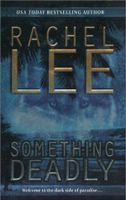
Something Deadly, by Rachel Lee

>> Thursday, December 28, 2006

Random pick from my TBR: Something Deadly, by Rachel Lee

An island of beauty becomes a gateway to terror...

Few could argue that the exclusive island of San Martin is anything less than paradise. In this wealthy enclave, veterinarian Markie Cross has a thriving practice, but her almost psychic connection to animals has made human relationships - especially with men - harder to navigate. Until mystery, murder and something unfathomable shatter her world . . .

People are dying strange, unexplained deaths. Island medical examiner Declan Quinn is stunned at the unearthly condition of the bodies, and he and Markie share a dark suspicion that something terrifying and impossible is at work here. Something that may not be human.

As a sinister message becomes clearer, Markie and Dec race to understand the tragic history of this island paradise and unlock the true nature of the evil now descending. Because if they can't, Markie may become the next victim...
Well, I should do the random pick thing more often, because Something Deadly was an excellent surprise. A very chilly ghost story, with a nice romance. A B.

The island of Santz Martina (not San Martin, as it says in the back cover) is a Caribbean paradise for the rich. It's prosperous and beautiful and perfect, isolated from the ugliness of the outside world. For both veterinarian Markie Cross and physician Declan Quinn, it's the perfect refuge from a real world that left them on the verge of a breakdown.

Until, that is, people start dying mysteriously. At first sight, the deaths look like heart attacks, but when Declan performs an autopsy (as the only doctor, the post of medical examiner falls to him by default), he finds the bodies completely liquefied inside.

His first thought is some kind of sickness, so he calls the CDC and the whole island gets quarantined. But it soon becomes clear that something very different is going on. Someone has stirred up evil for their own ends, bringing back the spirit of an evil woman who lived in the island some centuries earlier, and this spirit is out on a rampage. Only Declan and Markie seem to understand what might be happening and so it will fall to them (and to Markie's husky, Kato), to stop it.

With so many paranormals around, I feel like I've become desensitized to any kind of supernatural monsters, so it was nice to see that a good ghost story can still make my hair stand on end. SD was deliciously creepy and eerie, with a wonderful atmosphere. The contrast between the paradisiacal island, so perfect that there's a definite Disney World feel to it, and the evil running through it, makes things even more chilling. I also enjoyed the combination of this modernity with the ancient legend and the more recent events in the late '60s, which also play a part in the story.

Oh, and the dogs! You get some scenes from the point of view of both Kato and the dog belonging to the first man who dies, and though it may sound as a cutesy premise, I was surprised to see how well this and the other scenes featuring the dogs obviously noticing something strange increased the creepiness quotient.

I do admit that I thought the actual ghost and her motivations (such as they were) weren't really very convincing, but the atmosphere was used so effectively that it ended up not mattering all that much to me, and I couldn't wait to see what would happen.

This being a romance novel, this scary ghost story is combined with romance, and it felt pretty well integrated. Declan and Markie only knew each other by sight, and they meet for the first time outside the house where the first victim has just died, when Kato drags Markie there by force. From that very first moment, there is a sense of connection there, and there develops a warm and fuzzy and comforting relationship between them. It wasn't particularly exciting or sexy, but I did believe in the solidness of the love I saw developing there, and I did believe that something like this might have developed in such scary, stressful times for them.

The main characters were pretty much like their relationship: not particularly exciting, but very nice, especially good-guy Declan (my fondness for him might have been partly because of his name being Declan. For some reason, I have a weakness for it. I think it might be traced to my love of the character with that name in the TV show Mysterious Ways ). I think what I found more interesting about both of them was the sense of their being refugees from the outside world. In some ways, they both reminded me of a type of character I tend to enjoy: the warrior (be it a knight, a gunslinger, a secret agent or a soldier) who's tired of fighting and is looking for a home where he can tend his garden (or something) in peace.

Given this, I liked that there wasn't any censure of their choice to live in a place where they can enjoy the nice parts of their jobs while avoiding the bad parts. Markie, for instance, loves that since she gets a flat salary from the island government, she can properly treat every animal that comes to her, and not have to let die those whose owners can't afford to pay her. And Declan can concentrate on healing, without having to see all the senseless death he saw in the emergency of a big city hospital. I feared there might be some kind of indictment of their attitude, some kind of ending in which they decided they couldn't keep "hiding from the real world in this Disney Land", or something like that, but there wasn't, and good for Lee for writing it like that.

As sweet and nice as the main romance was, Lee really spiced things up with the secondary characters. We had quite an interesting storyline there, featuring an unfaithful wife coming back to the husband who loves her. I didn't much care for the way in which it ended up developing (I had hoped for the wife getting to appreciate her husband as he was, but we end up with something very different), but I thought the subject matter and the contrast between this couple and Markie and Declan added to the story.

This secondary storyline was tied in with the issue of the "villains", and I liked how Lee managed to keep me doubting and guessing all the book. There wasn't much intrigue about what had actually happened, because we get some scenes from the POV of these people and we know what they did long before Markie and Declan figure it out. Where Lee had me doubting was in whether they were bad or just stupid; what their actions were going to be when push came to shove, and whether they were going to leave things be or try to help solve them, and I loved not knowing until the very end.

I'm very glad I tried Lee again, after having read only one book by her and not having enjoyed it. I'll be checking out her recent backlist.

Note: Do not read the excerpt on the first page of the book. Whoever chose it is an idiot, because it comes from very late in the action and contains pretty big spoilers.

Read more...

Every Secret Thing, by Emma Cole

>> Wednesday, December 27, 2006

Ever since I read The Shadowy Horses, back in April 2003, I've regularly googled Susanna Kearsley's name, trying to find out whatever I could about upcoming books (as do many other people, apparently. I always get a few people a week in my blog who found me after searching for this author's name). It was frustrating, because for a long time there was nothing at all that I could find, other than listings of her older books at several booksellers' sites. So I was incredibly thrilled when a routine search a few months ago turned up her new website, and even more thrilled when that website mentioned a new book, Every Secret Thing, soon to be published under a new pseudonym, Emma Cole.

And my thrilledness (yes, yes, I know that's not a word) increased exponentially when Karen the Kearsley fan, with whom I'd got in contact at around the same time, came back from a Kearsley book signing asking for my addy and saying she had something for me. Yep, she was sending me an autographed copy of the book, and I literally did a victory dance when it arrived. So thank you ever so much for that Karen and Susanna!

When an old man strikes up a conversation with her on the steps of St Paul’s and makes a mystifying mention of murder and an oddly familiar comment about her grandmother, Kate Murray is intrigued. But she never gets to hear the rest of Andrew Deacon’s tale. Shocked by his unexpected death, she wonders who this strange old man was, and what the odd reference to her grandmother could mean. Interest piqued by the story never told, Kate becomes drawn into an investigation, uncovering secrets about the grandmother she thought she knew, and a man she never did. Soon she is caught up in a dangerous whirlwind of events that takes her back into her grandmother’s mysterious war-time past and across the Atlantic as she tries to retrace Deacon’s footsteps.

Finding out the truth is not so simple, however, as only a few people are still alive who know the story and Kate soon realizes that her questions are putting their lives in danger. Stalked by an unknown and sinister enemy, and facing death every step of the way, Kate must use her tough journalist instinct to find the answers from the past in order to have a future.
Reading what I wrote above, you probably have some idea of how much I wanted to love and adore this book. And you can probably imagine, too, how hard it is for me to say that though I did like it well enough, I wasn't blown away by it. I'd rate it a B.

Journalist Kate Murray is in London covering a story when she's approached by an old man who sits next to her on a park bench. Kate doesn't pay much attention to what she first thinks of as his rambling about old murders and justice, but her attention is firmly engaged when the man mentions her grandmother. And even more when the man is the victim of a hit and run the moment she walks away from her, right after his cryptic comment about her grandma.

Shocked and intrigued, Kate tries to find out more about this old man, Andrew Deacon, but what he finds is even more baffling. There was something he meant for her to investigate, some old murder he wanted justice for. But just what is it? From what Kate can find out, it's something to do with his spying work in Lisbon during World War II... old business, right?

But when tragedy strikes, and very close to Kate, too, it becomes clear that that for someone, that old business is still relevant today. Someone very much cares about keeping this secret still a secret, and this person is willing to kill to keep it so. As if discovering the secrets of the past weren't complicated enough, Kate will have to do so while staying one step ahead of this unknown, mysterious enemy.

There were many things I loved here. The Lisbon sections, for instance, were absolutely fantastic, both the current day ones and the flashbacks. Maybe the reason I felt that way was because this was was where I most saw the Susanna Kearsley touches I love so much. I saw them in the vividness and beauty of the setting, in the way Kate's investigations took place against such a clear backdrop, and one that wasn't simply incidental, but played a role in events.

I also saw them in the process through which the events of the past started taking form, the way Kate's interviews with people who'd known Deacon during the war started painting a picture of how things had been back then. And this picture was just fascinating. This is something I've never thought much about: what was going on in the countries that had declared themselves neutral during WWII? Apparently, there were some very dangerous games being played there. Spying and counterspying and manouvering, and all kinds of things that showed that the country itself might have been neutral, but the people there were anything but.

It wasn't just the WWII events in Portugal that were so good, I also really liked the connection between Kate's grandmother and Deacon in New York, even though I'm not the greatest fan of doomed love stories. At least the doomedness was perfectly clear from the start, so it all remained bittersweet to me, rather than disappointing.

Unfortunately, as much as I liked all this, there several things that dampened my enjoyment a bit. First and foremost, there's the fact that Kate never came alive for me. I never got a clear picture of who she was, and the more time we spent with her, the shadowier she became. Which, obviously, made it hard for me to care about her. It's strange, because the characters in the flashbacks did become vivid and real and completely three-dimensional, even the secondary characters. But Kate, who should have been much more accessible and immediate to me, was flat, and I didn't much care what happened to her. I did want her to succeed in her investigation, yes, but not at all for her sake. I wanted the secret out solely because that wonderful man Deacon deserved it.

And if Kate was blah, that goes a hundredfold for her love interest. Unless this is your first visit to my blog, you'll probably know that I look for romance even in the books I read outside of the genre. When I dip my toes into fantasy, it's usually something with a strong romantic thread, and the same goes when I read mystery, or science fiction, or thrillers, or whatever else. And yet, in this book, I found myself wishing Kate's romance thread would have been cut altogether. It was just so lukewarm and unexciting!

Another thing I thought disappointing was the ending. First of all, I imagine many people will find it anticlimactic. That's not a huge problem for me (I mean, the ending of The Shadowy Horses was pretty anticlimactic, too, and I rated that book an A+ anyway), but the fact that I didn't feel like I'd got much emotional payoff was.

See, emotional payoff for me would have been having Kate's investigations slowly, slowly bring out the truth. But they don't. All they do, really, is paint a good picture of what was going on at the time in Lisbon, and give us a clue about the players. Sure, I liked this very much, as I mentioned above, but as fascinating as this was, it doesn't compensate for the fact that the big revelations come in a somewhat deus ex machina fashion.

Do keep in mind, though, that as much as I'm criticizing several aspects of this book, I did enjoy it, and I would recommend it. It's just that I didn't love it and adore it quite as much as I was hoping for that is making me sound a bit down.

Read more...

No Rest For The Wicked, by Kresley Cole

>> Friday, December 22, 2006

No Rest For The Wicked is the sequel to Kresley Cole's A Hunger Like No Other. I actually read the first one only because I wanted to get to NRFTW and it seemed from the very complicated mythology (which included a very complex glossary) that it might be a very good idea to start at the beginning of this series. It's fortunate I did, because AHLNO was very good, and gave me great hopes for this one, too.

A soldier weary of life...

Centuries ago, Sebastian Wroth was turned into a vampire -- a nightmare in his mind -- against his will. Burdened with hatred and alone for ages, he sees little reason to live. Until an exquisite, fey creature comes to kill him, inadvertently saving him instead.

A Valkyrie assassin dispatched to destroy him...

When Kaderin the Cold Hearted lost her two beloved sisters to a vampire attack long ago, a benevolent force deadened her sorrow -- accidentally extinguishing all of her emotions. Yet whenever she encounters Sebastian, her feelings -- particularly lust -- emerge multiplied. For the first time, she's unable to complete a kill.

Become competitors in a legendary hunt.

The prize of the month-long contest is powerful enough to change history, and Kaderin will do anything to win it for her sisters. Wanting only to win her, forever, Sebastian competes as well, taking every opportunity -- as they travel to ancient tombs and through catacombs, seeking relics around the world -- to use her new feelings to seduce her. But when forced to choose between the vampire she's falling for and reuniting her family, how can Kaderin live without either?
Very entertaining, but with the very same problems the first one had. A B.

Valkyries aren't generally fond of vampires, but Kaderin the Cold Hearted hates them more than any of them. A vampire murdered both her sisters (they were triplets), and so she's spent centuries making it her life's work to kill as many vampires as she can.

All the killing doesn't bother her... actually, nothing does. The pain after her sisters' death was so bad that she wished those feelings would go away, and what do you know? Some deity with a sense of humour answered her unconscious prayer and took all feelings from her. Kaderin doesn't grieve for her sisters any more, but neither does she feel joy, or amusement, or sadness, or even sexual desire.

Things start to change when she answers the request of some Estonian villagers who report a scary vampire is living in the castle nearby. But the vampire in question is not what she expected. For one thing, he doesn't have an objection to her killing him. And for another, she just can't do it.

Sebastian Wroth never wanted to become a vampire, but his brother Nicholas turned him by force. Nicholas meant well (he'd only recently been turned himself, and returned from war only to find all his family dying, which he just couldn't allow), but Sebastian can't forgive him, and he's spent the centuries since alone in his castle, hating himself and what he's become, keeping himself alive by drinking animal blood.

When a Valkyrie comes to kill him, Sebastian sees it as a release and doesn't bother to fight her. But then comes the surprising thing: his heart starts beating again. See, as I mentioned in my review of the first book, many species in this universe of Cole's have some kind of fated mate, just as Lachlain and Emmie were in AHLNO, and for vampires they have their Brides. Until they find her, they're living dead, but the minute they see this woman that's fated for them, they're blooded, which means their hearts start beating and they start breathing again.

So when Sebastian gets close to Kaderin and feels his heart go thump-thump again, that's it for him. He must have her as his wife, because finding her has at last given him something to live for, and he'll stop at nothing to do so. He'll follow her around, even as she participates in a mystical scavenger's hunt called the Talisman's Hie.

And even as she would prefer for him to stop making her lose her concentration, too. Because winning the Hie this time is of the utmost importance to Kaderin, much more than it was all those times in the past when she did win. The price is such that it might help her do something about her sisters' death, and so ruthless Kaderin will be even more ruthless this time, both with the other contestants and with that vampire who's having such a disturbing effect on her, even making her experience some feelings again.

Phew! I meant to write a short summary of the plot, but Cole's stories are such that it's almost impossible to give a good idea of the plot in a few sentences. There's just so much going on! Fortunately, the author doesn't lose control of it. The huge, complex universe, filled with tens of different creatures and species, which had felt a bit pointlessly complicated in AHLNO, is much more relevant here, as the Hie plot gives them all a good reason to play a part in the story.

Speaking of the Hie, that was enormously entertaining, and the reason I was originally intrigued by the book. I loved that it took us to unusual locales, like Antarctica or Tierra del Fuego, in Southern Argentina, and in the very short time spent there, Cole managed to give a good feel for those places. I also liked that this plot allowed Kaderin to show that she really was as ruthless and tough as she'd been billed to be. Sebastian did help her a bit more than I would have liked, but I never doubted that if he hadn't got involved, Kaderin would have had no problem quashing the competition.

But what I loved best of all was the romance. Just as in AHLNO, this was a "mates" story that I enjoyed. This is usually one of my least favourite plot devices, but I don't deny it can work when it's done well, and I think Cole does know perfectly well how to handle it.

The key here is that she doesn't substitute the falling in love process with the simple biological compulsion to be with the other person. Sebastian locks onto Kaderin from the first moment he sees her, yes, and is relentless in his pursuit and need of her, but Cole doesn't try to convince us that this is love. Nope, for a long while, Sebastian admits that he isn't in love with Kaderin. He desires her and feels the need to be with her, and he does like her, but the love comes afterwards, and it comes because Kaderin is Kaderin, not because Kaderin is his mate. This is how a fated-mates story should be done, IMO!

Something else I liked was the characters, especially Kaderin. In too many romance novels, secondary female characters which are supposed to be strong and tough have a way of turning into ninnies, when their turn comes to be heroines. Some kind of fear on the author's part that the readers will be turned off by a heroine who's tougher than the hero, I suppose. Well, Kaderin is not one of those characters. She's not suddenly revealed not to have killed all those vampires, and she doesn't suddenly turn into a eek-eek girly-girl. She was an interesting character, and I very much enjoyed the struggle inside her between her growing love for Sebastian and her determination not to let him distract her in this very important mission of hers.

Sebastian was maybe a bit too perfect, and at first he seems to be yet another woe-is-me vampire, but the self-pity isn't too overdone, and ends pretty quickly. I usually enjoy a determined hero who will do anything to get his woman, but it's always best when he isn't arrogantly sure of himself. Sebastian isn't completely sure that he'll succeed (in fact, sometimes he feels he'll never manage to convince Kaderin), and his lack of experience with women means that he's actually pretty insecure about himself and his attractiveness, but he works through it and I thought this all made the book even sexier.

On the negative side, while as I mentioned above, the huge Lore universe is better integrated, the Valkyrie are just as annoying as they were in AHLNO. No, they were even more annoying, especially at the beginning. They are shrill and juvenile and generally irritating, and their scenes are filled to the brim with annoying slang and pop-culture references. I kept wishing they'd just SHUT UP for a minute. I guess their antics are supposed to be comic relief, because parts of the romance can get pretty dark, but it was a type of comic relief that just wasn't particularly comic to me.

I also disliked the time-travel elements in the ending. I hate time travelling, it makes my head hurt, and what Cole did here, in which the mechanics of it and the consequences that changing the past had on the future, had no rhyme or reason, made my head hurt especially bad.

Cole has been one of the better authors I've tried for the first time this year. I'll have to remember to put her on the list when I start with my retrospective posts!

Read more...

The Midas Trap, by Sharron McClellan

>> Monday, December 18, 2006

Well, believe it or not, The Midas Trap, by Sharron McClellan is my first Bombshell book.

Archaeologist Veronica Bright has a thirst to prove herself to the world. Her business, Discovery, Inc., a company devoted to the recovery of ancient artifacts, has done very well, but it's still not enough. In the end only one thing can bring back her reputation as a legitimate scientist—she must uncover evidence that supports her theory of ancient mythology being based on truth.

Dr. Simon Owens walked in the doors of Discovery, Inc. with a solid gold mouse in his pocket, and an offer to pay her generously for her expertise in helping him locate the legendary Midas Stone—a mythological gem with the abilities to turn anything into gold. Veronica was intrigued, but not convinced.

But once the artifact tests as authentic, how can she resist the possibility to uncover a piece of history that can restore not only her reputation and that of her colleagues, but make her rich beyond her wildest dreams?

Time is running out and the risk may be too high. Simon doesn't want her along, his past is too clean and she doesn't trust him. On an adventure like this, things can go from dangerous to lethal in an instant. Will he guard her back or run when faced with adversity and the possibility of breaking a few minor laws? And will the powers of the stone turn divine or deadly?
An excellent ending wasn't able to make up for a pretty mediocre start and middle. A C+.

Archeologist Veronica Bright's reputation still hasn't recovered from the damage done by her insistence on presenting a paper, despite everyone's advice not to, which proposed that some ancient myths were based on fact. As much as Veronica was convinced she was right, the evidence just wasn't there, and she was laughed out of the conference room. And to add to her hurt, one of the other archeologist doing the laughing was Dr. Simon Owens, with whom she'd had a very promising flirtation going.

A few years later, however, Veronica is vindicated when Simon comes to her for help. He has discovered evidence that the Midas Stone really did exist, and he needs her help, because certain things she discovered during her research of that much-ridiculed paper will be needed to find it. Their quest will take them all over the Mediterranean, trying to find clues to the Stone's current location and where to find it. But it's not just them after it. Rumours of the evidence Simon has discovered have got out, and so some very unsavoury characters are racing them to the finish line.

Suspension of disbelief is a funny thing. I had zero problem accepting the existence of the Midas Stone, but I never could buy for a minute that Veronica and Simon would be able to do what they did. Burglaring the Vatican, for heaven's sake, and all the rest! And all on the fly, practically without time to make careful plans or any money to buy help, too (of course, they didn't need it, because Veronica always had people oh-so-coincidentally perfectly placed and perfectly willing to risk their careers and lives to help her). Even with Simon's mysterious past (which was pretty "well, duh", actually), it didn't jibe for me.

Oh, and that assistant who's magic on computers and can create the most powerful decoder in the world? Now, that required some phenomenal suspension of disbelief! Are you kidding me? Why would a person with such skills have been looking for a job as a secretary? And I'm sorry, but some of the things she managed to do would take superhuman luck to achieve in a couple of days.

In addition to all this, all the adventures, the burglaring this, burglaring that, escaping from the bad guys, and so on, all that felt pretty blah. That they were looking for a mythological object could have added something, but these scenes were such that they could have been looking for pretty much anything. Plus, maybe it was because I didn't particularly care for the characters, but I couldn't manage to feel the slightest interest. I seriously considered at one point not finishing the book, because if I asked myself "Do you really care if these two people find the stone?", the answer would have had to be "No".

Fortunately, I did continue, because the ending was very nicely done. Yes, the characters were still flat, but the way they deduced what they needed to do, and the way things played out in the end, were very ingeniously done, and I'm glad I got to that final scene.

I mentioned that I didn't care at all about the characters, and neither did I care about their relationship. I've heard so much about how the Bombshell line is NOT romance, that I started the book without the expectation of reading one. I mean, I remembered liking the review at AAR, and I know I probably wouldn't have been tempted to buy a book that was all adventure and no romance, but what I mean is that I didn't start the book expecting to get a romance novel.

It was still a bit of a disappointment, because the relationship between Veronica and Simon had the potential to be pretty interesting... come on, the archaeologist with the ruined reputation and the man who'd ruined it? Sounds like something an author could do a lot with. But that just fizzled, which on reflection, might a been a good thing, considering that it would have been hard to accept any resentment of Simon on Veronica's part, because she had no one to blame but herself for the ruin of her professional name.

There was also a lame attempt at some kind of triangle, with that guy Michael, who was Veronica's former lover, but that angle didn't feel too developed. Kind of left me scratching my head, actually.

Finally, there was something that bothered me, but had nothing to do with the author's story. Harlequin has the most idiotic people choosing the short excerpts that are printed on the first page of the book. The one chosen for this book comes from much too late in the book, and is a huge spoiler. It's part of the final confrontation, and reveals the answer about whether there is a Midas Stone or not. As I'm writing this, I'm reading another book from Harlequin, a Mira title, and the exact same thing happens, damn them!

Read more...

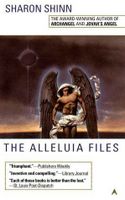
The Alleluia Files, by Sharon Shinn

>> Friday, December 15, 2006

The Alleluia Files is the third in Sharon Shinn Samaria series, coming right after her wonderful Archangel and Jovah's Angel.

Note: Just as I did in my review of Jovah's Angel, I must warn you away from the rest of this post if you haven't read the first two books. The very plot of The Alleluia Files is a spoiler for both of them and, unavoidably, so is this review.


Legend has it that the Alleluia Files contain the truth about the god of Samaria. Now, a child raised in captivity among the angels will journey the length and breadth of her world to seek the documents that will alter the face of Samaria forever...


.
An excellent close to this trilogy. I liked it a tiny little bit less than I did Jovah's Angel, which I liked a tiny little bit less than I did Archangel, but that's still an A-.

As I'm sure you remember, in JA we saw the Archangel Alleluia almost accidentally find out that the god everyone in Samaria worships is actually a spaceship orbiting around the planet, and that the angels are simply humans genetically engineered to fly, with the original intention that they might be able to deliver aural cues from closer by to the spaceship, so that its computer will know when it needs to act to spray chemicals on the clouds to modify the climate, rain down medicine or food, etc.

Alleluia decided not to share this knowledge with the rest of the community, believing they weren't ready to hear the truth. However, as TAF begins, we see that some glimmers of it somehow did leak out.

It's now some 100 years after the events narrated in JA. Some 20 years earlier a cult emerged, the Jacobites, who claimed that the god wasn't a god, but a machine, and that the Archangel Alleluia had found proof of this. They also insisted that Alleluia had somehow left this proof for people to find later, when they could handle the knowledge. The Jacobites insisted that the time was right then, and made it their lives' work to find this proof, which would allow them to convince the rest of Samarian society.

But the Archangel Bael refused to tolerate their -to him- blasphemous message, and started a bloody campaign against them with the help of some other angels and the always-warring Jansai tribe. 20 years later, as the main story starts, there are only a few Jacobites left, and Bael's continuing prosecution forces them to spend all their energies trying to survive, rather than concentrate their efforts on finding the Alleluia files.

One of these remaining Jacobites is Tamar, a young woman whose mother died in the early years of the campaign against the Jacobites. Tamar has spent all her life fighting for the cause and for survival, and is still fighting. When the Jacobites are decimated by yet another attack and an angel appears and offers her his help, both in getting out of her current jam and in finding those elusive files, Tamar is understandably not enthusiastic about the offer.

The angel in question is Jared, the leader of one of the three angel holds, and he's only now discovering just what Bael has been doing against the Jacobites. The Archangel has been doing such a good job of suppressing the Jacobites that until a concerned friend enlightened Jared, he, as most of the angels, had previously had only a vague idea of what the Jacobites stood for. And he'd certainly not realized that Bael and his Jansai were actually killing these people, he'd thought they were "merely" being prevented from spreading their seditious message.

But Jared is basically a decent, honest and fair guy, so when he hears this, he immediately goes looking for the truth. He doesn't believe in what the Jacobites are saying, but he's willing to help them look for these mysterious files they're after, including searching in places off-limits to them, like the archives in the different angel holds. Too bad that strangely fascinating woman Tamar, whom he meets at the site of the latest Jacobite-massacre, doesn't believe him and refuses his help. But Jared, though easy-going, is stubborn, so she will be getting his help, want it or not.

Let's get this out of the way: if you had a problem with Rachel, from Archangel, you'll likely have one with Tamar as well. These two women are remarkably similar in the way the trials in their lives left them bitter and untrusting and generally ill-disposed towards angels. Me, I loved Rachel, so I had no problem at all with Tamar. I completely understood why she was as she was and why she would refuse to trust that Jared was as good as he seemed, and her gradual warming to him (and to people in general, actually) was wonderful to watch.

As much as Tamar was very similar to Rachel, the whole dynamic of the main romance here was completely different to that of Archangel, mainly because the heroes were so dissimilar. While Gabriel was arrogant and cocksure and a natural, ambitious leader, Jared is much more of a beta figure. He doesn't lack courage (neither physical nor intellectual), but he's just not that interested in being boss. He's perfectly happy, for instance, to leave the day-to-day business of leading his hold to other people, and doesn't really care all that much about anything.

The developing relationship between this woman so committed to her cause and this man who can't even conceive of caring so deeply about anything is excellently done. Both grow through their interactions, Tamar starting to become more interested in people, rather than in a bloodless cause, and Jared finally finding something he cares enough for to put his life on the line.

I jumped right into the romance here, but as the rest of the Samaria novels, there's a huge lot of plot going on, and not piddling stuff, but world-changing, monumental events, because Tamar and Jared's mission can have some big, big consequences. Most authors seem to shy away from such a broad subject matter, but not Shinn, and I love the way she does it.

I enjoyed how the action developed, even though I guess I've become attuned to Shinn's writing, because I immediately saw the significance of certain things, like why we were getting the angel Lucinda's story, too (how she'd fit in in Tamar's story), or the significance of Lucinda trying to distract herself by learning the most difficult prayer she could think of, but in reverse. Still, even already imagining how things would turn out, seeing all the pieces fall into place was immensely satisfying.

Something else I enjoyed was that we get to see how Samaria has evolved in the 100 years since we last saw it, and it's an interesting picture. The society has industrialized, with its attendant problems and consequences, one of them being that many fear they might be going again in the direction that destroyed their original planet (the accepted history in the Librera -the Samarian "Bible"- is that the original planet was rendered unliveable by technology, and the people had to be "carried in the hands of the god" to a new planet, Samaria). The instinctive human push for knowledge and the futility of those who seek to suppress it is a theme in the book, and one I thought was very intriguing.

And, as in the other books in the series, so is faith. I thought it was interesting that, unlike what it may seem at first sight, it's Tamar who's this book's character most driven by faith... Tamar, the woman whose reason in life is to prove that other Samarians have placed their faith in a false god. Her belief in the Alleluia files is just as much a matter of faith than that of the other people's in Jovah, and it contrasts with Jared's almost perfunctory beliefs.

As much as I loved TAF, I thought there was something which wasn't that good, and that was the lack of subtlety in the villains. It's no spoiler that the baddies here are the Archangel Bael and his son, Omar. Part of my problem with them is the fact the situation is more or less the same as in Archangel... an archangel who doesn't want to relinquish power. But it's not all: even if I'd read this one before Archangel, I would have prefered the latter. Raphael's characterization and motivation were much more interesting than that of these two, who were just plain power-hungry.

I mentioned above that this book closed the Samaria trilogy, but there are actually two more books in it. It's just that from what I've read about them, rather than continuing with the overarching storyline about Jovah and its nature, they seem to be more about telling stories in this world, rather than about this world. Not that I won't read Angelica and Angel Seeker, of course, especially after the review of the former at DearAuthor.com!

Read more...

Day 5 - Advent Blog Tour

>> Thursday, December 14, 2006

Welcome! This is Day 5 in Marg and Kailana's Advent Blog Tour. I'm going to share a little bit about how we celebrate Christmas in Montevideo, Uruguay.

Christmas here is probably slightly different to what most of you are used to. For starters, I know most of the readers of my blog come from the US and Canada, and so odds are you're not celebrating Christmas in 30+ ºC heat (in the nineties, in Fahrenheit)!


Christmas celebrations for Uruguayan families typically start on the evening of the 24th, when as many members as possible of the extended family get together for dinner. This is, obviously, often subject of heated negotiations... "Last year we spent Christmas with your side of the family and New Year's Eve with mine, so this year we go to my side's on Christmas", and so on. In my case, we always get together at my uncle's (mom's brother), but it's yet to be seen if my sister's coming this year, since it's her first Christmas as a married woman.
I should point out that this is a very small country (no point of it is separated by more than 500 km -about 300+ miles) and half the population lives in Montevideo, so it's quite easy to get the whole family together (except, of course, for the family members who've emigrated abroad. And many have, especially after the big crisis we had some 4 years ago).

Presents don't arrive on Christmas morning, but on the afternoon or evening of the 24th. If there are small children in the family, there's always some big production to make them believe Santa (or Papá Noel, as we call him) really did come. Like, one year mom took us to visit a couple of distant relatives before we went to our uncle's, and when we got home, all the furniture in the living room had been overturned and the presents were strewn about among it. Dad told us Santa had been running late, so he'd banged into the furniture in his hurry to leave all the gifts.

These days, my youngest cousin is 17, so we simply deposit all the presents under the Christmas tree when we arrive at my uncle's, and simply exchange them after dinner, opening them all in turn, among much oohing and aahing.

Dinner itself varies a lot among families, but it's most common to first eat a "picada", which is a bit like the Spanish "tapas": a variety of hors d'oeuvres and snacks. Then it's the main course, which is often either some kind of buffet or an "asado", a barbecue. The most common thing to eat is "lechón", suckling pig, and sometimes also lamb.

Dinner starts late, at around 10 PM (we always dine late, but it's often even later on Christmas, because many of the guests have to pay visits before arriving), so dinner is usually just ending at midnight, when Christmas Day starts. At that point, everyone gets a glass of champagne or cider (yep, even the kids, though if they're very young, they get just the bottom of their glasses) and we all go around the table clinking glasses with everyone else, exchanging kisses and exclaiming "Feliz Navidad!" over and over again.


Immediately after that, all hell breaks loose. The phones start ringing (friends, family, boyfriends and girlfriends who aren't there, calling to say Feliz Navidad... the mobile phone networks always collapse at midnight), and fireworks start to go off all over the city, covering the sky with sparks and lights. And when I say a lot, I mean a lot. Last year the show was still going on at half past midnight.
It looks pretty, but I'm not much of a fan of this custom. For starters, it can be a bit dangerous... there are always people admitted to the emergency room that night who had one go off in their hand, and they lose fingers or even sometimes an eye.

Also, just thinking about the amount of money that gets burnt in that half hour makes my miserly little soul shrivel a little bit. Those suckers are NOT cheap! Actually, I have a theory, which I'm going to have to develop for work, that one could use the length of time the fireworks continue and their intensity as a predictor of economic activity, or at least, of the private sector's expectations. During the crisis I mentioned earlier, in 2002, it was like 5 or 10 minutes, a very piddling show. But once the economy started to go well again, that went up exponentially. Last year was the longest and most intense I ever remember seeing.


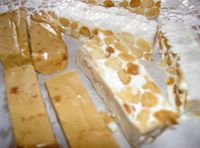
Ahem, sorry for the economic disgression. Then, after watching the fireworks, comes dessert, which can vary, but is usually ice cream. But whatever the dessert is, it's always accompanied by "turrón" and "pan dulce", which basically combines the two most common Uruguayan ancestries, Spanish and Italian.

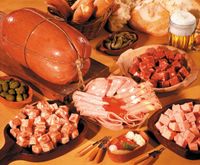
Turron is what you see to the left. I think it might be translated as nougat, in English. It's a kind of confectionery made of sugar or honey and roasted nuts. In the good ones, the nuts in question are almonds, walnuts, pistachios or hazelnuts, but many Uruguayans go for the cheaper, domestically-made versions, which use peanuts.

On the photo you can see two kinds. The one on the left is soft and oily, while the one on the right has caramelized sugar, so sometimes you can endanger your teeth biting into it! Turrón is typical both of Spanish and Italy, but the variety you see most often here is in the Spanish tradition.

On the photo on the right you can see a "pan dulce". That translates as "sweet bread", literally, but it's NOT a meat product (though we do eat sweetbreads here, and if dinner was a barbecue, we probably did eat some grilled sweetbreads -which we call "mollejas"- as part of the "picada").

Our "pan dulce" is basically the Italian pannetone, a kind of dome-shaped sweet bread, containing all kinds of candied fruits and roasted nuts.


After eating like pigs (we really should eat a bit lighter, not what our forefathers used to eat in the old country. It was winter there and they needed the calories!) the young separate from the old(er). The members of the older generation just stay chatting for a while longer (it's about 2 in the morning by then) and go to bed, while the teens and twenty-somethings go partying.

There are always some very big parties on Christmas, and it's one of the days of the year in which more people go out (the day most people go out is on August 24th, Nostalgia Night, when they play oldie hits everywhere, but that's another story). Most people go out in couples, and getting a date for the Christmas parties is a very big deal, and often decided weeks in advance.

This is actually another part of our Christmas that, like the fireworks, is quite dangerous. Most of the parties are what we call "canilla libre" (free tap or faucet), which is a way of saying that they're all-you-can-drink. Which, of course, means there are a lot of drunken people driving around at 6 or 7 in the morning, when the parties end. The police tries to stop this, with Breathalyzer tests and awareness campains beforehand, but there are always at least a couple of big accidents that night, and a few people who die. *sigh*

Ok, back to happier stuff. On Christmas day itself families usually get together again, and it's kind of a mix and match thing. If you went to a certain side of the family's place the evening before, you go to the other's that day. The food is usually leftovers from the night before, or else, something easy to cook, and the mood is more subdued (possibly because the kids are all hungover).

And well, that's about it. This turned out to be much longer than I'd planned (like that's a surprise! I know I'm longwinded), so thank you if you've read this far, and I hope you found it interesting.

Feliz Navidad to everyone!

Read more...

Sacred Sins, by Nora Roberts

>> Wednesday, December 13, 2006

Sacred Sins is one of two linked Nora Roberts romantic suspense books from the late 1980s. I've been rereading her older books in the past couple of years, and I read the other one, Brazen Virtue, some months ago. BV actually comes after SS, so I don't know why I reread it before!

SOME SINS ARE UNFORGIVABLE...

There's no escaping the sizzling heat of the Washington summer... or the twisted ministry of "The Priest" -a madman who is strangling slender, pretty blondes with the white silk scarf of a priest, leaving notes that forgive his victims.

But it's the flame of white-hot passion that is giving Tess Court and Ben Paris real trouble -two professionals who can't quite keep a professional distance from each other.

TESS COURT: the top-notch shrink assigned to the case by the mayor, is slender, pretty and blonde...

BEN PARIS: a magnetic police sergeant in charge of the investigation, is unable to resist her.

But someone else has his eyes on Tess... someone who dreams of saving her, of cleansing her soul with his special brand of absolution in the hot, still night.
As I write this review, I'm reading yet another police procedural / romantic suspense book by this author, and I think I can honestly say that very few authors can balance romance and a police investigation as well as Nora Roberts. The one I'm reading right now is the latest J.D. Robb, and it might be a bit better than this one, but SS shows that even 19 years ago, Nora knew what she was doing. A very enjoyable B+.

A serial killer is murdering slim, 20-something, blonde women in the streets of Washington D.C., strangling them with an amice, that scarf-like garment Catholic priests wear over their robes during Mass. The very original newspapers are therefore calling the guy "The Priest". What wit!

Cop Ben Paris and his partner, Ed Jackson (who's the hero of the next book), are investigating the case, but they're getting nowhere fast. And yet, when their captain is pressured by the mayor into consulting with a psychiatrist, Ben is very resistant to the idea.

But Dr. Tess Court is nothing like he expected: not cold and clinical and not a tall, thin, balding guy either (should I even mention that Ben had a very negative experience with a psychiatrist before this?). And neither did Ben expect to like and be attracted to her. But slim, 20-something, blonde Tess doesn't just hold Ben's attention, but the killer's as well.

I love romantic suspense like this one, where the romance and the suspense are equally strong. I'm not much of a suspense reader, and usually see the suspense subplot in a rom. susp. as something to be tolerated in order to get to read the romance, not as something to enjoy. This means that the fact that I'm saying I liked the suspense as much as the romance quite a big compliment.

I enjoyed the subtlety with which the murderer was portrayed and I was fascinated by the investigation, most especially with Tess insights into the killer's mind. The conclusions she was able to draw from the evidence were interesting, and felt right (obviously, I'm no psychiatrist. Maybe a pro will read this and say it sucked, but well, I'm saying it felt right).

Maybe the reason why the romance and the suspense felt so well-integrated was because much of the personal conflict between Tess and Ben stemmed from the same differences which drew them apart professionally. I thought Roberts did a very good job in describing the chasm between their different views, between Tess' insistence on understanding the murderer's mind, with a view on helping him, and Ben's determination to stop him and make sure he's punished, for the victims' sake. What I liked best here was how both these views were presented without the author making a judgment. Neither Ben nor Tess are proved wrong, both their views are valid, however different they are, and in the end, it doesn't mean they can't love each other anyway. This reminds me a bit of Eve and Roarke, and the way they mesh together just fine in spite of Eve's by-the-rules stance and Roarke's more relaxed approach.

Anyway, I liked pretty much everything about this book. Even Ben's resistance to adding Tess to the investigation didn't bother me much. There was a risk of him looking like an idiot for refusing to take advantage of Tess' potentially invaluable help, but his previous experiences made it understandable. And also, the fact that this book is almost 20 years old helped me accept this better. I mean, I thought understanding the killer's mind with the help of psychologists has been pretty standard procedure for years and years, but what do I know? Maybe 20 years ago it just wasn't so!

Read more...

Mistress for a Weekend, by Susan Napier

>> Monday, December 11, 2006

Susan Napier is the only Harlequin Presents author I follow, the only one on my... well, not really autobuy list. She's on my list of authors whose books I check for, and see if the storylines might appeal to me. Her latest, out after some 5 years without any new releases, is Mistress for a Weekend.

Nora Lang needs the most dangerous man she can find!

Enter tycoon Blake MacLeod. He normally prefers sophisticated blondes that don't require too much of his brainpower. But Nora's a challenge…the perfect opportunity for a little light relief. Until she acquires some important information that he can't risk being leaked.

Now Blake has to make sure Nora doesn't leave his sight--he'll make love to her for a whole weekend!


Quite nice! Interesting characters, an entertaining, if simple, plot and a sweet romance. A B-.

First of all, disregard the title. Or rather, disregard the first half of it. There's a weekend involved here, but fortunately, considering this is a contemporary, no mistresses.

Nora Lang and Blake MacLeod meet at a party in Auckland, when Nora is on the rebound after finding her long-term boyfriend in bed with her room-mate, an event which did quite a number on her self-esteem. Blake, a well-known business shark seems to her like a good candidate for a fling. As for Blake, unsophisticated Nora is nothing like the women he usually dates, but for some reason, he notices her the minute she arrives at the party and can't help but stare at her in fascination.

Their evening ends in Blake's hotel room, but Nora chickens out before much more than a few passionate kisses are exchanged. Unfortunately, on her way out she accidentally takes a computer disk that belongs to Blake, a disk with some very sensitive business information.

Blake's immediate assumption that Nora is some kind of corporate spy doesn't last long, but whether she's innocent or guilty of spying, her knowledge of the information the disk contains makes her a loose cannon. Blake can't afford to have her on the loose until the information becomes old news, the following Monday, and so what best way to ensure her discretion than to practically kidnap her and have her spend the weekend at his isolated beach house?

What I like about Napier is that her characters always have a little "extra" to them. That is, she writes them in such a way, gives their personalities such quirks and individuality that they feel three-dimensional.

Blake is much more than Mr. Arrogant Business-Mogul. He's got a sense of humour, for starters, a dry, wry one that had me smiling often. And then there's the way Napier gives this unrepentant capitalist a very interesting history, with an upbringing among a family of activists with very developed social consciences. The nonetheless fond relationship he has with his family, despite their differences, added even more dimensions to him.

Nora is a bit less distinct, but still someone I enjoyed reading about. Her history with her ex-boyfriend rang true, and so did her reactions when she discovered the cheating.

The romance was also good. There really isn't a lot of melodrama here, because the whole deal with Blake believing Nora is a spy disappears pretty immediately. After that, there isn't that much conflict between them, even if Nora isn't too happy about Blake's actions in keeping her a virtual prisoner in his beach house. The thing is, she knows he doesn't think she's guilty and knows that she'll only have to stay there for a couple of days, so she takes the situation with resignation. And this makes the romance more believable, I thought, because she really has no reason to hate Blake and resist her attraction to him.

So, basically, this book is mind candy. Not particularly nutritious of fulfilling, but it's nice to have some, every now and then.

Read more...

The Raven Prince, by Elizabeth Hoyt

>> Friday, December 08, 2006

It was the review at DearAuthor.com that sold me on The Raven Prince (excerpt), by Elizabeth Hoyt. Or rather, the review sold me on putting the book in my wish list, but it was one of the comments, which mentioned the two magic words, Liz and Carlyle, that made me want to read it immediately.

THERE COMES A TIME IN A LADY'S LIFE...

Widowed Anna Wren is having a wretched day. After an arrogant male on horseback nearly squashes her, she arrives home to learn that she is in dire financial straits. What is a gently bred lady to do?

WHEN SHE MUST DO THE UNTHINKABLE...

The Earl of Swartingham is in a quandary. Having frightened off two secretaries, Edward de Raaf needs someone who can withstand his bad temper and boorish behavior. Dammit! How hard can it be to find a decent secretary?

AND FIND EMPLOYMENT.

When Anna becomes the earl's secretary, both their problems are solved. Then she discovers he plans to visit the most notorious brothel in London for his "manly" needs. Well! Anna sees red-and decides to assuage her "womanly" desires . . . with the earl as her unknowing lover.
If I hadn't known that TRP was Hoyt's debut before I started reading, I never would have guessed it. Her style is smooth and assured, and the resulting book excellent. A B+.

Edward de Raaf, the Earl of Swartingham has a rotten temper, and this keeps costing him his secretaries. He needs a new one ASAP, so he orders his agent, Mr. Hopple, to find him one before he returns from London. That turns out to be a harder job than it seems, so poor Hopple is forced to go as far as to consider a woman for the job.

The woman in question is widow Anna Wren. Anna's late husband left her some pitifully small investments, and they aren't doing very well lately, so she's been forced to look for a paying job. She finds nothing suitable until, in desperation, she practically forces Hopple to hire her.

Anna proves to be an excellent secretary, and she and Edward develop a productive working relationship. But there's also a very strong -though unacknowledged on either side- attraction there, and when Anna accidentally finds out that Edward will be visiting a notorious brothel, one in which high-born ladies sometimes put on masks and play the whores, a plan begins to form.

Yep, our respectable widow goes as far as to engineer a secret meeting with Edward at Aphrodite's Grotto and, hiding her identity with a mask, proceeds to have wild, torrid sex with him. Ordinarily, I'd say "Oh, puh-leeze!", but Hoyt writes it in such a way that it's good, really good.

I think the main thing was that she made me buy the thought processes that led to Anna's very risky decision. Her unconscious, barely acknowledged reasoning is that Edward's arousal was provoked by her, and so it somehow belongs to her. She won't tolerate him giving it to someone else; it's her right to use it, as it were. I thought this rang very true, especially given her experiences with her late husband, who did take his sexual desire and give it to other women, not caring that he was leaving his wife sexually unfulfilled and frustrated.

Another reason why I liked this plot element was what was going on in Edward's mind at the time. Unfaithfulness is a touchy subject for me, and I see it as a broader concept than merely sleeping with someone else once the hero and heroine are involved. The situation here comes kind of close, because when Edward sleeps with his mysterious prostitute at the Grotton, though nothing has yet happened between him and Anna, he is very attracted to her, almost obsessed, I would say. And yet, I didn't mind it at all, because Hoyt was able to make me believe that Edward subconsciously knew that Anna and the prostitute were one and the same, and even that this was the very basis of fascination with the latter. In fact, he develops for this mysterious woman an obsession almost identical to that he still feels for Anna, and these feelings merge in his mind, as do his fantasies.

Both Edward's and Anna's characterizations were wonderfully done. As often is the case in romance, he was the more interesting character, but Anna was perfectly three-dimensional herself, with her imperfections and her sense of humour and her sometimes inappropriate (but very human) feelings.

As I said, though, Edward is even more interesting. If I've ever read a book with a hero with a more volatile, explosive temper, I've forgotten it. We're not talking about "coldly angry", or anything like that. No, the guy practically throws tantrums and has fits. He breaks things and screams. It doesn't sound very attractive, but three things make it better: a) that he contains himself quite a bit with Anna; b) that even if he didn't, Anna would be perfectly ready to tell him to calm down or else; and c) that even though he gets angry easily, this is not an angry man. I don't know if I'm explaining the last one well, it's a matter of attitude. Edward is able to laugh at life and at himself, even, after the fact, to laugh at how angry he was.

There's also a very appealing vulnerable side to Edward. His whole family died of the pox many years earlier, and he was the sole survivor. This reflects in many aspects of his personality, especially in his hunger for a family of his own (a problem, because Anna didn't have children in years of marriage, which they assume indicates barreness. I liked the way this was resolved, though, the way he ended up accepting it). The pox also left him riddled with scars, which, in turn, adds to the loneliness and vulnerability, because he's become used to women finding the scars disgusting, including his first wife.

When the truth about the whole deception comes out, Edward is (predictably) very angry, but soon he comes to see the good things about a woman being so excited by him that she'd do something like this, and it was lovely to see.

Ok, this is getting much too long, so I'll just list a few more things that struck me. I loved the setting. TRP takes place in 1760, and I enjoyed the different sensibilities to the more common Regencies (would a genteel woman be able to work for a man like Edward, though, often spending time with him unchaperoned, and not have her reputation suffer? Maybe someone more knowledgeable about the period can tell me. I just shrugged and thought "ok"). I loved the fashion, too, including Edward's friend with the red heels. Oh, and speaking of fashion, Hopple's waiscoats! Hopple was marvellous comic relief.

I loved almost everything about TRP, but there were a few negatives. First and foremost is the blackmail plot, which felt to me pretty unnecessary. It felt as if Hoyt thought that the book needed some kind of sense of impending menace, and so added this, but it never really got off the ground. Plus, it sparked Anna's only TSTL-ish action.

I also rolled my eyes a little bit at the inclusion of the prostitutes. I guess it was a way of getting Anna to gain entrée to Aphrodite's Grotto, but it was just so clichéd!

And finally, that fairy tale about the Raven Prince that is told at the start of each chapter: it was entertaining enough a tale, but what exactly was the point of it? I do see a couple of parallels with the plot here, with the hero who's literally a "beast" and the hero and heroine having sex with one of them not realizing who the other is, but I don't really think it added anything to the main story.

Small stuff compared to all that was great about the book, right? No wonder I want to read the next one, The Leopard Prince. Amazon UK has a very intriguing summary here.

Read more...

Column up

>> Thursday, December 07, 2006

My column is up at Romancing the Blog. Go read! :-D

Read more...

Kiss Me, Annabel, by Eloisa James

>> Wednesday, December 06, 2006

Annabel was one of my favourite characters in Eloisa James' Much Ado About You, so I started her book, Kiss Me, Annabel, almost as soon as I closed the first.


What cruel twist of fate put Miss Annabel Essex in a carriage on her way to Scotland (the place she abhors) with a penniless earl (and she longs to be rich), and all the world thinking they're man and wife? Sleeping in the same bed? Not to mention the game of words started by the earl – in which the prize is a kiss. And the forfeit…

Well. They are almost married, after all...


A delightful road romance, funny and sexy and yes, romantic. A B+.

Though both her sisters Tess and Imogen have married and are now very rich (Tess a filthy-rich wife, Imogen a filthy-rich widow), second sister Annabel is still determined to marry a rich husband herself, too. Having a head for figures and growing up with a father who spent all his money on his horses, meant that it fell to Annabel to manage the household's finances, such as they were. It was torture for her to assume the responsibility of trying to rescue some money from her father's obsession and deal with all those tradespeople they couldn't pay, and so Annabel early on made the decision to never put herself in that position again.

She won't marry for love, but for money. Oh, of course, she'll try for a husband she likes and respects, someone with whom she'll have a comfortable, satisfying life, but the money thing is the only characteristic that's not negotiable in a potential husband.

Which means that Ewan Polley, the Scottish Earl of Ardmore, very definitely does not qualify. It's rumoured that he's penniless and in London to get himself an heiress, so no matter how much he intrigues her, Annabel cannot pay any attention to him. And given that she has no dowry herself, other than a horse, she's actually doing him a favour in not accepting his impulsive marriage proposal and pointing him towards better-dowered ladies.

But Annabel didn't count on her sister Imogen wanting Ewan for a lover and that her machinations will go wrong (very, very funnily so. I couldn't stop laughing at the way Ewan manouvers Imogen with all that talk about the conney's kiss) and end up with Annabel being found in a terribly compromising position with Ewan. Which, as we all know, means that a marriage between them becomes necessary.

Annabel is resigned, but Ewan is perfectly happy with the way things turn out. Only, he would prefer for them to get married in his home, back in Scotland, and so he convinces Annabel's guardian to allow them to travel there together, a trip which will be much more adventurous than planned, both in a physical and emotional sense.

Annabel was a delight from the first, and remained so throught the entire book. I loved her clear-headedness and good-natured pragmatism and I couldn't help but understand her insistence on marrying for money. She's kind and reasonable, and perfectly willing to be flexible and adapt to circumstances, not blaming Ewan when she's forced to marry him.

I ended up loving Ewan, too, even though I had a few doubts at first. The first sections of KMA reminded me a bit of MAAY in that it initially seemed that though Ewan was intrigued by Annabel, he didn't really care all that much if she returned his attention. In fact, it seemed that he didn't really care whom he would marry, whether it was Annabel or someone else, even one of her sisters.

But that changes once they are on their trip, and we start getting to know him better, as Annabel does. Ewan is as nice and kind as Annabel, and while not a fanatic, he is a very religious man. Quite a novelty, this. Ewan is actually worried about his immortal soul, so he tries to behave according to the rules of his religion, which includes not making love to Annabel until they're married. This makes for some very fun scenes, as Ewan begins to realize just difficult it will be for him to deal with the consequences of his impulsive decision to not marry Annabel in London, but wait until they're in Scotland. If he keeps kissing Annabel, then remaining celibate becomes even harder, but he can't stop kissing her, the addled-brained fool.

I loved these sections, can you tell? The sexual tension keeps ratcheting up, and not being able to spend all their time having sex makes Ewan and Annabel have to actually talk to each other, which results in a very sweet and believable slow process of falling in love. Even the section that has Ewan trying to do a Taming of the Shrew thing and prove to Annabel that being poor isn't as bad as she fears is perfect, as Ewan ends up realizing that indeed, it is. I loved this for for exactly the same reasons James herself talks about in her author's note.

KMA had less of an ensemble cast than MAAY. Because the road trip had Annabel and Ewan away from her family for a long stretch, the focus here was solidly on the romance in this book, unlike the other books I've read by this author. Not that what James did in her other books, but it was nice to see that she can handle a more traditionally written romance very well indeed.

Of course, not all the book is devoted solely to our hero and heroine. Imogen has a very big role, especially at the beginning. Before I started the book, I'd heard much vituperation of her character, to the point that I had the impression that not only was it her fault that Annabel's reputation was compromised, but that she'd actively arranged this out of spite, which is not the case at all. Maybe it's because I like imperfect heroines, the more imperfect the better, and Imogen is plenty imperfect, but I closed this book very interested to see what James does with her story. Imogen is not goody-goody perfect and virtuous, but that makes her all the more interesting in my eyes. And having read all the history with Draven in MAAY, I think the path James took with her character in KMA made perfect sense.

So, up next: Imogen's book, The Taming of the Duke, and youngest-sister Josie's story, in Pleasure For Pleasure, out only last week.

Read more...

Blog template by simplyfabulousbloggertemplates.com

Back to TOP