Lord of Sin, by Madeline Hunter

>> Thursday, March 16, 2006

AngieW's March TBR challenge was easy: I just needed to read a historical. So here's my choice. Not the only historical I've read so far this month, but it was the first! It's just taken me a while to actually write this down and post.

Title: Lord of Sin (excerpt)

Author: Madeline Hunter

Year published: 2005

Why did you get this book?: Madeline Hunter is an autobuy author for me. I first became a fan with her debut, By Arrangement, and I've bought all her books ever since. So even though Lord of Sin didn't get very good reviews online, I automatically got it anyway.

Do you like the cover?: I wasn't crazy about it initially, but it grew on me. I mean, at first sight it's very attractive, but it bothered me that I didn't get a "historical" vibe from it (probably because it has a black and white photo on it and because the female model's clothes just didn't feel 19th century enough for me). And also, you don't immediately understand just what male body parts you're seeing *g*.

As I read it and got used to it, I began to like it, though.


Blurb:

When carefree rake Ewan McLean inherits an earldom, his plans for his new fortune are entirely in keeping with his lifestyle: to expand his collection of erotic art and expensive mistresses. That is, until he becomes acquainted with his most intriguing new responsibility.

Bride Cameron is beautiful, unmarried, and sole caretaker of her three younger sisters. Now it’s Ewan’s duty to see that she is provided for. But to his amazement, the last thing the fiery lass wants is Ewan’s help. The simplest thing would be to walk away. But Bride, with her sparkling gaze and fierce wit, is the most bewitching woman Ewan has ever met. And he intends to have her—and to learn how she has managed to survive on her own. Even if he has to employ all the arts of seduction for which he is notorious. . .
Did you enjoy the book?:

A bit like the cover, not very much at first, but I liked it more and more as the story developed. I guess it took me a while to warm up to the characters. Bride was a bit too prickly and rude for no apparent reason and Ewan came across as just another spoilt rake (and I'm sick of rakes) who felt justified in preaching to others about how they should live their lives. Add to that some secondary characters I just itched to slap (*cough*Mary*cough*), and I worried the book might, in fact, be as lackluster as it had been reported.

But then, once Bride and her sisters arrive in London, things improved. Bride's behaviour started making a lot more sense once I found out exactly what that big secret of hers was, and her pricklyness and paranoia ended up feeling pretty justified. And even Ewan's rakishness began taking a different colour. I'd rolled my eyes at the mentions of his "special parties", which were basically orgies, but then I actually liked his motivations for throwing these parties. It did act a bit of depth.

And I also quite liked the way Bride and Ewan's relationship develops, with Ewan becoming increasingly fascinated and wanting more and more from Bride. The ending, the way the suspense subplot and the romance interact and come to a head together, with Ewan having to make an agonizing decision, was excellent.

I'd grade Lord of Sin a B.

Was the author new to you and would you read something by this author again?: Not new at all, and I've already read the sequel as I write this. There was a very tantalizing excerpt from Lady of Sin at the back of the book, and I after I read it, I couldn't resist reading it immediately.

Are you keeping it or passing it on?: Keeper!

Read more...

Four Meme

>> Wednesday, March 15, 2006

I've been tagged by Renée (might have been tagged by someone else, too, but I haven't been bloghopping much lately... my sister's wedding's on Saturday and I've been swamped this week!)

Four jobs you have had in your life:

The last 4:

Tour guide for English-speaking cruises arriving to Montevideo
Business analyst at an internet company which folded when the internet bubble burst
Product manager at a bank
Economist at the Ministery of Industry

Four movies you would watch over and over:

Four movies I have actually watched over and over:

Monster's Ball
No Retreat, No Surrender
Notting Hill
Dawn of the Dead

Four places you have lived:

Can't do this one, as I've lived all my life in Montevideo. I can't even come up with 4 different addresses in Montevideo!

Four TV shows you love to watch:

Lost
Changing Rooms
Narda Lepes' cooking show
Medium

Four places you have been on vacation:

Outside Uruguay:

Buenos Aires
Brazilian Northeast (place a bit south of Porto Galinhas)
Iguazú Falls (Brazil - Argentina - Paraguay border)
Paris

Four websites you visit daily:

All About Romance
Mrs. Giggles
Haloscan
Bloglines

Four of your favorite foods:

Hummus and Tabbouleh on pita bread
Pasta sciutta with hot red sauce with chopped black olives (and some grated parmesan on top)
Molleja (sweetbread -only part of the cow that I eat) - grilled crispy with lemon juice and mandioca flour
Grilled salmon with a nice green salad.

Four places you would rather be right now:

Home in bed (we had a bachelorette's party for my sister last night)
Morocco
Punta del Este
Japan

Four friends you are tagging that you think will respond:

It seems to me everyone's already been tagged! (I'm late, as usual)

Read more...

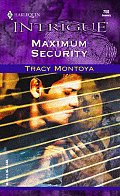
Maximum Security, by Tracy Montoya

book cover

Seems I was feeling a bit tired of straight romance, because Harlequin Intrigue's Maximum Security, by Tracy Montoya is the second straight romantic suspense I read.


She was the sole survivor of the deadly game of a serial killer—a man who'd ensnared women and eluded police for far too long. And since her daring escape from his clutches, ex-cop and bestselling crime author Maggie Reyes had remained locked in her beach house, paralyzed with fear until "the Surgeon" was caught.

Then FBI agent Billy Corrigan came to her, demanding her help in the hunt for a killer that wasn't just a job—it was personal….
It's books like this one that are hardest to blog about. With very good and very bad books, the reviews pretty much write themselves, because I just have piles of things to say about why they were so good or why they were so bad. But with this one, which was a C+, only slightly better than average, it's hard to come up with reasons for that averageness!

The suspense part of the Romantic Suspense here is a serial killer case. Eighteen months earlier, former cop and true-crime writer Maggie Reyes became the focus of the serial killer known as The Surgeon. He captured her and tortured her until she was able to escape him (we're never told exactly how). Knowing that he wouldn't give up, Maggie ran away to a friend's house in Monterey and hid there with a false identity the FBI helped her get. By the time the story starts, Maggie has become agoraphobic and fears she's losing her mind. When she realizes the Surgeon has discovered where she is and is coming to get her, Maggie fears the police won't believe her.

But even if they don't, Billy Corrigan does believe her. His sister Jenna was one of the Surgeon's first victims, and he wants revenge. Billy works for the FBI, but for the Computer Crimes division, so he's risking his career by butting in in this particular investigation. He doesn't care, however, and tracks down Maggie to ask for her help (though I never understood exactly why he thought it was worth the trouble to track her down).

Maggie doesn't welcome Billy's requests with open arms, but they soon become friends, especially when it becomes clearer and clearer that the Surgeon is there and stalking Maggie (and killing other women in town). And since Billy has a friend in the Monterey Police Department, he manages to involve himself in the investigation, in which Maggie is assisting, as well.

I thought the case had pretty interesting bones. There was some promise there, but I wasn't too crazy about the execution. The main thing that bothered me was that the investigation felt a bit off. I don't know if I can really pinpoint what it was that made me feel this way, and of course, I know nothing about the proper procedures, no more than what I've read and seen in movies or TV shows. All I know is that when I read about serial killer investigations in, say, the In Death books, it feels as if the investigators are taking all the precautions and exploring all the directions I can think of (and some I never even imagine).

Here, OTOH. it felt as if, for some reason, they were all going, as we say in Spanish, "a la guerra con un tenedor": off to war armed only with a fork. The resources devoted to this investigation were piddling, and it seemed to me the cops of the Monterey Police Department were the most inept ever. That, or the killer had superhuman powers. The guy slipped by hordes of police without even trying and knocked them out in droves without ever being seen!

The romance didn't work all that well for me, either. I've writen this about too many Harlequin Intrigue books lately: the characters were likeable enough, but their relationship just didn't capture my attention. And then there was the fact that I just didn't see any chemistry there. Don't know why, but the vibe I got from Maggie and Billy was almost mother-son, not romantic.

I guess Montoya does show some promise, and I'd probably pick up something else by her in the future, but Maximum Security just didn't hit the spot.

Read more...

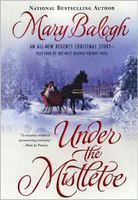
Under the Mistletoe, by Mary Balogh

>> Tuesday, March 14, 2006


Under the Mistletoe reprints four of Mary Balogh's old Christmas stories and adds a new one. I'm sure longtime Balogh fans who always made sure to buy the anthologies containing her short stories aren't happy to have to buy an entire book to get only one new story, but not having read any of them, it works for me! And at least the fact that four of the stories are old is stated right there on the front cover!


The new story is A Family Christmas, and it was one of my favourites. It tells the story of a couple who have been married for a year, have a four-month-old son, and have actually been in each other's company for no more than a few days.

Aristocratic Elizabeth married Cit Edwin Chambers because her family made it clear she must do so to improve the family's failing fortunes. As for Edwin, he married Elizabeth because his father wanted him to marry an aristocrat. Or, at least, that's why each thinks the other went into the marriage.

Two weeks after their Christmas wedding Edwin's father died, and after going to the funeral, Edwin went back to town alone, leaving the pregnant Elizabeth at their country estate. The only other time they saw each other was for a week after the birth, and all those meetings took place in the presence of Elizabeth's mother.

As the story starts, it's Christmas again, and Elizabeth's parents are still at her estate, and her mother, especially, has taken over her life. When Edwin decides to spend Christmas with his wife and son, Elizabeth will have to decide if she can be corageous enough to confront her mother and take her life back.

I was surprised at how much I liked this story. It's got two things that I didn't think were going to work for me: Elizabeth's passiveness in letting her mother completely dominate her and the fact that the only reason Elizabeth and Edwin are estranged is miscommunication and misunderstandings. Well, it all worked fine.

I completely understood Elizabeth's behaviour, as a product of her upbringing and a continuation of her trying to be what her mother always raised her to be. Given that, seeing her slowly begin to take control of things was wonderful. I especially liked that there weren't any loud, spectacular scenes, because that would have been out of character for her. She simply quietly asserted her will.

As for the situation between Elizabeth and Edwin, again, it was all perfectly understandable. Considering the circumstances surrounding their wedding and how very little they knew each other, it made sense that they would believe as they did of each other. And given that, it made sense that neither would dream of putting their real feelings out there. I loved seeing how they slowly began to see glimmers of the real persons behind the façades they saw, and I thought their romance was really sweet.

My grade for this story would be a B+.


The Star of Bethlehem is the oldest of the stories. It was originally published in the A Regency Christmas anthology in 1989.

We have another marriage-in-trouble story here, but it's one that's very different from the first story in the anthology. Estelle and Allan married for love, but that wasn't enough to make a happy marriage. Allan's jealousy and Estelle's flirtatious nature didn't mix very well, and after a few years, every exchange between them seems to end either in a fight, passionate lovemaking or (most usually) both.

As the story starts, Estelle and Allan are on the brink of becoming officially estranged, when Estelle's loss of their original engagement ring, and their rescue of a young chimney sweep (who isn't the perfect angel he seems to be) act as catalysts to Estelle and Allan becoming close again.

I quite liked this story. The plot is fun and the characters are interesting, and even when their relationship is at its worst, you never lose sight of the fact that they do love each other very much. However, I wasn't completely convinced that they'd managed to fix the issues that had come between them in the first place. I never got the feeling Allan's compulsive jealousy had completely gone away. Still, I was hopeful that they'd be ok, so I'm rating this story a B.


The third story is The Best Gift, from the A Regency Christmas VI anthology, first published in 1994.

When Viscount Buckley's sister and her husband decide at the last moment to spend Christmas in Italy, they stick him with their 15-year-old daughter, even thought they know he makes a point not to celebrate Christmas at all. Since he has no idea what to do with his niece, finding her some sort of companion seems like a good idea. So when he goes to pick her up from her school, he asks the headmistress if there are no other students or teachers who will be remaining there and would be willing to spend Christmas with them. There is: Jane Craggs, and she's very happy to go. An illegitimate daughter, supported by her aristocratic father until she was old enough to earn her own way, Jane has never been part of a Christmas celebration. But when they arrive at the house only to find Lord Buckley's illegitimate daughter waiting for him, after the death of her actress mother, Jane acquires a mission: to save her from a fate as lonely as Jane's.

This one wasn't my favourite. I never really warmed up to Jane, who seemed very nondescript to me. I get it that she was supposed to be that way at first, having had to hide inside herself all her life, but even when her personality was supposed to be emerging and making Lord Buckley fall in love with her, she remained just as grey and drab to me. What I did like, very much, was the thread about Veronica, Buckley's illegitimate daughter. I found the love growing between Buckley and Veronica much more convincing and affecting than the one between him and Jane. A B-.


Fourth comes Playing House. This one was originally published in the A Regency Christmas II anthology, back in 1990.

Stephen, Lord Bedford, has returned to his family estate after some 6 years' absence and an unhappy marriage which has given him a daughter he's not even sure is his. His first visitor is the person he most looked forward to seeing, his first love, Lilias Angove. But Lilias isn't there just to say hello. Her family was left with nothing after her father's death, and this is the last Christmas before she has to go to a governess post and separate from her young brother and sister. She wants their last Christmas together to be memorable, so she asks Stephen to repay an old debt and give them a goose and presents for the children, a request Stephen interprets as Lilias trying to make him feel sorry for her and ask her to marry him.

This was a good one. Lilias wasn't really particularly interesting (too much of a perfect, innocent, virtuous woman, incapable of asking for anything for her, but willing to risk humiliation so that her brother and sister can have a nice Christmas, yadda, yadda, yadda), but I just adored Stephen's internal dialogue, the way he started out cynical and resentful, only to slowly start wanting to believe in Lilias, and then doing so. The ending was beautiful, and so was the atmosphere of classic white Christmas. A B+.


No Room at the Inn comes last, and it was not a particularly successful close for the anthology. This is a story which was originally published in the A Regency Christmas V anthology in 1993.

Rather than concentrating on a single couple, No Room at the Inn ambitiously tries to knit together multiple storylines. It's a couple of days before Christmas, and the rain is pouring down and making the roads impassable, with the result that a number of people who were travelling to different places for Christmas find themselves stuck at an extremely unprepossessing inn.

There's the young governess going home to spend the holidays and the rake who sees her as potential prey (he was going to a house party and refuses to allow this Christmas to be a loss, carnally!); there's the young estranged married couple; there's the older married couple; there are the two spinster sisters travelling together; there's the single, mysterious man no one knows anything about and finally, there's the poor young man and his unmarried pregnant girlfriend, who's about to give birth in the stable.

Some of those storylines had potential, but there just wasn't space enough for development here. The governess and the rake story was ridiculously underdeveloped, and while the thread about the young, estranged couple did have a bit more substance, I hated that the man had been keeping mistresses for years. The other storylines were pretty much ignored. And then the was the birth in the stable thing, which I thought was much too heavy-handedly preachy. This one was a C for me.


No perfect stories here, but I did get a couple of extremely enjoyable ones and two which were pretty good. With only one story that failed, this was a good anthology. A B.

Read more...

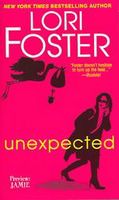
Unexpected, by Lori Foster

>> Monday, March 13, 2006

I didn't like the few Lori Foster books I've read, but for some reason, her books keep accumulating in my TBR. I guess her stories sound interesting, so I always end up picking them up used when I see them cheap. That's what happened with her Unexpected. In fact, what tempted me here was that it sounded really close to the story I've always wanted to read in a romance novel... a kind of romantic suspense but with the heroine being the tough warrior and the hero being the regular guy who's caught in a situation that's out of his depth.


Eli Conners expected hired mercenary Ray Vereker to be a tank of a guy with forty tattoos - not a gorgeous creature with considerable karate skills. While Eli certainly needs Ray's help, he thinks she could use a little of what he's offering...a down-and-dirty, body-scorching passion of the forever kind.

Ray's as good as any man when it comes to storming enemy compounds and loading an AK-47, but Eli's strong sensuality and gentle touch leave her shaken and stirred. And really, who could blame a girl for succumbing to mind-blowing temptation in the steamy jungle? But now it's back to business. If only Ray wasn't feeling hot, bothered, dizzy, and just a little bit, well, queasy.

The last thing either of these unlikely lovers expects is to be expecting. Suddenly, Ray's precise, no-nonsense mission is veering wildly off course, derailed by raging hormones, out-of-control desire, and a delirious love that is completely unexpected.
I think when I decided to pick this one up I mustn't have read the blurb in detail, because I really didn't remember the pregnancy angle. When I opened my box and saw that stork there in the cover, my jaw dropped. Uh-oh, I thought, is there any way Foster can get a HEA ending without... er... emasculating (you know what I mean) Ray, given the premise? Without her having to give up what made her different from other romance novel heroines in the first place? And I do NOT like stories which are all about the pregnancy.

Turns out both my worries were the least of my problems with Unexpected. It was awful, but not because of these issues.

Ray does give up her mercenary gig, but that was ok with me, because right from the beginning you know she's burnt out, only doing this one more mission because she needs the money. So her giving it up didn't bother me at all because it didn't feel like one more woman giving up the career she loves because hubby disapproves.

The pregnancy thing? Ehhh, I didn't actually like what Foster did with it, but it wasn't that bad. And actually, this happens late enough in the book that it's a bit puzzling that Kensington decided to make it such an upfront thing in the packaging. It shouldn't have been mentioned at all in the back cover blurb, as far as I'm concerned.

So what makes this such a bad book? Well, basically that Foster takes an interesting premise and then totally chickens out. She goes out of her way to reassure us that Ray isn't that strong and competent, that Eli can totally overpower her if he wants to and didn't really need her to rescue his brother, that in bed Ray is very "womanly" and submissive... it went on and on. She starts out with characters who might be interesting and original and beats them over their heads with a stick until they've squashed themselves into stereotypical "romance hero" and "romance heroine" molds.

Reading this book felt like experiencing the Death of a Thousand Cuts. Every couple of pages there was something so incredibly irritating that it threw me out of the story (and nearly made me throw the book against a wall). None of these problems were fatal in themselves, but they accumulated until the book was deader than dead.

Stuff like getting to meet Jane, for instance. Jane, whom, even having read only a couple of Lori Foster books, I recognize. She's totally "the other woman". Foster's "other women" (and by "other women" I mean any woman who's not the heroine or maybe the heroine of a previous book or the hero's mother -though sometimes the mothers are like the "other women", too) are all cut out of the same cloth. They're shrill and hysterical and they're all money-grubbing whores.

You know what? Even thinking about this book makes my head hurt, so I'll stop this review right here. My grade? A D.

Read more...

On The Edge of the Woods, by Diane Tyrrel

>> Friday, March 10, 2006

book coverOn my neverending quest for gothics, especially modern gothics in the tradition of some of Barbara Michaels' books, someone suggested Diane Tyrrel's debut novel, On The Edge of the Woods. And seeing the comparison made right there on the back cover was a good sign.

And speaking of covers, I quite liked this one. Even if I hadn't heard anything about the book, it would have made me pick it up...I'm a sucker for "mysterious house" covers! ;-)


It was a white elephant of a house -- a turn-of-the-century rambling manor in the shadows of the Sierras, full of intriguing nooks and crannies, rich with architectural details and delights. Architect Stacy Addison knew that she had come home the moment she saw it. And even though it needed months of renovations, nothing would stop Stacy from buying this beautiful house on the edge of a fairy tale-like forest. Not the fact that it was hours from her life and job in San Francisco, or that her intriguing new neighbor Brand Vandevere had wanted the house first. Especially not that.

But then come the threatening notes, the phone hangups -- and the harassment. Someone doesn't want Stacy in the house, and will stop at nothing to see her leave. But not just the house, Stacy slowly realizes. Someone wants her gone -- permanently ...
Even though I don't really see the resemblance to Barbara Michaels, OTEOTW was actually pretty good. I'd rate it a B-, even though I'm pretty sure people who aren't as tolerant as I am when it comes to modern gothics would rate it lower.

Architect Stacy Addison has a vague desire to buy a summer and weekend residence in the Californian Sierras. She is half-heartedly looking at some houses, not really sure if she really means to go ahead with her plans, when she sees the house she somehow knows is meant to be hers. Conscious of the fact that it's too big, too run-down and probably too expensive for her, she makes the best bid she can afford... and it is accepted.

But as she begins to spend more and more time there and getting to know her neighbours (the very welcoming Tessa, the outwardly charming Saul, the rude but very attractive Brand, who everyone tells her was very anxious to buy the house himself), the weirdness begins. From strange phone calls harassing her at work in San Francisco to creepy messages written on the wood floors under the carpets, from strange sounds to cryptic and mysterious letters left behind by the previous owner, Stacy starts to get the feeling someone doesn't want her there.

The story encompasses a long time, about a year, and that works well, because it's a leisurely book. It's also a book that feels much longer than the barely 350 pages it is, not because it's boring, or tedious, but I think partly because of the long time it covers, partly because the story is not at all fast-paced. It's a story of the slow development of Stacy's life in the house, with some shocking events, yes, but all spaced out enough that it makes sense that she's not running away screaming into the woods. That said, at times it did feel to me that Stacy wasn't worried enough, or not taking enough steps to figure out what was going on, or not talking to people she should be talking to and demanding the truth. It didn't really make her TSTL in my eyes, because I kind of could see why she'd act the way she did, but at times I got a bit frustrated by her lack of proactiveness.

The slow pace and the long period covered also made Stacy's relationship with Brand work better than it might have (in the gothic tradition, who exactly the hero is isn't exactly straightforward from the beginning, but since the fact that it's Brand is mentioned right on the back cover blurb, I'm not going to hide it here). I guess I could have been more irritated than I was by the way her relationship with Brand seems to stall after each apparent step forward. I know I was, at some points (especially when NOTHING happened after that Fourth of July!), but I was also very aware that this is how it sometimes is in real life. I've had things like that happen... one night it looks like the guy is SO into you, and you expect for things to progress in the next few days, and then... nothing. And part of your mind says "call him", but the other says "what if he just had had too much to drink and really isn't into you at all?", so you end up not doing anything yourself and things just fizzle out. And sometimes you just don't ever find out what was going on, but sometimes you do, and it turns out the guy really *was* into you, but your ex-boyfriend's friends warned him off, and... er, sorry, going off on a tangent here. I just meant to say I understood this more than I would have liked to, really.

Brand's attitude wasn't so easily excusable. I especially detested seeing him with Alana. The revelations at the end do make it all a bit better, because you kind of understand where he was coming from, but just as with Stacy, I think I would have appreciated a more proactive attitude on his part. In some parts of the book, the constant, never-ending lack of communication got to be a bit much. Both Stacy and Brand seem always content with either what other people tell them or with the half-things they hear, and they NEVER ask each other for clarification.

Ok, so why, if all I seem to be able to write are criticisms, did I mostly enjoy the book? I guess the house. Tyrrel's story has a wonderful sense of place, and the process of seeing Stacy build a new life in the Sierras, just as she rebuilds and restores the house, is immensely satisfying. And the whole mystery of what can be going on, why someone wants Stacy gone and how they imagine they might benefit from it, was very intriguing. The actual ending wasn't perfect, but it did explain things well.

I already have Tyrrel's second book, On Winding Hill Road, in my TBR, and it sounds pretty good as well.

Read more...

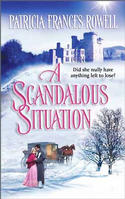
A Scandalous Situation, by Patricia Frances Rowell

>> Thursday, March 09, 2006

book coverI picked up A Scandalous Situation (excerpt), by Patricia Frances Rowell after seeing it mentioned in CindyS's blog. She listed it as one of her "great reads", and it sounded really good.

Browsing in Rowell's website, I see this one is part of a series, one in which each book is one of the four elements of nature. A Scandalous Situation is supposed to be Air, while A Perilous Attraction would be Fire. Then there's A Dangerous Seduction, which is Water, and finally, A Treacherous Proposition which is... Earth? Nope, Moonlight. Er... ok.


Her past was a dark country...

Iantha Kethley was a lady with a past--one not of her own making. Still, she found herself in a very difficult position. The English nobility would never forget what had happened to her, and marriageable gentlemen were not understanding at all of that sort of, uh... situation.

But that was neither here nor there. Iantha's ordeal had left her unable to bear being touched at all, let alone able to endure the intimacy of the marriage bed.

That is, it was neither here nor there until Robert Armstrong, Baron Duncan, plucked her out of the path of a snow slide and sheltered her in his home.

And asked her to marry him.

Recently returned from India, the widowed Rob found himself with an empty, aching heart, holding only grief for his lost wife and daughter. That is, until he rescued a wraith-like damsel in distress and fell under her spell.

And determined to make her whole, one touch, one kiss, one embrace at a time.
I really have to thank Cindy for this rec. This is an author I'd never even heard about, so if I hadn't seen Cindy's blog, I would have missed out on a very sweet, emotional story. A B.

Iantha Kethley endured a traumatic gang rape six years earlier, and this has left some understandably deep mental scars in her. She's uncomfortable being with people, especially men, and she pretty much can't stand to be touched, even by her loving parents and brothers and sisters, with whom she lives a very quiet life in the country. Her recovery isn't helped by the fact that all this time she's been receiving taunting letters, presumably from the rapists, who every clue seems to indicate are from the upper classes.

One day, as she's out painting in the snow, she's rescued from an avalanche by her new neighbour, Robert Armstrong. With a big storm approaching, there's no way she can get home, and Rob takes her to his. Iantha is obviously very scared, especially by the fact that since Rob has just arrived back home after many years in India, there's no female staff at his castle. However, Rob is kind and patient from the beginning, even if he doesn't understand why this lady is so cold and skittish, and his men are perfectly respectful, so Iantha is soon at ease and they establish somewhat of a rapport.

Once the storm is over, Rob returns Iantha to her house, and makes the obligatory offer of marriage, since she's spent a few days with him without a chaperone. Even though he's attracted to her, he's not completely sure he wants such a cool woman for a wife, but well, it can't be helped. But when Iantha's father feels honor-bound to reveal what happened to Iantha all those years ago, before he can accept Rob's proposal, Rob finally understands Iantha's behaviour. He's still not sure if he'll be able to build a real marriage with her, but he's determined to give it his best try and convince her that she doesn't have to spend the rest of her life hiding.

What I loved best about this book was how Rowell slowly builds a real relationship between Iantha and Rob. The process of Iantha completely trusting her husband and being completely comfortable with him (in bed and out) was a long, gradual, laborious one. I loved that while Rob was all that was kind and generous and patient, this didn't come effortlessly to him. It was difficult for him to control himself and he had quite a few doubts about whether he was ever going to succeed completely, and even, at some dark times, about whether all that very hard work was worth it. But he persevered, the adorable man!

I also liked how Rowell wrote Iantha. She's a truly strong heroine, not in a physical, outgoing way, but in the way she is so quietly determined to get over her fears and make a life with Rob. Even when the rapists step up their campaign to terrorize her and she starts having to face many of her fears head-on, she doesn't flag in her efforts and still tries to keep all this from taking over the life she's started to get back. I've read too many books in which being a survivor of rape is all there is to the heroine's personality, but this is not the case here. Iantha is a well-rounded character, and the effects the rape had on her are not all there is to her personality.

A long, careful process like the one Rob and Iantha embark on isn't as satisfying without some major emotional payoff, and A Scandalous Situation has that in spades. When Iantha finally shows she's comfortable even with a certain sexual position, when she finally lets go of her feelings and risks all those emotions she's had bottled up inside her for all those six years, Rowell makes these scenes so powerful and satisfying that I was really affected.

Something else I enjoyed was Rowell's writing, the way she created a very vivid atmosphere for her tale to take place in. The beginning, especially, was lovely, and the cover reflects this mood wonderfully. Oh, but speaking of the writing, I have a tiny nitpick: Rob "pulsed" every time they made love, which I found a bit distracting. Well, I did say it was a tiny nitpick, didn't I?

Where I had some bigger trouble with the book was with the villains' motivations. It just stretched my credibility that they would spend so much time and effort taunting Iantha and torturing her by sending her letters. I mean, they seem to have had other victims. Why not them? Or were they sending them all letters like that? And how much time were they spending on their correspondence, if that was so?

Compared to what worked here, though, that was not important, and the book was a success for me. I wonder how the other 3 in the series compare? I may have to seek them out!

Read more...

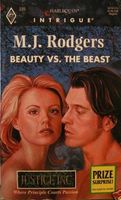
Beauty Vs. The Beast, by M.J. Rodgers

book coverBeauty Vs. The Beast is the first in M.J. Rodgers' Justice Inc series, centered around the lawyers working of the Seattle law firm with that name. I've actually read one of the five books already, Baby Vs. The Bar, but that was without really knowing anything about it being part of a series. I'd just finished a Rodgers book I'd liked, The Dream Wedding, and my friend had this other one in her shelves, so I just borrowed it. Anyway, that one is book #2 in the series, Baby Vs. The Bar. After the AAR review of the entire series (which I link to above), I ordered the rest of the books.


Attorney Kay Kellogg thought she had seen it all until her psychologist client brings her a case that's destined to set a new precedent. Psychologist Damian Steele has been treating a dual-personality patient, LeRoy Nye, and has successfully "killed" Roy, the nasty half of his personality. But now Roy's wife is filing a multi-million-dollar wrongful death suit against Damian, claiming he "murdered" her husband.

The case causes an immediate sensation and ultimately the jury is faced with redefining life itself. Kay knows that in order to win she'll need her client's full cooperation. But Damian refuses to give her all the facts. What is he hiding and why? While Damian seeks to protect Kay from physical danger, he also knows he must keep his emotional distance; for his deadly secrets stalk the mind as well as the heart.
Well, this was certainly interesting. The plot did completely overwhelm the romance, as the AAR reviewer warned, but it was interesting enough that the book was still a success for me. A B-.

Kay Kellogg is a lawyer at Justice Inc. One day, her boss, Adam Justice, asks her to meet a friend of his who has a very unusual case she might want to take. That friend is psychologist Damian Steele, who's being sued for killing one of the personalities of a Multiple Personality Disorder (MPD) patient.

It's a case that's just fascinating. The patient, Lee Nye, had come to Damian complaining about black-outs. He'd wake up and be in strange places (in an alley behind a bar, for instance, reeking of alcohol, a couple of ribs broken and a rat nibbling on his fingers), hours or days after the last thing he remembered. Trying to find out exactly what happens during those blackouts, Damian hypnotizes Lee and they discover there's another personality inside him, a very self-destructive, aggressive one called Roy. So Damien treats Lee, and the upshot is that he "kills" the Roy personality. Thing is, Roy was married, and once Lee gains complete control of his consciousness, he divorces the woman. And so the woman decides to sue Damian in civil court for killing her husband.

Most of the book is a wonderfully done courtroom drama, and that's what worked for me best. The case is obviously weird and entertaining, and so are most of the characters. Plus, Kay is a very competent lawyer, and I loved seeing her tear down the opposing counsel's witnesses and manouver around his tricks (which were many and very unethical).

Meanwhile, outside the courtroom, Damien and Kay are very attracted to each other, and as they prepare themselves for the case, they also give in to that attraction. This thread was definitely not the high point of the book, but it was basically ok. The protagonists were likeable enough, if lightly drawn (though that Beauty and the Beast comparison just felt a little labored), and some of the scenes were fun. But, to be honest, whenever they were together, what I was wishing for was more about the court case.

The book's main weak point was the climax, which was just not up to the development of the rest of the mystery. The best scenes -as I've mentioned ad nauseam- had been those of the courtroom drama, and I think it would have been miles better to have the climax of the action there, inside the courtroom, mind against mind. It certainly looked like it was heading in an interesting direction there, with them planning to interrogating a certain person (don't want to give any spoilers!), but then it ended in a much more clichéd fashion, and one that wasn't really all that plausible. I just didn't buy the motivation of the culprits.

Still, this is a good introduction to the series. I'll try to read the rest of the series as soon as possible, and see how they compare.

Read more...

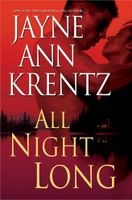
All Night Long, by Jayne Ann Krentz

>> Tuesday, March 07, 2006

book coverIn the past few years, I've been easily able to wait for the PB release of Jayne Ann Krentz's books. If one of my Uruguayan friends who live in the US was coming, I'd ask them to bring me a couple of used HCs, and I usually made one of those a JAK, but if not, I was resigned.

With her latest book, however, I just couldn't wait. The buzz was just too good for me to resist. Was it really a bit of a return to her older, Golden Age romances? Fortunately, I managed to find someone who could bring me a copy of All Night Long, and I was soon finding out for myself.


The smaller the town, the darker the secrets...

Shy, studious Irene Stenson and wild, privileged Pamela Webb had been the best of friends for one short high school summer. Their friendship ended the night Pamela dropped Irene off at home—and Irene walked in to discover her parents' bodies on the kitchen floor. It was ruled a murder-suicide, and Irene fled the northern California town of Dunsley. But seventeen years later, when Pamela sends a cryptic e-mail asking for help, Irene returns to her hometown to find her old friend has died suddenly, leaving behind a lot of ugly, unanswered questions.

Caught up in a firestorm of desperate deceit and long-buried secrets, Irene knows it would probably be smarter to just pack up and leave Dunsley behind again, but her reporter's instinct—and her own hunger to know the truth—compel her to extend her stay at the local lodge. Even more compelling is the man who runs the place—a hazel-eyed ex-Marine who's as used to giving orders as Irene is to ignoring them. Luke Danner can see the terror beneath Irene Stenson's confident exterior—and he is intent on protecting her. But he is also driven by passions of his own, and together they will risk far more than local gossip to sort out what happened to Pamela Webb, and what really happened on that long-ago summer night. . . .
Well, the buzz was right. While not as perfect as, say, books like Trust Me or Family Man (some of my absolute faves), JAK has managed to recover some aspects which made me love those books so much, and which had seemed to fall by the wayside in some of her latest books. A B+.

After the tragic death of her parents in an apparent murder-suicide when she was sixteen, Irene Stenson left the small town of Dunsley and never went back. She also left behind her new-found and new-lost friend, Pamela Webb, daughter of the town's leading family.

Seventeen years later, Irene receives a strange email from Pamela and goes back to Dunsley to talk to her, only to find her dead body, apparently a suicide. But Irene doesn't believe it, just as she didn't believe the official verdict on her parents' death, and is determined to get to the bottom of it, whether Pamela's powerful family and the authorities want it or not. In this, she's reluctantly helped by the new owner of the town's lodge, newcomer Luke Danner, a man with whom she shares a growing attraction.

The suspense part of this romantic suspense was ok, but nothing to call home about. The romance and the characters, however, were what I know JAK can do so well and just wasn't fully delivering earlier.

Irene is interesting and likeable as a young woman who was able to get over some very difficult things to become a mentally healthy person, and I was especially charmed by Luke. As a hotelier, he'd give the Fawlties, from Fawlty Towers, a run for their money. A former Marine who's working on a new project, he purchased the lodge because he wanted some peace and quite. Well, he didn't count on demanding customers, people who come up with such silly concepts as wanting room service! Seeing Luke dealing with the lodge's guests, trying unsuccessfully to impose some military discipline, was just hilarious.

I also loved Luke's fascination with Irene, even if she is one of those pesky, too-demanding customers. He knows he should want nothing to do with someone so determined to stir up trouble, but he just can't help himself and keeps following her around and helping her, whether she wants it or not.

I think what I loved best about their relationship is how these two apparently very different people discover that at their cores, they are very similar. They are both people who share certain values and have matching worldviews, and even have some similar psychological issues, and that makes them much more compatible than simple appearances would suggest. And the best thing, is that I got a definite feeling of connection between them, a sense of a kind of intimacy, if you will. And I don't mean just sexually, though this is a nicely sexy book: these two completely understood and liked each other, and they found in this something they hadn't been able to find with anyone else.

Not with anyone else, and especially not Luke with his family. Luke comes from a family of very successful wine-makers, but he's always marched to his own beat. From philosophy to the military, his family has never been able to understand that he really doesn't want to get involved in their business. The one time when he let himself be persuaded to do so, it became a real debacle, and Luke is still battling some neverending family pressure about this. They're worried he's just not right, and this makes for some very satisfying scenes in which they are each put in a position to defend the other.

Even though the suspense subplot ends up being a bit too dark and horrible for the tone of the rest of the book, the romance was good enough that All Night Long was a definite success for me.

Read more...

AAR's annual reader's poll (looooong post!)

>> Monday, March 06, 2006

It was hard, but I managed to hold back from sharing most of my choices for AAR's 2006 annual reader's poll. I think I only gave away a couple of the categories ;-) But now that the results are out, here's a long, long post on what I voted and why, and how I feel about the books that were actually the winners.

Best Romance:

My vote: Simply Unforgettable, by Mary Balogh

It was actually pretty hard to decide, because there wasn't one book this year that stood head and shoulder above the rest. But out of the 3 books I graded A-, this one very narrowly edged out Loretta Chase's Mr. Impossible and Hot Target, by Suzanne Brockmann.

Actually, I almost feel guilty for voting for SU, because it's neither different, nor revolutionary, nor daring. It pretty much follows the rules for Regency-set Historicals, those same books we're all saying we wish weren't saturating the market, but the thing is, it just so well done! And a good book is a good book, whatever it is about.

Winner: Mr. Impossible, by Loretta Chase.

Needless to say, I have no quarrel with this result. It really was a wonderful book!

Favorite Funny:

My vote: Mr. Impossible, by Loretta Chase

I didn't really have that many "funnies" in my list. The choice was basically between Mr. Impossible and Julia Quinn's It's In His Kiss, and What Do You Say To A Naked Elf?, by Cheryl Sterling, was also in the running. But even though these three were all just as funny, Mr. Impossible was the better book, and the category isn't "Funniest book", but "Favourite Funny", isn't it?

I have to say, though, that if I'd managed to read it before the polls closed, I'd probably would have considered voting for The Secret History of the Pink Carnation, by Lauren Willig. I just adored the humour in that one.

Winner: Match Me If You Can, by Susan Elizabeth Phillips

Oh, I so want to read this one! Unfortunately, I wasn't able to get it in time, but I think I'll probably be getting in the next few days.

Most-Hanky Read:

My vote: His Secondhand Wife, by Cheryl St. John

My choice is all about Noah here! Reading this one was a very emotional experience.

Winner: A Breath of Snow and Ashes, by Diana Gabaldon

Nothing to say here, because I just haven't paid all that much attention to this one. I haven't even read Outlander yet, even though I do have it in the TBR. I seem to remember some people really hating the latest entry in the series, but it appears at least some of her fans were happy.

Most Luscious Love Story:

My vote: Midnight Angel, by Lisa Marie Rice

I read quite a few 2005 books that were pretty luscious (Lydia Joyce's and Stephanie Vaughan's, for instance), but I had absolutely no doubts about my vote in this category. "Luscious" is actually a tame word for this one! I know some people found the love scenes silly and unbelievable, not erotic, especially due to Douglas' extreme priapism, but it definitely worked for me. And this was my first vote ever for an ebook!

Winner: Passion, by Lisa Valdez

It's in the TBR, but this was another book I wanted to but didn't manage to read before voting. I'll be sure to read it ASAP.

Most Tortured Hero:

My vote: Noah Cutter, from His Secondhand Wife, by Cheryl St. John

Can you get any more tortured than this guy? And what's even more important, the way he was so tortured was perfectly justified. Noah very definitely wasn't making a big deal about nothing!

Winner: Bastien Toussaint, from Black Ice, by Anne Stuart

I stand by my choice, but yes, Bastien was pretty tortured!

Strongest Heroine:

My vote: Rosalind Harper, from Black Rose, by Nora Roberts

Roz wasn't kick-ass in a physical way, but she's who I want to be when I grow up.

Winner: Eve Dallas, from Survivor in Death, by J.D. Robb

Say all you want about Nora, but I think what I appreciate the most about her books is that she does some seriously strong heroines! Eve was in the running for me, too.

Best Hero:

My vote: Rupert Carsington, from Mr. Impossible, by Loretta Chase

Charming, funny, brilliant, Rupert made Mr. Impossible sparkle!

Winner: Rupert Carsington, from Mr. Impossible, by Loretta Chase

Yay! First one in which I vote for the winner!

Best Heroine:

My vote: Fabienne Argonat, from Dedication, by Janet Mullany

In this case, unlike in my vote for Best Romance, what I loved about Fabienne was how different she was from the norm.

Winner: Blair Mallory, from To Die For, by Linda Howard.

Well, I liked Blair much better than I thought I would, but nowhere near as much as some people seem to have!

Best Couple:

My vote: Lucius Marshall & Frances Allard, from Simply Unforgettable, by Mary Balogh

They're why I voted their book as the best of the year, since Simply Unforgettable was pretty much nothing but their romance, so my choice in this category was pretty easy.

Winner: Rupert & Daphne, from Mr. Impossible, by Loretta Chase

Yes, they were a wonderful couple, and they're a good choice for this category.

Best Villain:

My vote: The Harper Ghost, in Red Lily, by Nora Roberts

I always have trouble voting in this category, but this year, my choice feels right. The Harper Ghost, even dead for some 100 years, was more complex and alive than 99% of the villains out there. Oh, and it closely beat Dick Reese, from Alison Pace's If Andy Warhol Had a Girlfriend. That guy was just deliciously horrible.

Winner: the villain from It Happened One Autumn, by Lisa Kleypas

This is the first category in which I really disagree. As much as I want to read Devil in Winter, I happened to think the whole thing about the villain was the weakest point of IHOA. It felt poorly motivated and much too calculated to arouse interest in the next book.

Most Annoying Lead Character:

My vote: Wyatt Bloodsworth, from To Die For, by Linda Howard

I was pretty sure Blair, the heroine from To Die For would receive many more votes than Wyatt did, but he was the one who made me want to bang his (and my) head against the wall.

Winner: Blair Mallory, from To Die For, by Linda Howard

*sigh* I was right. Well, I guess I can see how she would annoy people, even if she didn't annoy me.

Best Author Who Debuted in 2005:

My vote: Lydia Joyce

Easy choice. Both her books were wonderful, and they showed an assurance and polish it takes more authors years to get.

Winner: Lisa Valdez

Yep, will definitely have to read her book. I'm heartened to see my choice at least got a honorable mention here.

Best Buried Treasure:

My vote: The Music of the Night, by Lydia Joyce

To be honest, I don't really know about this vote. Was it really a buried treasure? I decided it was based on the fact that it was mentioned in the ATBF column about buried treasures, but it definitely got lots and lots of buzz online. Though I don't know if it got that much notice in the off-line romance community, being by a new author, so that might make it all right.

Winner: The Music of the Night, by Lydia Joyce

Great! Only the second category in which I bet on the winner, if anyone's keeping count.

Guiltiest Pleasure:

My vote: Midnight Angel, by Lisa Marie Rice

The "guilty" part came because I felt pretty manipulated by the author while reading Midnight Angel. The "pleasure" part is because I absolutely loved it anyway.

Goodness Had Nothing To Do With It, by Lucy Monroe was another possibility, but in this case, it was lots and lots of guilt and only a little pleasure, and I decided I'd rather go with lots and lots of pleasure, with only a little guilt.

Winner: Passion, by Lisa Valdez

I guess people felt guilty because there was a lot of sex?

Author Most Glommed in 2005:

My vote: Lisa Marie Rice

I've now read every single ebook of hers. I'm only missing a short story in one of the Secrets anthologies. I also glommed Anne Stuart last year. I probably bought more books by AS, but as a % of her backlist, LMR wins.

Winner: tie between Anne Stuart and Mary Balogh.

Both good authors, with wonderful backlists. Good win.

Best Cabin or Road:

My vote: The Veil of Night, by Lydia Joyce

My choice was a cabin romance. The almost claustrophobic ambience was one of the things I enjoyed the most about this one, actually, so it's a fitting choice.

Winner: Mr. Impossible, by Loretta Chase

... and the winner is a road romance. I guess I tend to prefer cabin to road, which might be why I went for TVON even though I actually rated Mr. I higher.

Best Medieval/Renaissance:

My vote: Blank

Given that I've never been a great fan of Medievals and that fewer and fewer seem to be getting published these days, I'm not surprised I didn't read even one from 2005.

Winner: Return of the Warrior, by Kinley MacGregor

This is one winner I don't think I'll be trying. MacGregor's books haven't really been a success for me in the past.

Best European Historical:

My vote: Simply Unforgettable, by Mary Balogh

...as I'm sure you've deduced. I've never really understood voting a book for Best Romance and then not voting it as best in the time period it belongs to.

Winner: Mr. Impossible, by Loretta Chase

Well, the results were coherent this time. It might not be exactly intuitive for an Egypt-set book to win here, but it makes sense, as LLB explains in the column accompanying the results.

Best traditional Regency:

My vote: Dedication, by Janet Mullany

It was actually the only 2005 Trad I've read (still need to read Megan Frampton's, which is another one I meant to get to before voting), but I enjoyed it enough that I feel comfortable voting for it as best.

Winner: Dedication, by Janet Mullany

It's probably telling that the winner in the Trad category was a book that didn't read at all like the usual Trad.

Best Amer Hist or Frontier:

My vote: His Secondhand Wife, by Cheryl St. John

See what I wrote for Trad Regency? Ditto here. Only one I read (not a big fan of this subgenre, either), but it was great.

Winner: A Breath of Snow and Ashes, by Diana Gabaldon

Interesting. I hear Gabaldon, and I think Scottish historicals, not Westerns.

Best Contemporary :

My vote: Midnight Angel, by Lisa Marie Rice

I wondered if this one might not be Romantic Suspense, but no, I don't think it is. The suspense subplot is just background, IMO. The focus is on the romance.

Winner: Match Me If You Can, by Susan Elizabeth Phillips

I want, want, want!

Best Series:

My vote: Danger Calls, by Caridad Piñeiro

I hadn't read any 2005 series books until the week before I sent in my ballot. Both were great, and it took me a while to decide to vote for Danger Calls and not for Marie Donovan's Her Body of Work.

Winner: a tie between The Mysterious Miss M, by Diane Gaston and With Child, by Janice Kay Johnson

Ok, Miss M is a book I'm anxiously anticipating reading, and I might be able to overcome my allergy to pregnancy plots for With Child, because it does sound good.

But on the subject of the Gaston book, while, as LLB says, it is technically a series romance, I just don't see what the difference between it and other European Historicals is, other than the fact that it was published by Harlequin. Not even length: there are plenty of single title historicals which are as short as (or even shorter than) Harlequin Historicals.

Best Romantic Suspense:

My vote: Hot Target, by Suzanne Brockmann

Not only did I love the book in general, I also quite enjoyed the suspense part, which is definitely not usual with me, so this was a good choice. Anne Stuart's Black Ice was a possibility, as well, but HT edged it out.

Winner: Black Ice, by Anne Stuart

Another good choice.

Best Alternate Reality:

My vote: Survivor in Death, by J.D. Robb

Seems I always end up voting for an In Death in this category!

Winner: Dark Lover, by JR Ward

If I were to vote today, I would go for this one, actually. Too bad I read it on the week after I sent in the ballot.

Best Chick Lit/Women's Fiction:

My vote: The Givenchy Code, by Julie Kenner

I LOVED this one! If Andy Warhol Had a Girlfriend, by Alison Pace was in the running, too, but I liked TGC a bit more.

Winner: The Givenchy Code, by Julie Kenner

Yes!

Best Short Story:

My vote: Blank

I read only one 2005 anthology, Bewitched, Bothered and BeVampyred, but it wasn't very good. I guess I could have chosen the best story there (some were good), but I felt so unenthusiastic about the whole collection that I didn't. I wish I'd had time to read the Strangers in the Night anthology. I've heard great things about the Pam Rosenthal story there.

Winner of a honorable mention: Falling for Anthony, from Hot Spell, by Meljean Brook

Way to go Meljean! I want to read Hot Spell both for this story and for the Emma Holly.

Author You Gave Up On in 2005:

My vote: Blank

No one comes to mind. I don't think I really gave up on anyone just this year!

Loser: Julie Garwood

Heh, I gave up on her YEARS ago! Don't even like her "classic" historicals.

Author Others Love that You Don't:

My vote: Christine Feehan

Probably shouldn't have voted in this category, but I'd just been reading a particularly silly discussion between Feehan fangirls and I was feeling pissy. And well, I really don't love her books!

Loser: Nora Roberts

Weirdos, all of those who voted this ;-) No, seriously, I guess her voice is so distinctive that it might not work for everyone.

Most Disappointing:

My vote: One Little Sin, by Liz Carlyle

Not a bad book at all (I gave it a B-, actually), but I'd been eagerly anticipating it and it just wasn't as good as I was hoping for. Carlyle more than made up for this with her next book, Two Little Lies. If that one hadn't had a 2006 copyright (even though it came out in late December 2005!), I think I might have voted it for best romance.

Loser: It Happened One Autumn, by Lisa Kleypas

This one did have a huge buzz, which could have something to do with people considering it disappointing.

Worst:

My vote: Blank

My worst 2005 read was the Bewitched, Bothered and BeVampyred anthology, but it was just a C+... i.e. not nearly bad enough for me to vote as worst book of the year!

Loser: A tie between Passion, by Lisa Valdez and What Do You Say To A Naked Elf?, by Cheryl Sterling.

Same as always, while the positive categories really do pinpoint some of the best books published that particular year, I never think the "worst" category chooses a book that's anywhere near the worst of what came out in the year.

Purplest Prose:

My vote: Dark Desires, by Eve Silver

So very overwrought! I kind of liked it, at first, but after a while it got on my nerves.

Loser: Passion, by Lisa Valdez

Will need to read it to form an opinion, but I did hear this one was pretty purple!

*****


...aaand that's it! Thanks for sticking with me this far. So, what do you think?

Read more...

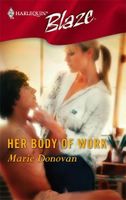
Her Body of Work, by Marie Donovan

>> Friday, March 03, 2006

book coverAs the AAR readers' poll approaches, I always go a bit crazy trying to read as many books as I can from the year in question. I always end up voting really late because of this (sorry, LLB!). As I made up a tentative draft ballot earlier this month, I noticed I'd read no 2005 category books. None at all. When my latest batch arrived (quickly and expensively, as some of you I've shared my shipping issues with know), it contained two 2005 series books I had high hopes for, so I read them as soon as I could.

The first was Danger Calls, and the second Her Body of Work, by new-to-me author Marie Donovan.


When sculpting a nude, the artist must…

…understand the male body

Chicago sculptor Rey Martinson has always worked with nudes, but she is floored by her new model’s male perfection. Cuban-American Marco Flores’s body is more than inspiring—it’s irresistible.

…be good with her hands

Because it turns out that Marco is incredibly talented with his--on Rey! After each wildly arousing modeling session, they find release in intense lovemaking.

…have an eye for detail

Rey can’t ignore that there’s something suspicious about Marco. He’s the first lover she’s ever had who sleeps with a gun under his pillow! But for Rey, being with Marco is worth the risk. Because she’s never been with a man who stimulates her so strongly—as an artist…or as a woman.
It was a really good example of what Blaze books can be, when done right. I ultimately decided to vote for Danger Calls as best series books (and that's the last thing I'll say about my ballot until the results come out... any time now), mainly because the ending of HBOW wasn't as good as the rest of the book. Still, a B is quite a good grade.

I tend to have a kind of love/hate relationship with the Harlequin Blaze line. I really love a romance where the sex is steamy and works to develop the relationship, and I've found some Blaze authors who are really good at that. However, when Blazes are bad, they tend to really stink. I especially detest: a) ridiculously contrived setups which are supposed to be sexy but are just silly, b) mechanical love scenes which add nothing to the story and are just there because the author thinks because this is a Blaze, she needs to add X number of love scenes, whether the story asks for them or not. Sadly, both a) and b) apply to a large percentage of the Blaze books I've read.

The good news is, they definitely do not apply to this one. As for a), the setup here is sexy and provocative, but not at all silly. Marco is a formerly undercover DEA agent whose cover has been blown. He's now on the run from the drug dealers he'd infiltrated and, knowing that they will try to get to him through his family, the first thing he does is to get them out of the way.

His mother is easy: off she goes on a cruise of the Mediterranean. Then it's on to Chicago, to try to get his model/actor brother out of the city. He lucks out, because Francisco has an audition in LA, but before he goes, he guilts Marco into covering for him and showing up to an audition for a sculptor. After all, they look similar enough, at least at first glance, and that way, Francisco's agent won't be pissed and he'll still have a job if his LA thing doesn't work out.

The artist who's looking for a model is sculptor Rey (short for Freyja) Martinson, and she specializes in naked men. She's looking for the perfect model for a big commission, a marble sculpture of Mars for an important client, which will finally put her on the map if it's a success. The sparks fly on Marco and Rey's very first meeting, and in spite of their reservations -Rey because she's had bad experiences with her models and has long made it her policy not to get sexually involved with any of them, and Marco because he's on the run and knows he's going to have to get out of town soon- they're soon creating even more sparks, between the sheets.

I very much enjoyed this. Both Rey and Marco are interesting, likeable characters, and they have some very nice chemistry. I thought Donovan did a wonderful job in using her frequent and imaginative love scenes to show the slow progress of their relationship, from simply a very strong attraction to fondness and tenderness and finally love. And when I say imaginative, I mean it! It's actually pretty kink-free, but there are certain things there I haven't seen elsewhere in Romanceland (the Cubana, BTW, we call Russian here. Interesting!)

Plus, both Rey and Marco are immigrants, she from Sweden, he from Cuba, and the exploration Donovan does of the immigrant experience, of how it affected them and shaped who they are now, is fascinating. I thought it really added some interesting and fresh layers to these characters. (And isn't it a funny coincidence that the heroes in these series books I read, one after the other, are both Cuban immigrants?)

All through the book, the grade I had in my head was a B+. It wasn't quite an A read (just lacked that extra zing that's the mark of one, I guess), but it was solidly enjoyable. The ending, however, lowered that grade somewhat. That's when the suspense subplot came to the foreground, and while it wasn't really bad, it just lowered what was previously a fresh, fun story into humdrum territory. The villain was uninteresting, and I just didn't completely get Marco's behaviour there at the end.

This is just a small part of the book, though. This is one I'd recommend, and a new author I'm definitely going to be keeping an eye out for from now on.

Read more...

The Perfect Rake, by Anne Gracie

>> Thursday, March 02, 2006

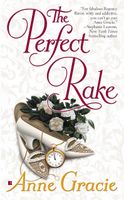
book coverI adored Anne Gracie's The Gallant Waif, so, even though I disliked the other one of hers that I read, Tallie's Knight, I picked up The Perfect Rake (extras) when I saw it for sale online. And then I moved it up in my TBR after something KristieJ said, something about Gideon's attitude towards Prudence that sounded wonderful.


She ran from a brute...

Fleeing the harsh guardianship of her grandfather, Prudence Merridew escapes with her beautiful younger sisters to London. One of them must marry—and fast. To act as her sisters' chaperone, Prudence invents a secret engagement to a reclusive duke... But when the duke arrives unexpectedly in London, she needs his help to avert disaster.

...into the arms of a rake

Aristocratic Gideon, handsome, rakish and with a strong frivolous streak, casually hijacks Prudence's game, awarding himself a stolen kiss or three along the way. Used to managing sisters and elderly men, Prudence is completely out of her depth with a charming, devious and utterly irresistible rake. And her plot goes terribly—if deliciously—awry...
The Perfect Rake is an unfortunately uneven book. As I write this post, I'm reading M.J. Rodgers' Beauty Vs. The Beast, a Harlequin Intrigue I started right after finishing TPR and which deals with a psychologist who's been sued for killing one of the personalities of a patient with Multiple Personalities Disorder (MPD). I found myself wishing I could have done the same to TPR, and killed the irritating personality and keep the good one. When this book is good and showing the nice personality, it's wonderful, but when the evil personality is out... ugh. Unfortunately, there just aren't enough of those good parts, and the book ends in a false note.

We start with a disturbing glimpse of the bad personality. Prudence Merridew and her four younger sisters have been living with their evil grandfather since their parents died, 10 years earlier. "Evil" is actually an understatement for what this bastard is. He's obsessed by the fact that the girls' father (his son) ran away to marry a cit's daughter, and he believes the girls are all tainted. He beats them, severely and frequently, for the slightest transgressions, and he's kept them pretty much isolated for all those 10 years.

As the book starts, he falls down the stairs while chasing after Prudence, and seeing that he will take a while to recover, the sisters take that chance to run away to their great-uncle Oswald in London. They only need a few more weeks until Prue comes of age and can become the other girls' guardian (as per their father's will), and as for money to support them, once one of them marries, she'll come into her inheritance, and they've agreed to share that money and live on that.

So here was my first problem. Smaller one first, to get it out of the way: those complicated will stipulations? Completely out of character for what we're told about the parents. Biggest problem: I didn't buy for a second that Prue and her sisters could be so untraumatized, after 10 years living in hell (and it was hellish). I think I would have bought their behaviour so much more easily if they'd been there for maybe a year, or even less. But 10 years is too long a time for Prue to have the attitude she has, especially if what we saw was representative of the behaviour they'd had to endure from their grandfather. I mean, given THAT, if Prue had always been as defiant with him, she'd have been dead!

So I was extremely doubtful as the book got going, but I soon was enjoying myself much more, as the girls got to London and I got to see the book's other personality.

Great-uncle Oswald receives the sisters with open arms in London, accepting their story of their Grandfather having sent them. He loves having them there and treats them with kindness. The only problem -and this is something they can't get him to budge from- is that, seeing that Prudence is extremely plain next to her incredibly beautiful sisters, he decides he'll fire her off first, and only then allow the other girls to come out, once Prue is engaged and they can't overshadow her and ruin her chances to get married.

The thing is, the girls need one of them to get married ASAP, which they can't tell Oswald for fear of getting him in trouble, so this just won't do. Prue is already secretly engaged to her neighbour Phillip, who's been in India for the past 4 years (something else they can't tell Oswald), and, in any case, it's doubtful that, being as plain as she is, she could manage to get engaged as soon as they need.

So smart Prue makes up a story of a secret engagement to someone who can't possibly be reached by their uncle: a duke who's known for being a hermit and not having budged from his estate in Scotland for years. But, as luck would have it, the duke has just arrived in London, and off Oswald goes to confront him. Prue rushes out to warn the poor man, but when she arrives at the duke's town house, she makes a mistake and thinks the duke's cousin, Gideon, Lord Carradice, is the duke. And so begins a kind of comedy of errors that was light and frothy and funny and witty and just generally lovely.

I think what I loved best about this is how Gideon sees Prue so differently from the way everyone else sees her. For him, Prue isn't plain. He's convinced she's spectacular, so much more beautiful than her sisters. I just loved that. It was wonderfully funny to see things through his eyes, the way he was so convinced that everyone must see Prue as the beauty he believes she is, the way he's convinced all other men must be after her as well, because, how could they not be crazy about such a spectacularly beautiful woman? He's a well-known rake, but after seeing Prue, other women just hold no attraction to him and he soon realizes he wants her forever.

Gideon and Prue have chemistry and attraction in spades. I loved their banter and the way he keeps trying to make her laugh and succeeds, even though she doesn't want to like him and be amused by him. So why is she so resistant to him, you ask? Because of that secret engagement. She gave her promise and she'll keep her promise, even if she's quickly falling in love with this man who seems to think she's beautiful and who she likes much more than she ever liked her fiancé!

It is when the sisters receive news that their grandfather is recovered and is coming after them that things start to go downhill. Gideon and his cousin, the duke, on being told why they need to run away, put themselves at their disposal and help them escape to Bath, where the men's aunt lives and can take them in.

Unfortunately, from then on, Gideon and Prudence's relationship becomes all about her engagement to Philip and how she can't possibly not fulfill her promise, whatever her wishes are, and this got really tedious, really fast. It just irritated me. Unlike Gideon, I didn't find Prudence's blind loyalty admirable, I found it stupid.

To hang on that way to a promise made to a guy who -possible spoilers here, highlight the following (the gist is: he treated her abominably)- abandoned her with her grandfather when she was 16, knowing full well that the old goat thrashed her any chance he got; and not only that: he left after seducing her (and there are certain hints there that it wasn't quite consensual, as Prudence's mention of Philip getting a certain result after applying "his masculine strength" seems to imply), and, again, knowing her grandfather, he didn't come running when she wrote to him about being pregnant. Hell, even not knowing he grandfather, not coming after that particular letter should have been enough for Prudence to break that engagement!. (end spoiler) Argh! It was SO obvious the guy was a real bastard, that Prudence looked like an absolute idiot for not considering their connection severed YEARS before. And when he finally showed up, spouting nonsense, she should have kicked his ass, not allow him to make her promise not to go out in public. Stupid, irritating woman. And then to believe his lies about Gideon. Stupid, irritating, peabrained woman!

This part of the book also shows much of that darker, horrid personality that doesn't go at all with the part of the book that I loved. Certain revelations Prudence made were just much too painful and traumatic to have been overcome so effortlessly! And then to find out that all the suffering was unnecessary was too much for me.

And another complaint: the actual ending of the book. In the good parts, this is a very sensual book, even if Gideon and Prudence never do much than some passionate kissing. But then, when all that other crap takes over, that aspect of their relationship disappears, only to return in the very end, when I didn't care anymore. The last 15 or so pages are basically nothing but love scenes (yes, sceneS. Three or four of them, IIRC), and I was terribly tempted to skim them, because, at that point, I didn't think they could add much. I was right, and they didn't. Their inclusion there is a puzzling choice. It kind of felt as if the book had started out as a Trad Regency and then the author was asked to turn it into a single-title historical and told by her editor it needed some sex. And since it would have been much harder to write them into the original story, she just decided to cram them in at the end.

Hmm, I like that theory. And actually, I think this book would have done MUCH better as a Trad Regency. It didn't need the extra length. Or rather, the extra length was just padding, and it made the second part of the book boring as hell. Add to that the uncomfortable back and forth between light and frothy and painful and traumatic, and this was a very strange book.

My grade? That's really, really difficult. If I could split it up, I'd probably give the parts about Gideon and Prue's initial relationship an A, and the other parts a D. I thought maybe a B-, but given that it ends so badly and left me with a bad taste in my mouth, I think I'll go with a C+. Too bad.

PS - A minor nitpick: "Montigua del Fuego"? Doesn't sound right to me, though I guess it's possible. What isn't possible is that Lady Augusta Montigua del Fuego spent those years in Argentina, since I'm pretty sure it wouldn't have been called that way back then in 1816. I need to google it, but my feeling is the Argentina name didn't appear until later. At the time this book is set, it would have been Provincias Unidas del Río de la Plata: the United Provinces of the River Plata (or River Plate, as it's sometimes called in English). Well, I said it was a minor nitpick, didn't I?

Read more...

The Secret History of the Pink Carnation, by Lauren Willig

>> Wednesday, March 01, 2006

book cover
New author Lauren Willig debuts with a very different novel: The Secret History of the Pink Carnation (extras).

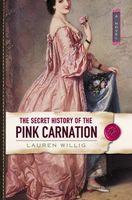
And didn't she luck out with that cover? No heaving bosoms to be seen, and VERY attractive! :-)


Nothing ever goes right for Eloise. The day she wears her new suede boots, it rains. When the subway stops short, she's the one thrown into some stranger's lap. And she's had her share of misfortune in the way of love. So, after deciding that romantic heroes must be a thing of the past, Eloise is ready for a fresh start.

Setting off for England, Eloise is determined to finish her dissertation on two spies, the Scarlet Pimpernel and the Purple Gentian. But what she discovers is something historians have missed: the secret history of the Pink Carnation-the most elusive spy of all time. As she works to unmask this obscure spy, Eloise has more and more questions. Like, how did the Pink Carnation save England from Napoleon? What became of the Scarlet Pimpernel and the Purple Gentian? And will Eloise Kelly escape her bad luck and find a living, breathing hero of her own?
Did I really think I was all tapped out on spy stories? Let me correct that: I'm sick of obligatory, humdrum, spy subplots. When the author shows as much enthusiasm for her subject matter as Willig does here, well, then, I like spy stories very much! A B+.

Ok, first of all, you should mostly disregard that blurb I quoted above. It sounds like it's all about Eloise, but actually, most of the story centers on the Purple Gentian and Pink Carnation, spying and heroic derring-do in Napoleonic France. Eloise is basically a frame for this story.

A PhD candidate working on her dissertation on 19th century gentleman spies, American Eloise Kelly is spending some time in England, doing research. She knows all about the Purple Gentian, who was unmasked as Lord Richard Selwick early on, but what she really wants to do is to find out who the Pink Carnation was, as it would be a very nice scoop for her dissertation!

Reasoning that, in the same way that Lord Richard was in contact with Sir Percy Blakeney, the Scarlet Pimpernel, he must have also been in contact with whoever was the Pink Carnation, Eloise resolves to find his correspondence and look for clues there, so she contacts his descendents to inquire about old family papers. Most of her responses are lukewarm, but she receives both a big set-down (from Colin Selwick) and an invitation (from Arabella Selwick-Alderly). Arriving at Mrs.Selwick-Alderly's house, she's immediately shown a pile of old papers, which, the lady tells her, will answer all her questions.

So in between some very cute encounters with Colin (who happens to be Mrs. Selwick-Alderly's nephew and is not too happy to have Eloise butting into his family's history), Eloise reads those papers, and the story of the Pink Carnation slowly takes place.

And what a story it is! Amy Balcourt (née Mademoiselle Aimée de Balcourt in France) lost her father to the guillotine during the Terror after the French Revolution. She and her mother were visiting her mother's family in England when the Revolution took place, and Amy has spent most of her life there, living with her uncle. Deeply affected by her father's death, Amy fantasizes about joining, first the Scarlet Pimpernel, and after his cover is blown, about joining the spy who takes his place: the Purple Gentian.

After the peace of Amiens, Amy receives an invitation from her brother, who remained in France and is now a hanger-on in Napoleon's court. Seeing an opportunity to finally meet her beloved Purple Gentian, Amy convinces her uncle to let her go, and so she leaves, full of plans and accompanied by her cousin Jane and their chaperone, Miss Gwen.

Amy gets her wish even before leaving England, though she doesn't know it. Her party shares the boat in which they cross the Channel with Lord Richard Selwick. Both of them are very attracted to each other, but once Amy finds out this charming Englishman is in Napoleon's confidence and even accompanied his troops to Egypt, as part of the archeological party of the expedition (an excellent cover for his spying), she dismisses him as a traitor. Or, at least, she wants to, because she still feels much too attracted to him. And when she finally meets the Purple Gentian (masked, of course), well, she's attracted to him, too!

Amy and Richard's story is quite a farce. This is not a dark, realistic spy story, but a fun, lively one, which was a joy to read. And even though many of the historical characters were exagerated and made pretty ridiculous, there still was a feel there that it was all based on some very solid and deep research, and I loved that.

And really, for all that they did feel 21st century-ish, I loved the characters. Both Amy and Richard have charm to spare, and even though I think I'd have ordinarily though Amy a bit too cute and perky and adorable for my taste, her joie-de-vivre was too contagious for me to resist, and I found myself very involved in their romance, which was surprisingly sensual for such a light, comedic read.

I can't decide if it was the characters or the writing that I loved best about the book. I usually tend to prefer it when third person POV is done using, well, I don't know the technical term, but I guess you could call it a "deep" POV. When we're in a character's POV, I like for the action to be narrated as seen from that character's eyes: only what he or she knows and feels, narrated in the words he or she would use. And I don't really mind some head-hopping, but I do prefer it when we stay in one character's head for a while... maybe a scene?

So I really would have thought Willig's writing wouldn't have worked well for me, since POV hopped constantly from Richard to Amy, and even sometimes to other characters... a paragraph here, a couple of paragraphs there, then back for a few more paragraphs... all the time! And even when we were in one particular head, there were constant little omniscient asides. I actually recently abandoned a certain book after a few pages, because this same thing kept kicking me out of the action.

But you know what? Here, it worked. No, not just worked: it was wonderful! I adored Willig's voice so much that I'll probably be buying her books, whatever they're about. Her voice actually reminds me a bit of Julia Quinn's. Not that she feels like a Quinn wannabe (like too many light historical authors), not at all! It's just that both voices are wonderfully witty and, well, they sparkle, I guess! Oh, and another similarity is that, like JQ often does, Willig writes a story which could actually make for some dark angst, but she does it with such a light, witty touch, poking gentle fun at her characters' foibles, that even though the story doesn't lose it's emotional core, it becomes tremendously funny and feel-good.

I really think the humour was what I liked best here. It was not haha, slapstick humour, it was more like constant smiling at the way she put things... elegant, witty turns of phrase that charmed me. And I loved that Willig wasn't afraid to make fun of certain embarrassing things her characters felt and thought.

The ending, while pretty much closing the story of Amy and Richard, leaves Eloise and Colin's story open, making it clear that there are some sparks between them, and that these sparks will have an occasion to develop, because there are many more family papers to go through. The sequel to Pink Carnation, The Masque of the Black Tulip, is already out, and it's about Richard's sister Henrietta and his friend Miles. There's another book due after that, at least according to the Willig interview included after the book, but I don't know who it's about yet. We're only told it's not about Jane, who I really want to know more about, but I guess I can wait!

Read more...

Blog template by simplyfabulousbloggertemplates.com

Back to TOP